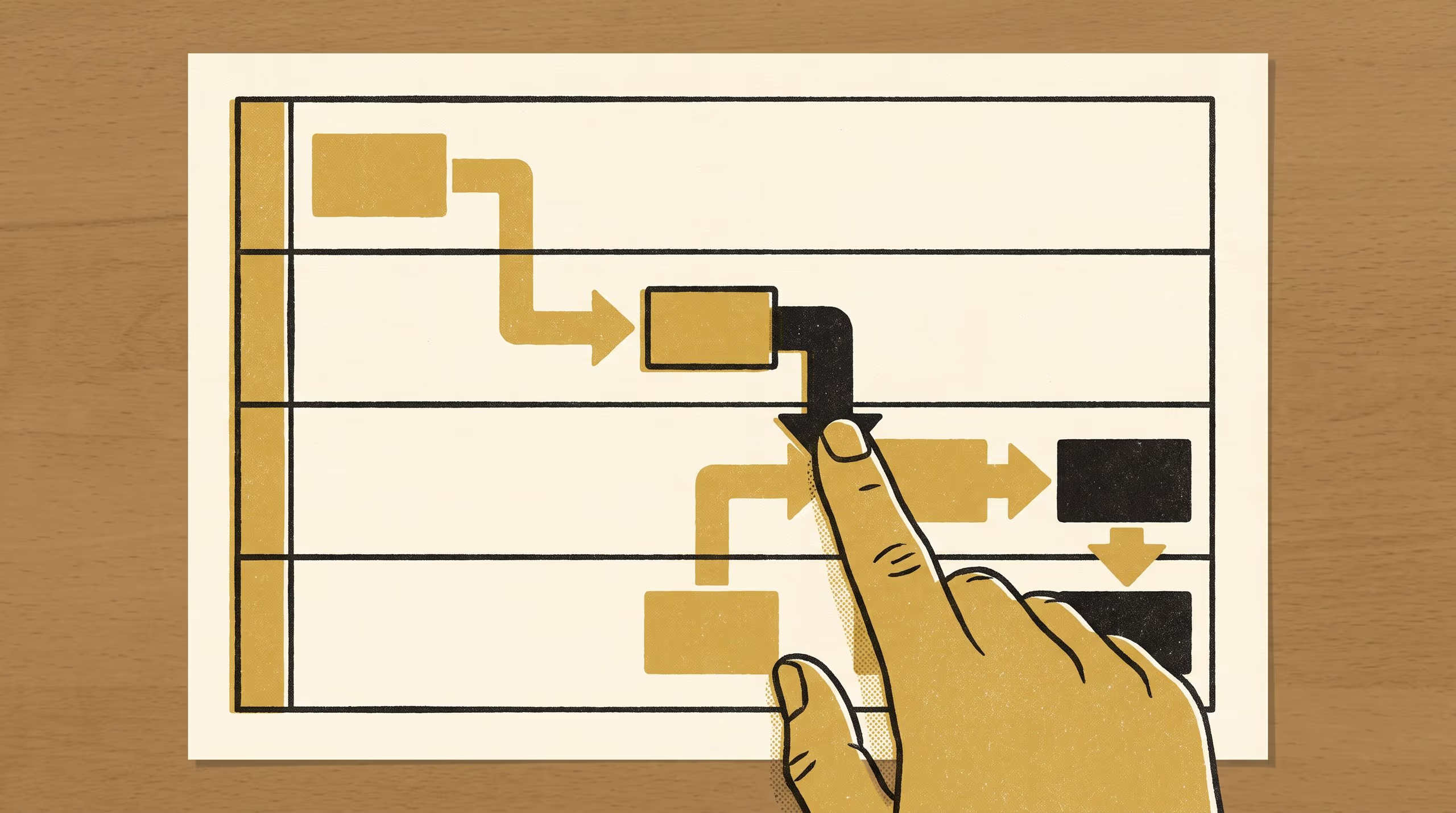
A new paper from the School of Continuous Improvement finds that novices who trace a swimlane process map with their index finger learn its handoffs better, and that their hands slow at every lane boundary without being asked.
Two experiments with short-course enrolees find the benefit lies in where the finger stops
Across two experiments run alongside the University’s Capability Sprints short courses, 228 newcomers to process mapping were handed a set of worked swimlane maps and, in some cases, asked to follow each arrow with a fingertip as they read. Following the Arrow Across the Lane, a new paper by Dr Renke Sabel, Senior Lecturer and Convenor of the Indicator Commons, with Dr Ingeborg Nwachukwu, Lecturer and Convenor, Capability Sprints, and Dr Mirela Hanke, Postdoctoral Fellow and Deputy Convenor, Living Dashboard, reports that those who traced went on to read the handoffs in unfamiliar maps more accurately, and that the advantage was greatest on the largest maps.
Our School draws process maps for a living, and we had always taken the drawing to be the difficult part. It has been instructive to watch so many readers find the handoffs with their hands before anyone had pointed them out.
— Dr Renke Sabel, Senior Lecturer and Convenor, Indicator Commons
The study brings the cognitive-science literature on learning from diagrams into conversation with the everyday practice of workplace induction, aligning the School’s longstanding attention to process with an embodied account of how process is first understood. Its most unexpected observation is a quiet one: tracers’ fingers lingered wherever an arrow passed from one role’s lane into another’s, and the readers who lingered longest learned the most, while a recorded hand moving at an even pace offered no reliable benefit.
The University counts the paper among the clearest recent expressions of its belief that capability is built on a role’s first morning. “We are already rethinking what the first hour with a new map should look like,” said Dr Nwachukwu.
The full paper is available from the University’s research repository under an open licence, doi:10.5555/slop.ihvfou.