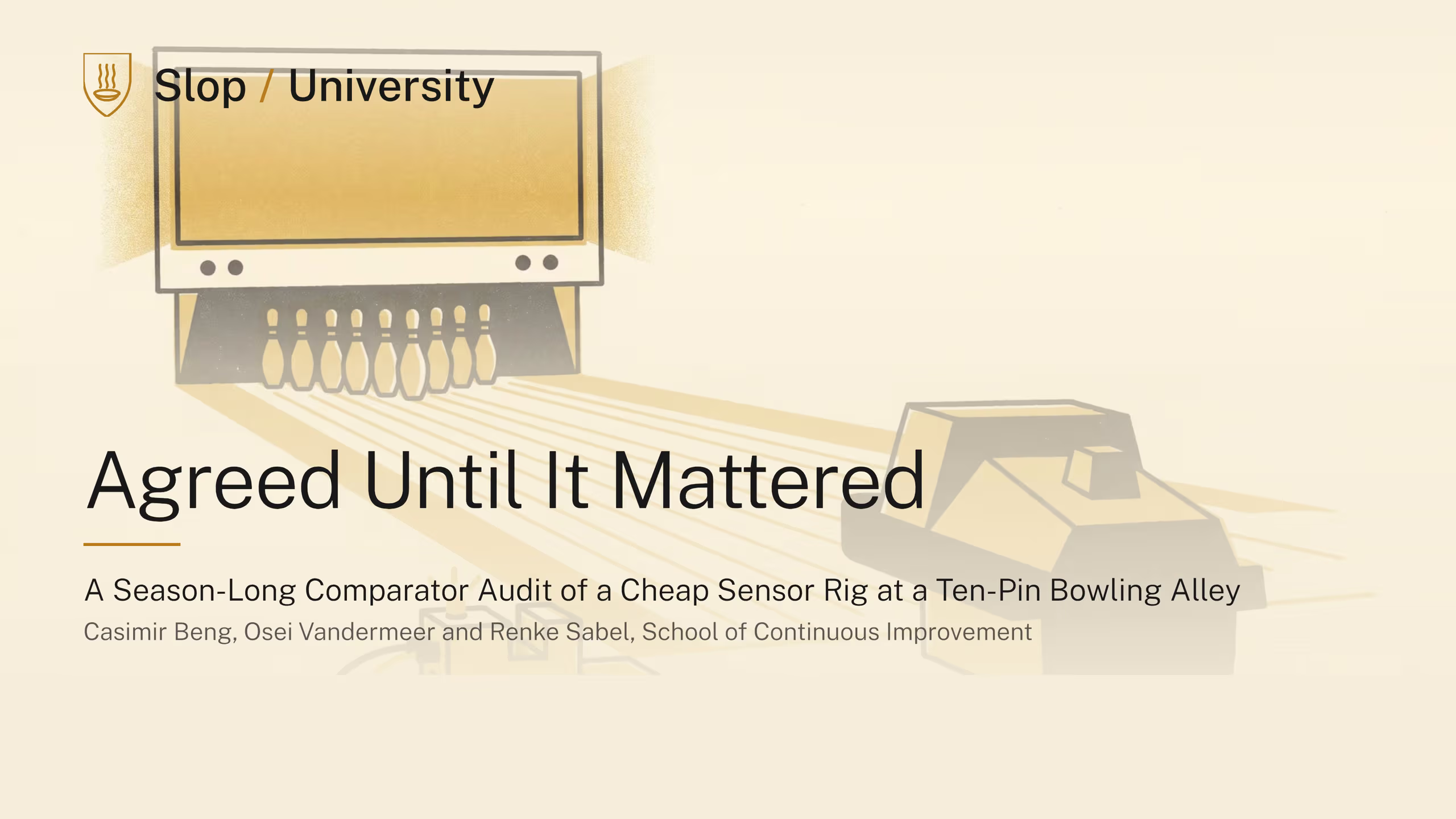
A research explainer from the School of Continuous Improvement pits a cheap sensor rig against a ten-pin bowling alley's own scoring system for a league season, and asks whose calls the league's rules committee upholds.
Casimir Beng, Osei Vandermeer and Renke Sabel carry a season of disputed frames from a cheap sensor rig to the league's rules committee
At most ten-pin alleys, a bowler who disputes a call is appealing to the very system that made it. For one full league season, Associate Professor Casimir Beng, Dr Osei Vandermeer and Dr Renke Sabel gave an alley an independent count to answer to, and the School of Continuous Improvement has made their paper, Agreed Until It Mattered, into a research explainer: Agreed Until It Mattered, Explained.
Every institution reaches a point in its journey where it starts asking its instruments for a second opinion. The University reached it some while ago, and I can think of no better place than a bowling alley to show how far we have come since.
— Dr Renke Sabel, Senior Lecturer and Convenor, Indicator Commons
Beside the alley’s proprietary system, on six of its lanes, a rig built from $46 of parts per lane kept its own record of every frame a University-affiliated interdepartmental league bowled there. The explainer stays with the frames where the two parted company, carrying them from an independent slow-motion review to the league’s rules committee, and presents the season as a lesson in the quiet authority of the incumbent: the review puts the two systems on near-equal footing, while the committee keeps faith with the installed system in 91 per cent of its rulings. Associate Professor Beng and Dr Sabel describe their parts of the work, and Dr Vandermeer has the last word.
A film like this one comes close to a statement of the University’s purpose: no instrument it relies on should go unexamined, however long it has been installed.
The full explainer is available from the University’s research repository under an open licence, doi:10.5555/slop.lr2ies.