A new paper from the School of Underlying Conditions listens to a corridor of practice rooms for eight weeks and finds that its loudest players avoid sounding at once, while no instrument family keeps to its own part of the spectrum.
Recorders in a basement practice corridor test whether musicians share out their acoustic space like a dawn chorus
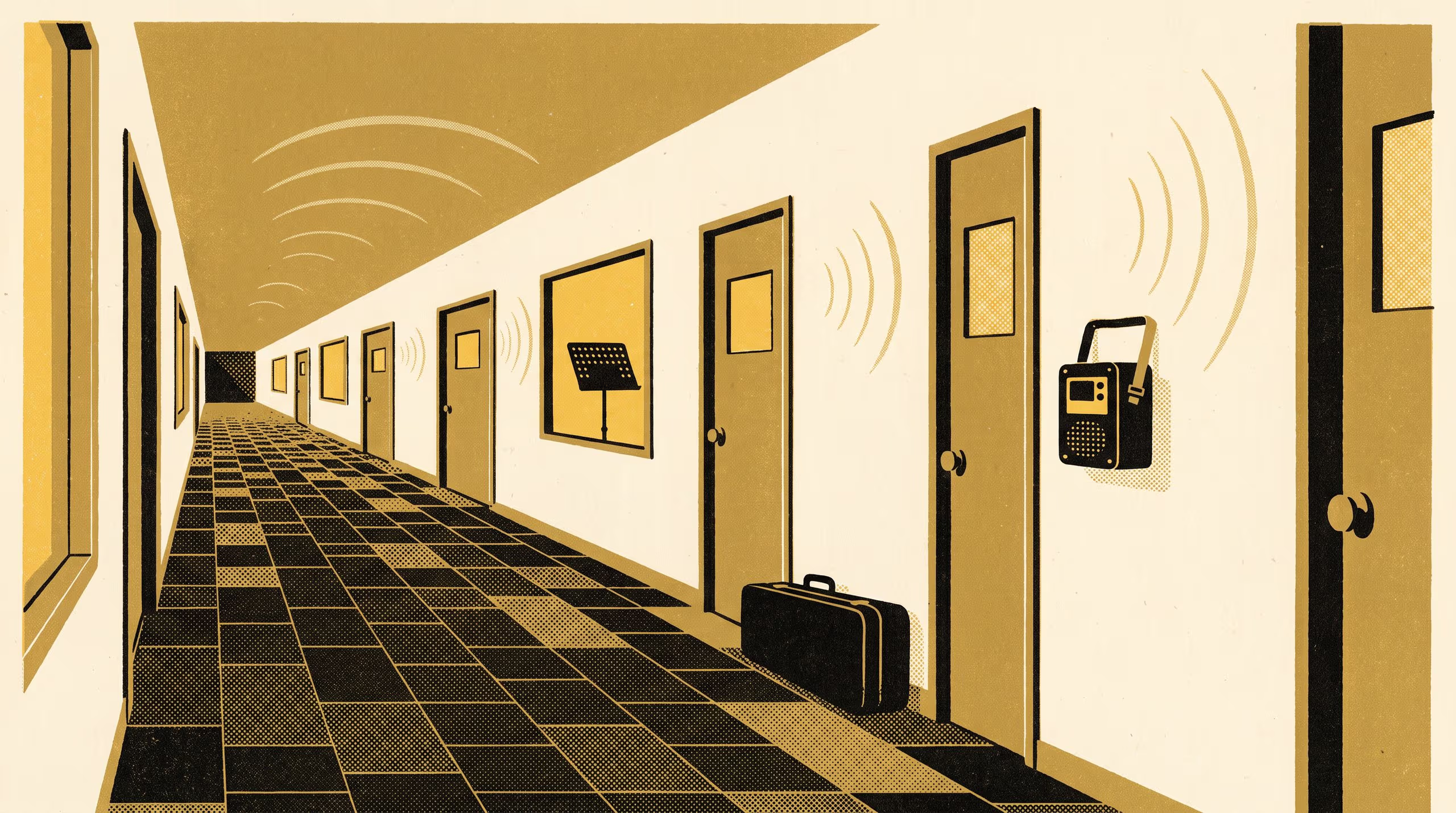
Does a corridor full of musicians sort itself out? Associate Professor Ragnhild Uzoma, Lead of the Basement Relations Group in the School of Underlying Conditions, and Mr Eivind Onwuka, Doctoral Candidate in the School of Continuous Improvement, set out to ask the question as a field ecologist would. Their new paper, Turn-Taking Without Partitioning, places a small recorder opposite each of twelve closed practice-room doors and listens across 56 days of a teaching period.
We went down the stairs expecting to count instruments, and came back up having learned a great deal about listening. The corridor was generous with us, and we have tried to repay it with care.
— Associate Professor Ragnhild Uzoma, Lead, Basement Relations Group
In method, the paper pairs field ecology’s established toolkit for imperfect detection with contemporary machine listening, positioning a familiar campus space as a living setting for questions more often asked of rainforests and frog ponds. The authors report that the corridor’s brass and percussion players avoid sounding next to one another, and that when a second trumpet starts beside a first, the first falls quiet within ten minutes about a third of the time. No instrument family, they find, keeps to a part of the spectrum of its own.
It is the kind of patient, close-to-the-ground inquiry on which the University has always been content to stake its name, carried here from the borehole to the practice room.
“Most of what we know about these rooms came through a closed door,” said Mr Onwuka. “That seemed to us a good place to start rather than a reason to stop.”
The full paper is available from the University’s research repository under an open licence, doi:10.5555/slop.hwzsla.