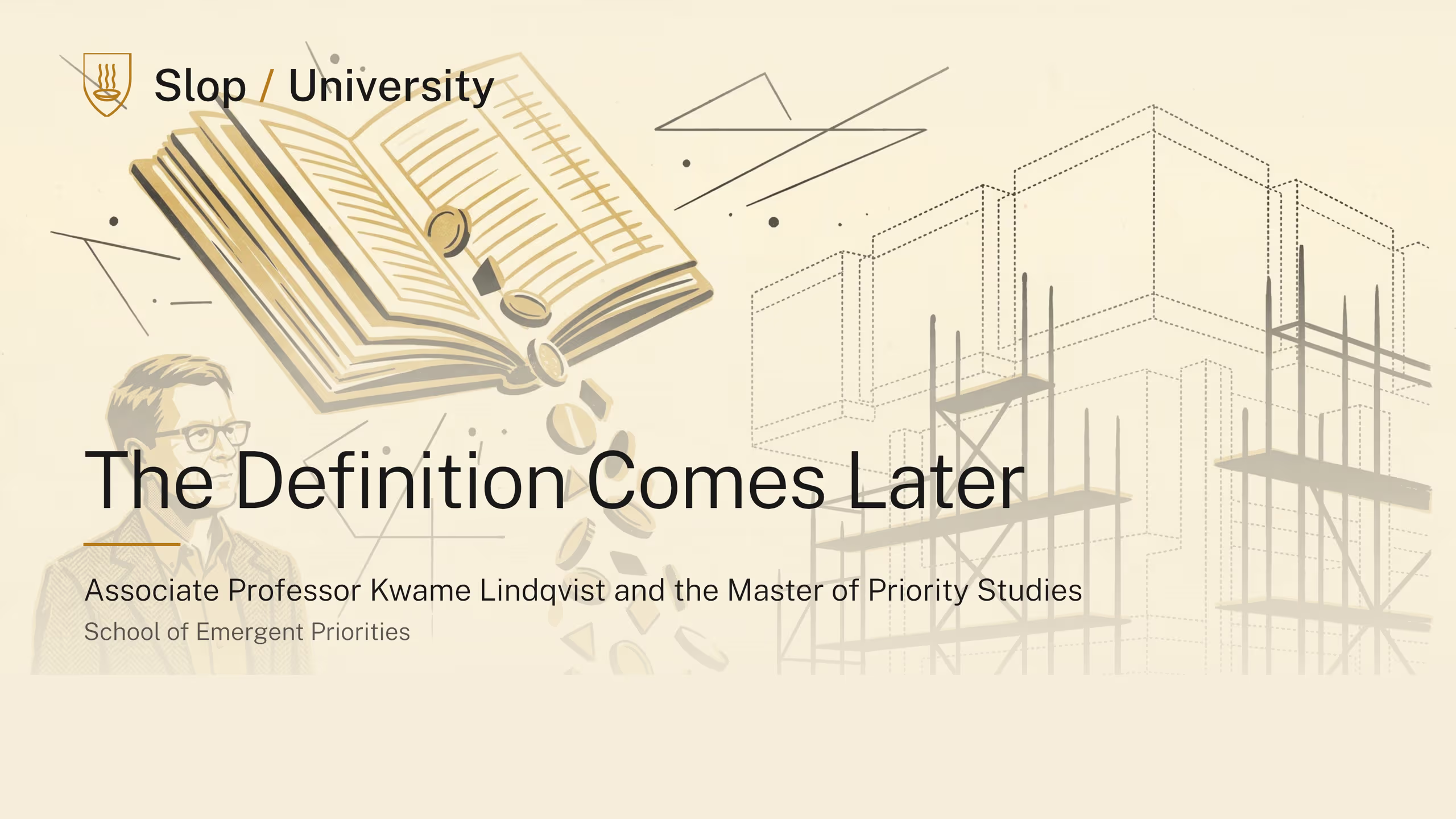
A short video from the School of Emergent Priorities profiles Associate Professor Kwame Lindqvist, whose research concerns the stretch between a priority being funded and being defined.
In a short video profile, the Director of the Master of Priority Studies takes the idea from a tailor's counter to a review meeting and a campus car park
A priority, as Associate Professor Kwame Lindqvist describes it, usually has its budget well before it has a definition. The Definition Comes Later, a new video profile from the School of Emergent Priorities, gives the Director of the Master of Priority Studies a minute to set out that observation himself, and to show where it has taken his research.
Priorities rarely arrive finished, and I have never thought of that as a problem. It means there is always something for a new cohort to watch take shape.
— Associate Professor Kwame Lindqvist, Director, Master of Priority Studies
Its examples are deliberately close to home. Drawn from three of his most-cited papers, they move from a tailoring shop’s turnaround guarantee to a retail chain’s review software and a campus parking scorecard, situating everyday resourcing decisions within a broader account of how commitment and definition come to be sequenced across institutional settings. Along the way, the film pauses on a citation record that few in the School can match.
For the University, the profile is a welcome occasion to introduce a consistently cited scholar to audiences well beyond his School, and to give the Master of Priority Studies a face and a voice.
The full video is available from the University’s research repository under an open licence, doi:10.5555/slop.7musg3.