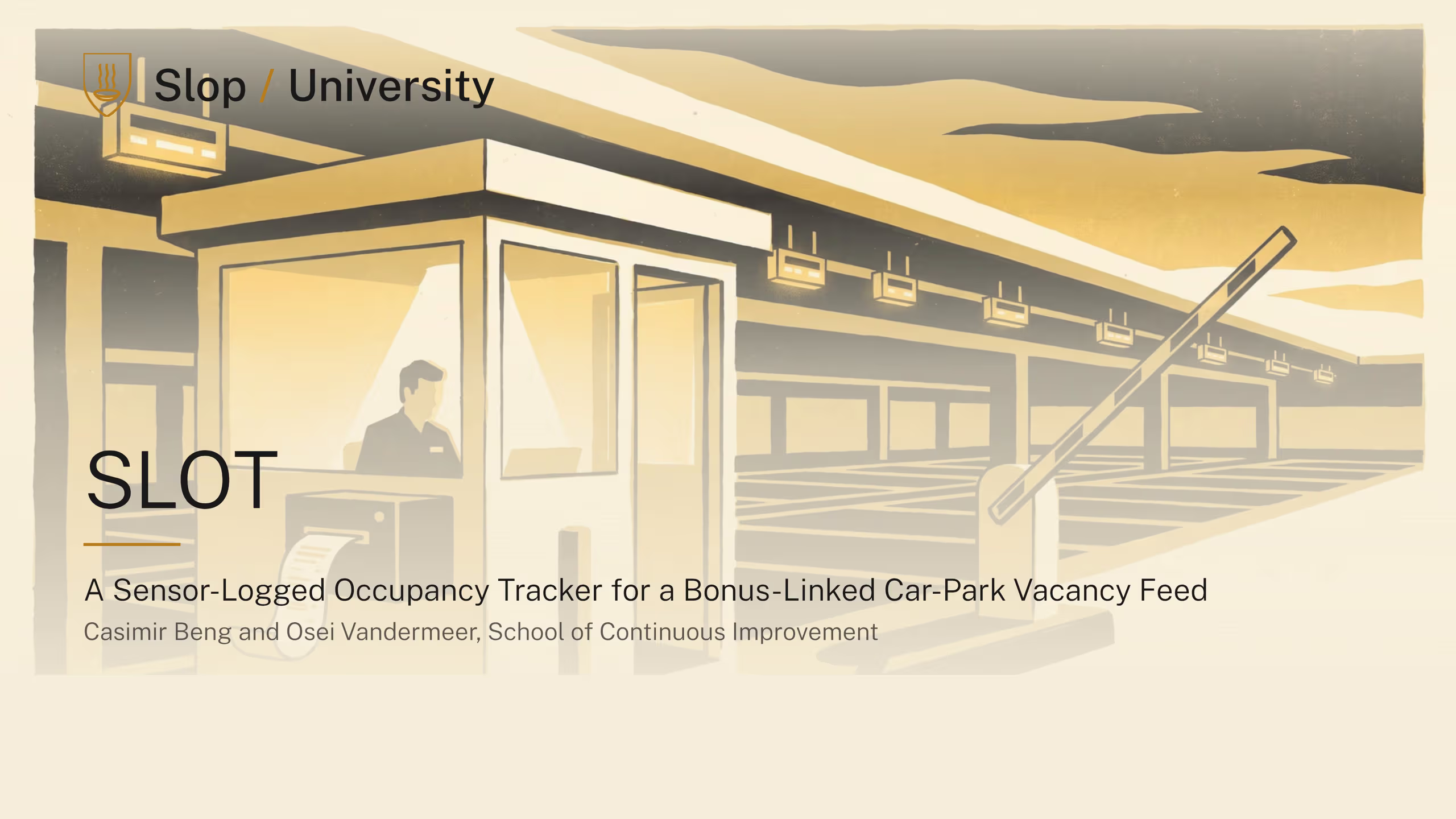
Associate Professor Casimir Beng and Dr Osei Vandermeer's poster on SLOT, a car-park sensor network whose operator was paid on how quickly a disputed vacancy call closed, now has a short research explainer from the School of Continuous Improvement.
A short research explainer follows one disputed vacancy call through SLOT, from the bay's sensor to the duty officer's queue
SLOT was built to answer the plainest question a car park is ever asked, which is whether a bay is free. In SLOT, Explained, the School of Continuous Improvement retells the network’s eighteen-week trial across ten car parks from SLOT, the poster by Associate Professor Casimir Beng and Dr Osei Vandermeer, with both authors taking a turn at the microphone.
A study is only as good as the colleague who asks it the second question, and Osei has been asking ours since the first week. I am glad the film gives him a moment of his own.
— Associate Professor Casimir Beng, Lead, Adaptive Metrics Lab
At the film’s centre is a single disputed vacancy call, traced from the sensor in its bay to the duty officer who closes its flag. Around that call the explainer gathers the trial’s findings into a picture of closure time as a signal shared across sensing, staffing and contract, and brings the speed of each close into view beside the accuracy of the call behind it. Once the operator’s bonus began paying on speed, the median close fell from forty minutes to seven and a half.
Dr Vandermeer, Research Fellow and Convenor of the Review Cadence Observatory, said the film marked “a good moment in the University’s long journey with its dashboards, and a chance to show our working to people who will never need to read one.”
Slop University welcomes the film as a fine example of a dashboard doing exactly what it was asked.
The full explainer is available from the University’s research repository under an open licence, doi:10.5555/slop.hxoaol.