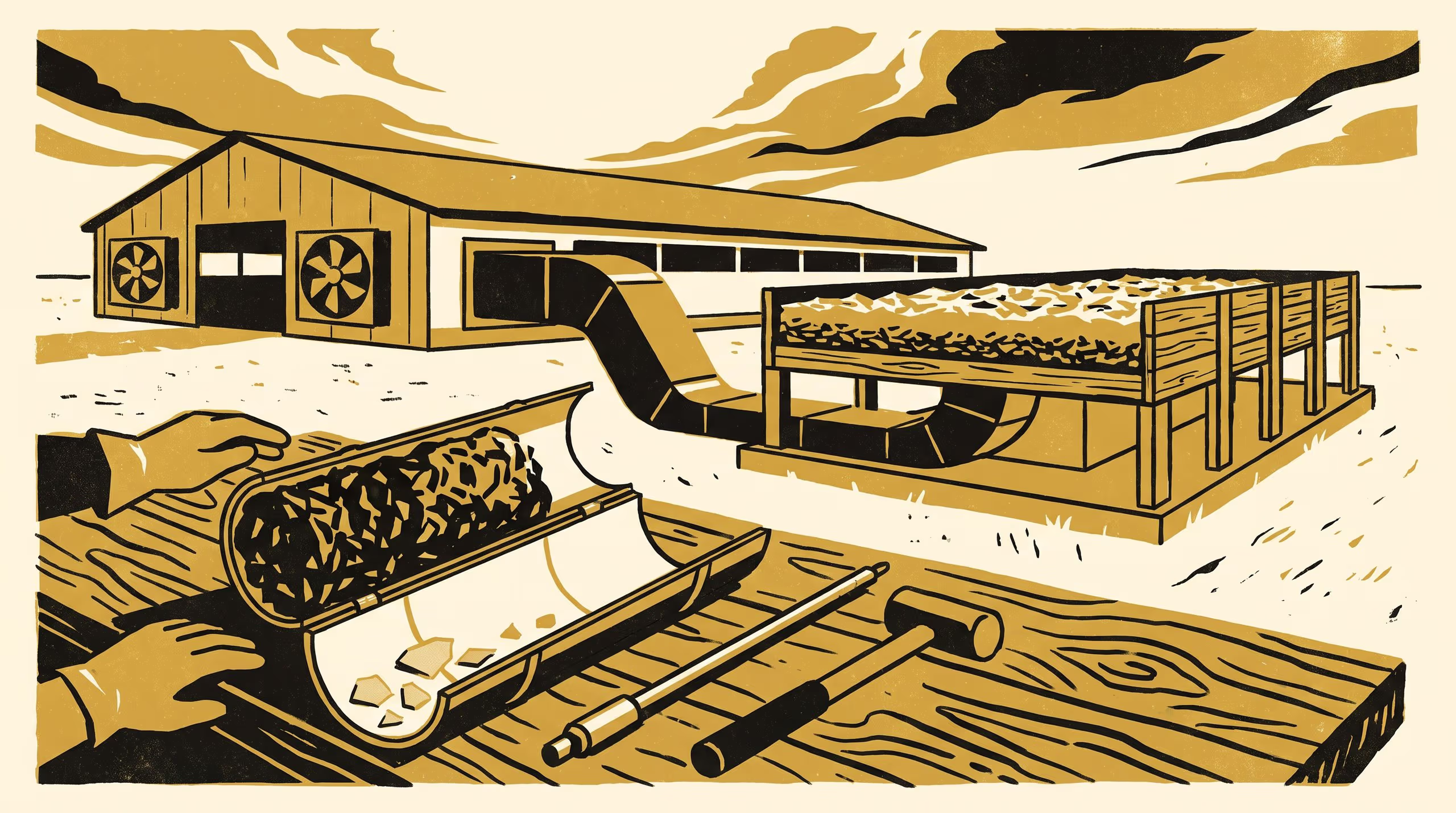
A new paper from the School of Underlying Conditions traces an ageing farm biofilter's lost performance to the layer of media nobody could see.
Coring a wood-chip bed at a piggery shows the air found its way past the driest layer
A planned replacement of filter media at a working piggery was put on hold this season, after researchers from the School of Underlying Conditions found that the part of the bed that had stopped working was the part nobody could reach.
Every bed we core sends us home with better questions than we brought. We are grateful to have been handed some of them by a farm.
— Associate Professor Ragnhild Uzoma, Lead, Basement Relations Group
Associate Professor Uzoma and Dr Brynjar Obiora, Senior Research Fellow, drove 24 cores through an ageing wood-chip biofilter and logged each one as the School logs ground, interval by interval. The cores, the air above them and a tracer pulse through the bed together point to a dry stratum at the base, where much of the exhaust air had been finding an easier way through. Restoring moisture to that stratum lifted the bed’s ammonia removal from 48% to 70% over six weeks.
The University regards the study as a timely expression of its commitment to looking beneath the surfaces of the systems it serves, and of the School’s growing capability at the interface of the earth sciences and process engineering.
“The School has always been at its best below the waterline,” said Dr Obiora. “It is good to see that instinct travel.”
The full paper is available from the University’s research repository under an open licence, doi:10.5555/slop.yeg7xf.