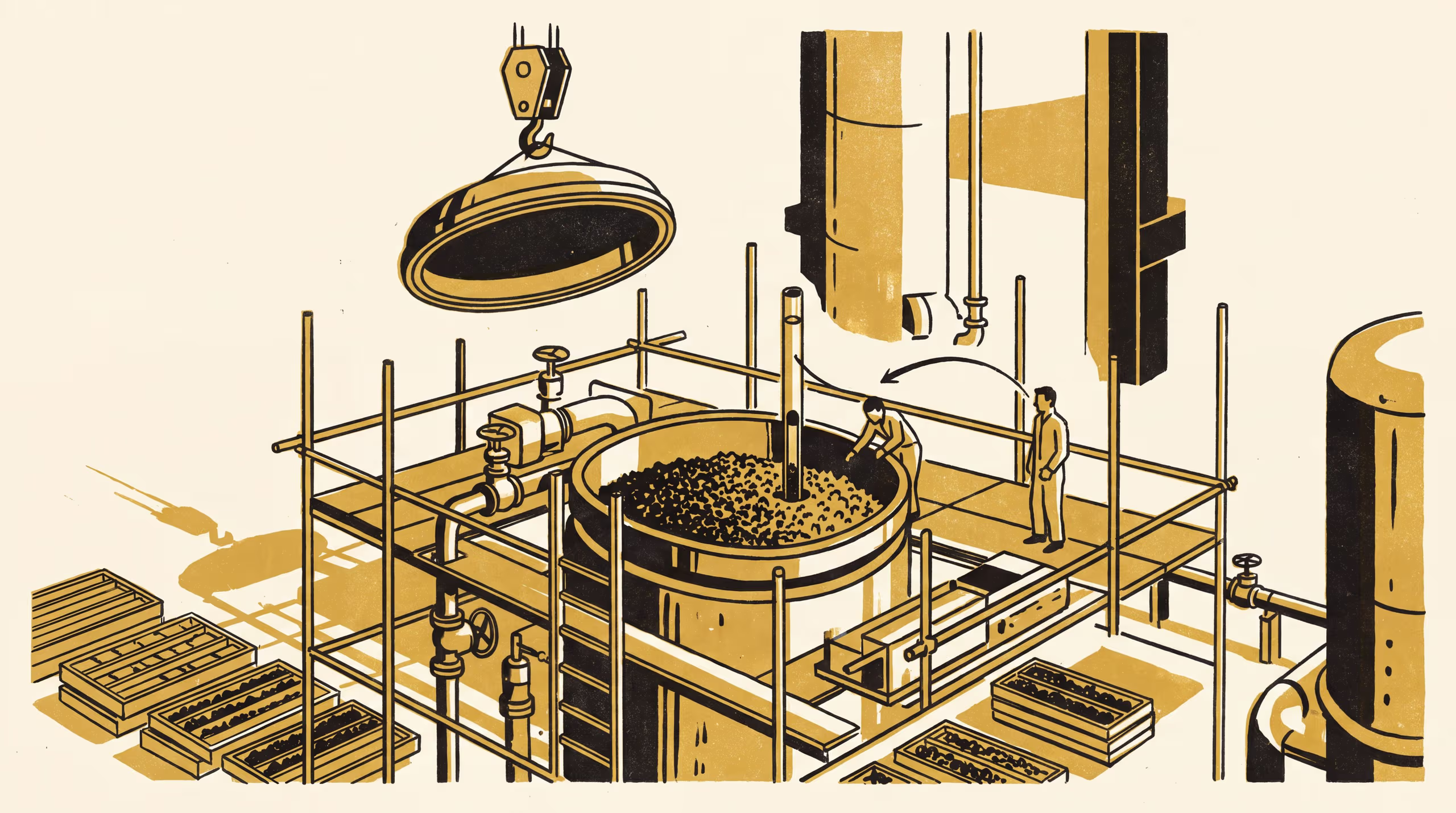
A new research poster from the School of Underlying Conditions brings drill-core practice to the spent catalyst bed of a retired ammonia converter, and asks what the plant's own discharge sample leaves out.
A research poster reads a spent catalyst bed by depth and finds the routine discharge sample misses its most worn layer
The sample a plant keeps of a retired catalyst bed, it turns out, is not quite the bed it retired. That is the central finding of What the Discharge Leaves Behind: Coring the first bed of a retired ammonia converter before its iron catalyst is vacuumed out, a new research poster by Associate Professor Ragnhild Uzoma of the School of Underlying Conditions and Dr Bram Ntuli of the School of Continuous Improvement.
The team drove nine cores through the first bed of a decommissioned converter before it was emptied, logged every interval the way a geological survey logs a drill run, and tested what came up for remaining activity. The worn crust at the top of the bed was the hardest to recover by coring and, the poster reports, the part the routine drum sample saw least: much of it left the vessel as fines. The drum composite read 0.77 of a fresh charge; the cores put the bed nearer 0.69.
My whole career has been spent with the metres that do not come up, and I was glad to find them waiting for me inside a pressure vessel. The crew who opened it for us did the difficult part, with more patience than we had any right to ask for.
— Associate Professor Ragnhild Uzoma, Lead of the Basement Relations Group
The work carries the School’s field methods into plant, process and infrastructure settings, and lends the University’s growing body of work on nitrogen and its fixation a steadier footing from the ground up. “Any review is only as good as what it is shown,” said Dr Ntuli, Lecturer and Convenor of Improvement Grand Rounds. “I am grateful to have been shown a catalyst bed.”
The full poster is available from the University’s research repository under an open licence, doi:10.5555/slop.qus26g.