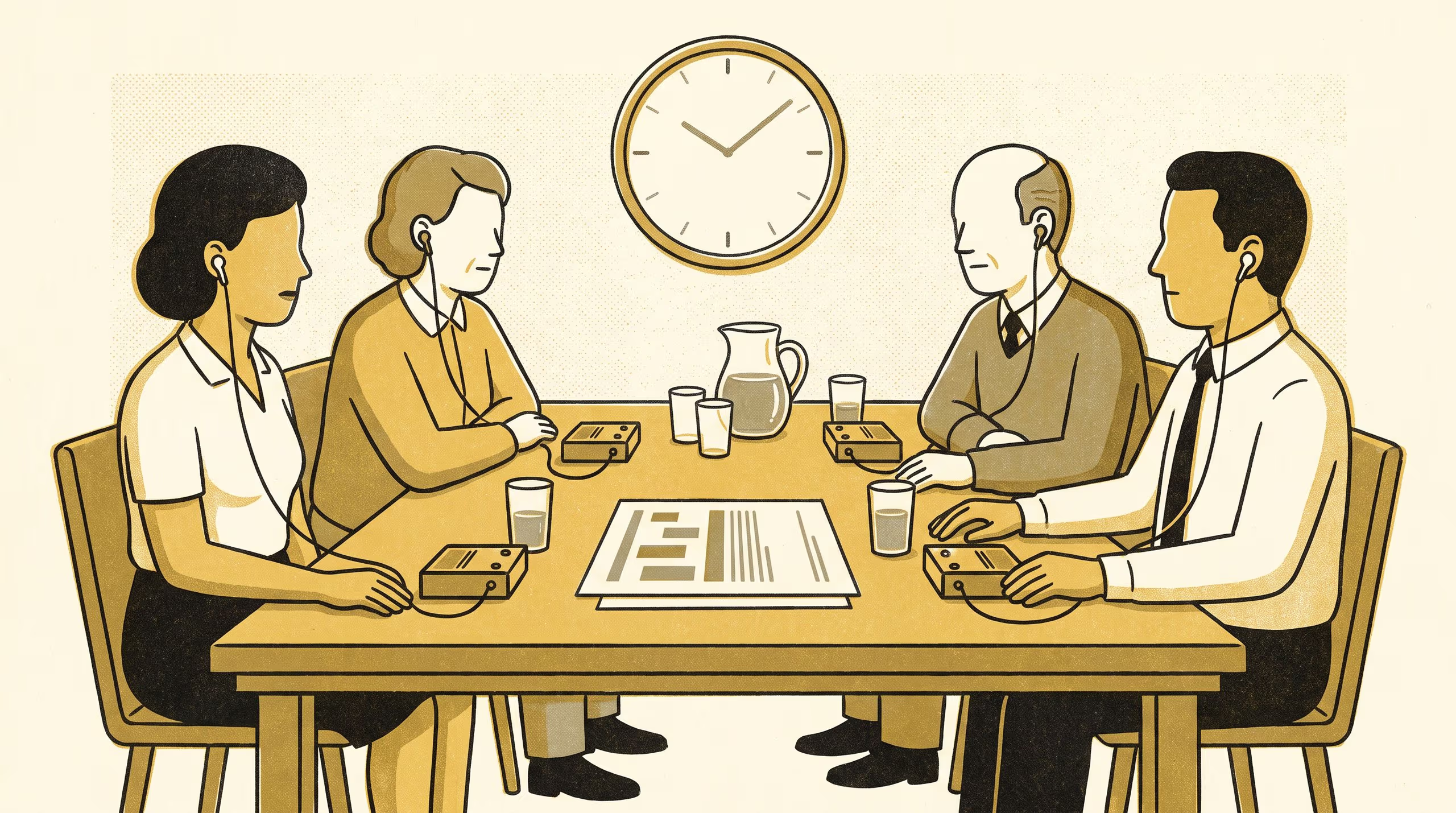
A new paper stimulates the vagus nerve of every committee member through the ear and finds the order of business, not the stimulation, deciding what gets resolved
A sham-controlled study of 24 four-person committees finds that where an item sits on the agenda counts for more than stimulating members' ears
We set out to study the people at the table and found ourselves studying the order of business. The School will be turning that over for some time, and gladly.
— Ms Ylva Onyekwere, Doctoral Candidate, School of Emergent Priorities
The committees in a new School of Emergent Priorities study resolved more of their agenda as each meeting went on, and a light current at the ear did not change that. So finds Stimulating the Ear Does Not Move the Agenda: A Sham-Controlled Crossover Study of Transcutaneous Auricular Vagus Nerve Stimulation in Four-Person Deliberating Committees, by Ms Onyekwere with Dr Runa Adegoke, Senior Lecturer and Convenor, Strategic Drift Survey, and Dr Anneke Tolan, Senior Research Fellow and Deputy Convenor, Futures in Committee.
The study brings the School’s long attention to how groups dispose of their business into conversation with the neuroscience of the vagus nerve, convening 24 committees of four to manage an imagined building across four meetings each. Members wore a small ear electrode delivering either active or sham stimulation, and every agenda item was followed from its introduction to its resolution, deferral or referral. The two conditions resolved items at almost exactly the same rate. An item taken last, by contrast, was resolved far more often than an item taken first.
The paper extends a line of inquiry the School regards as one of its quieter strengths, and one it expects to keep returning to. “Every committee we have studied has had an agenda, and it seems we had not been reading it closely enough,” said Dr Tolan.
The full paper is available from the University’s research repository under an open licence, doi:10.5555/slop.vln9d7.