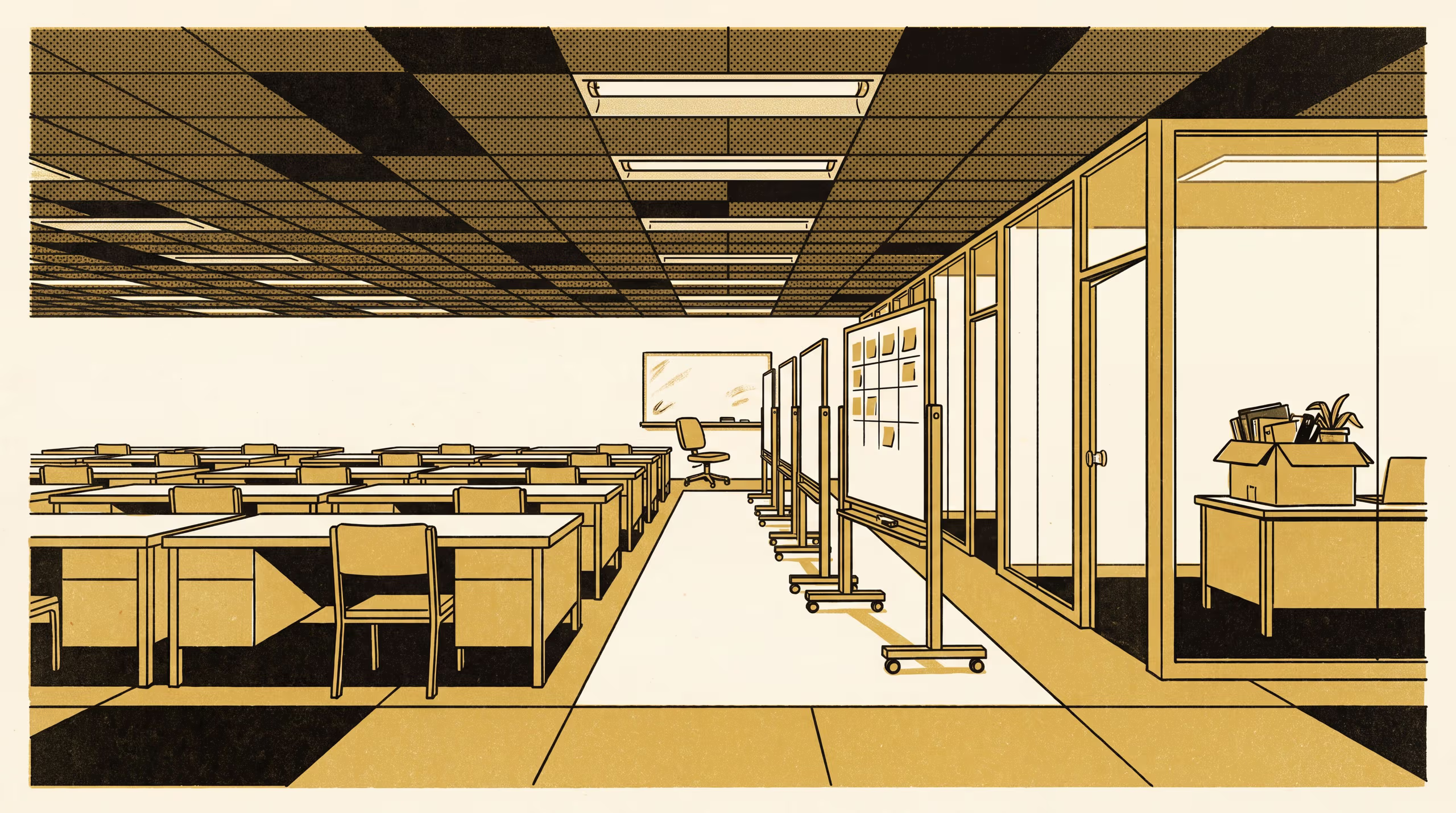
A new research poster from the School of Continuous Improvement follows 187 internal innovation pilots through a public service agency's register and finds that most lapsed in the months after their executive sponsor moved on, rather than at a scheduled evaluation gate
An event-history study of 187 trial projects at a public service agency finds the scheduled evaluation gate rarely decides how a pilot ends
The trial project, according to a new research poster from the School of Continuous Improvement, outlives its evaluation gate but not its sponsor. The Pilot Outlives Its Gate, Not Its Sponsor, by Dr Joost Nwosu, Postdoctoral Fellow, with Dr Ronja Oyelaran and Dr Runa Adegoke of the Strategic Drift Survey, follows 187 internal innovation pilots through more than a decade of a public service agency’s register to ask how each one came to an end.
Most did not end so much as stop. Of the 102 pilots that lapsed, 71 left no closure decision behind, and endings cluster in the six months after an executive sponsor moves on, at close to four times the usual rate. A scheduled evaluation gate, by comparison, barely registers.
We have run a few pilots of our own over the years, and I suspect one or two of them are still open. The School is well placed to take this one forward.
— Dr Joost Nwosu, Postdoctoral Fellow, School of Continuous Improvement
The poster brings register-based event-history analysis, steering-group documentation and a sponsorship-continuity lens together into a single account of the pilot lifecycle, positioning the stewardship of a trial as a shared organisational capability rather than an individual undertaking. The work was supported by the Anticipatory Capability Fund.
The University regards the handover as one of the quieter sites of institutional learning, and counts this poster among the School’s clearest contributions to that agenda so far. Dr Oyelaran, Senior Lecturer and Deputy Convenor of the Strategic Drift Survey, expects the findings to travel. “Anyone who has inherited a pilot will recognise the moment it describes,” she said. “We would very much like to hear from them.”
The full poster is available from the University’s research repository under an open licence, doi:10.5555/slop.w1p6vg.