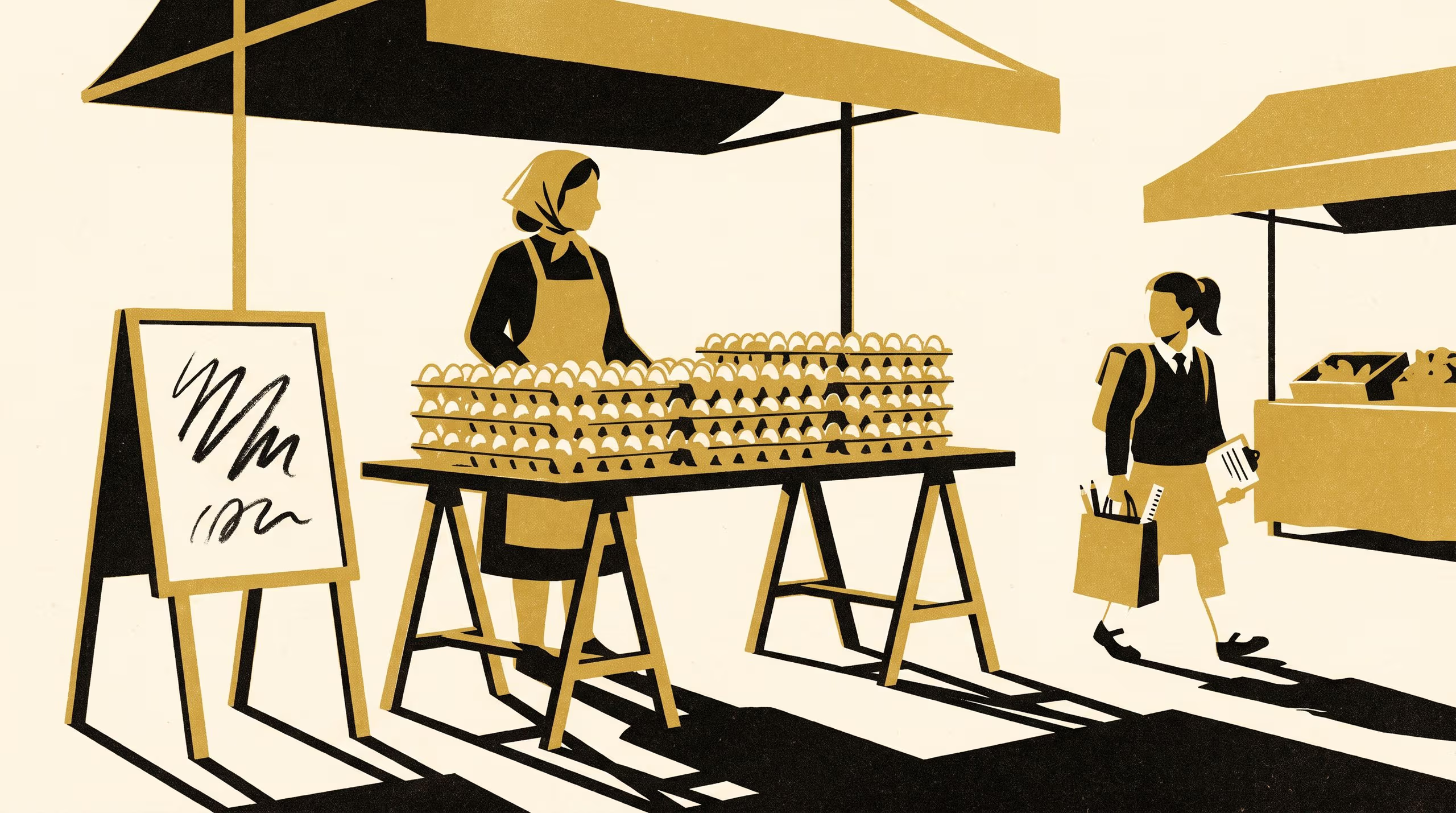
A new paper from the School of Emergent Priorities follows a national examination timetable into a rural egg market and asks who pays when candidates' families buy breakfast.
Egg prices at a rural weekly market rise in national examination week, and households with no candidate carry most of the premium
An examination timetable is drafted in an office far from any market, and the School of Emergent Priorities has made a habit of following such documents to wherever they finally land. Its newest paper follows one to a trestle of egg trays. Who Pays for the Candidate’s Breakfast? Examination Timing and the Incidence of a Demand Shock at a Rural Periodic Market is by Dr Petra Umbile, Postdoctoral Fellow, with Sunniva Balogun, Doctoral Candidate, and Associate Professor Kwame Lindqvist, Director, Master of Priority Studies.
Families with a child sitting the school-leaving examination buy eggs for that child’s breakfast, and in the week the first paper falls the price of a tray rises by more than a tenth. The team’s finding is that the families without a candidate pay about two-thirds of that premium, and the poorest among them buy fewer eggs.
We came to see the market as one more place where a whole district prepares for an examination. When the timetable next moves, we intend to be standing by the egg trestle again.
— Dr Petra Umbile, Postdoctoral Fellow, School of Emergent Priorities
The study brings eleven years of market ledgers, a long-running price survey and purchase diaries from hundreds of households into a single account of how a national calendar is absorbed by the household table. It applies the incidence toolkit of public economics to a cost that no school budget records.
Associate Professor Lindqvist said the paper had given the Master of Priority Studies “a case its students can hold in one hand, and a reason to ask who else is paying whenever a date is set”.
The University counts the paper among the clearest recent instances of its research-strategy school reading a priority from the ground up.
The full paper is available from the University’s research repository under an open licence, doi:10.5555/slop.4md22o.