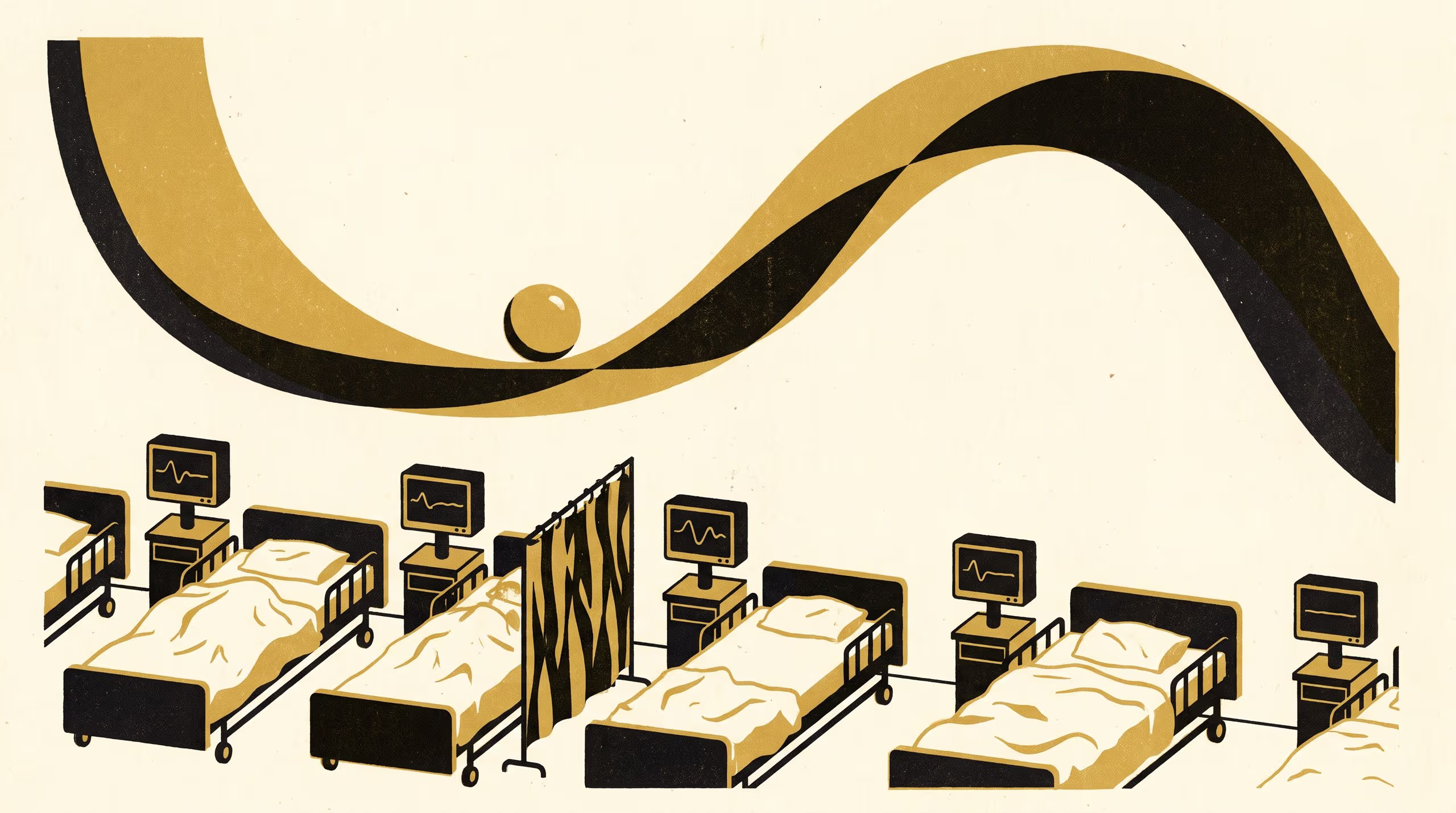
A research poster from the School of Underlying Conditions shows, in simulation, that the lead time of a learned early-warning score is fixed by the route to collapse rather than by the capacity of the model
The route a system takes to collapse, not the model watching it, sets the lead time
There is no ward in the new research poster from the School of Underlying Conditions, and no patient. There is an equation, nearly a quarter of a million simulated trajectories for each of two routes to collapse, and a question the School regards as overdue: how far ahead can an early-warning score see?
The Horizon Is Set by the Route is the work of Associate Professor Ragnhild Uzoma, Lead, Basement Relations Group, with Dr Fenna Okoro, Senior Lecturer and Convenor, Horizon Register, and Dr Vigdis Emenike, Senior Lecturer. Its answer is that the horizon belongs to the dynamics. Where a system’s reserve drifts slowly towards the edge, the best possible score sees about eighteen relaxation times ahead; where collapse arrives by fluctuation, it sees about 1.8, and no model class the team tested does better.
A horizon is a courtesy we extend to whatever comes next. The Register keeps a few of its entries undated on purpose, and it is a comfort to have the mathematics on the side of that habit.
— Dr Fenna Okoro, Senior Lecturer and Convenor, Horizon Register
The poster brings the School’s long-standing attention to the unrecovered interval into conversation with the theory of rare events, positioning stochastic dynamics as an enabling vocabulary for the wider early-warning landscape and anchoring a cross-school agenda in anticipatory modelling.
Associate Professor Uzoma said the team “would welcome any question the poster provokes, including the ones we have not yet thought to be worried about”.
The poster takes its place in a body of University scholarship that is more at ease with uncertainty each year.
The full poster is available from the University’s research repository under an open licence, doi:10.5555/slop.no33sj.