A paper from the School of Continuous Improvement works out by simulation how a laboratory plate should be divided between two experiments if a kinetic model is to be fitted to it
A simulated 96-well plate recovers the rates of a transporter model only once most of it stops drawing the familiar curve
No cells were grown for the latest paper from the School of Continuous Improvement, and its authors regard that as a strength of the design. Three Columns for the Curve: Optimal Allocation of a 96-Well Plate between Translocation and Antibody-Uptake Time Courses in a Three-Pool Model of Glucose Transporter Recycling is the work of Dr Bram Ntuli, Lecturer and Convenor, Improvement Grand Rounds, with Dr Joost Nwosu, Postdoctoral Fellow, and Associate Professor Casimir Beng, Lead, Adaptive Metrics Lab.
A plate has twelve columns whether or not anybody has given them any thought. We were allowed to give them some, and I am conscious that not every column is so fortunate.
— Dr Bram Ntuli, Lecturer and Convenor, Improvement Grand Rounds
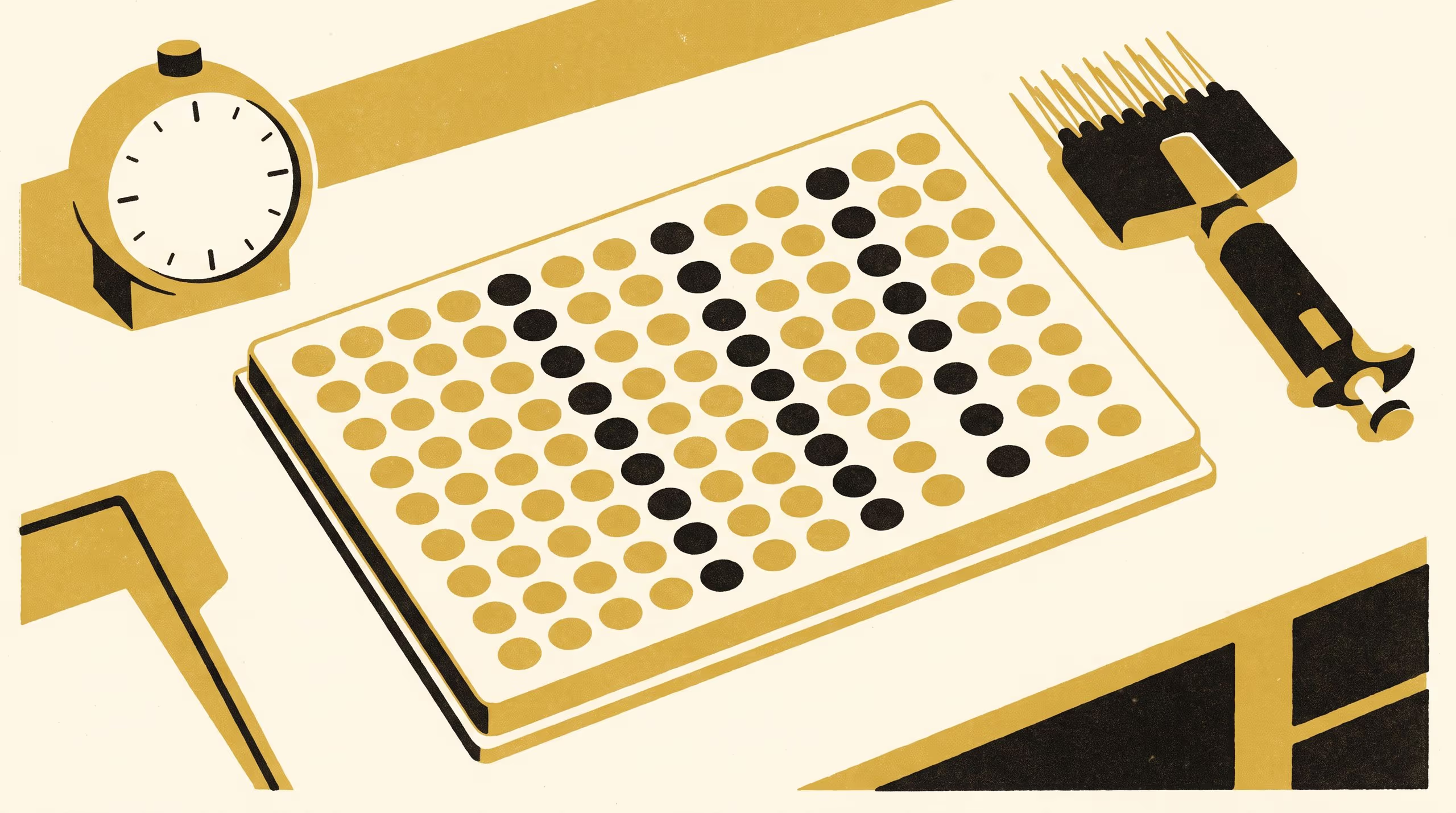
The paper considers a laboratory plate on which each column is a moment in time, and asks how those moments should be spent when a model with four rates is to be fitted to the result. It reports that rearranging the time points of the usual experiment changes little, nearly half of 1,000 simulated plates under each schedule returning an estimate at the limit of the search. The best plate the authors found gives three columns to that experiment and nine to a second one, and recovered every rate within twofold in every simulated fit.
The analysis aligns an established body of design theory with the School’s allocation-and-review capability, moving from a compact kinetic model through an optimisation layer to a programme of simulated fitting. The University is content to see the School’s interest in how a layout is arrived at carried as far as the bench.
Associate Professor Beng said the result “belongs to whoever next stands in front of an empty plate, and we wish them a considered morning”.
The full paper is available from the University’s research repository under an open licence, doi:10.5555/slop.y3xyfk.