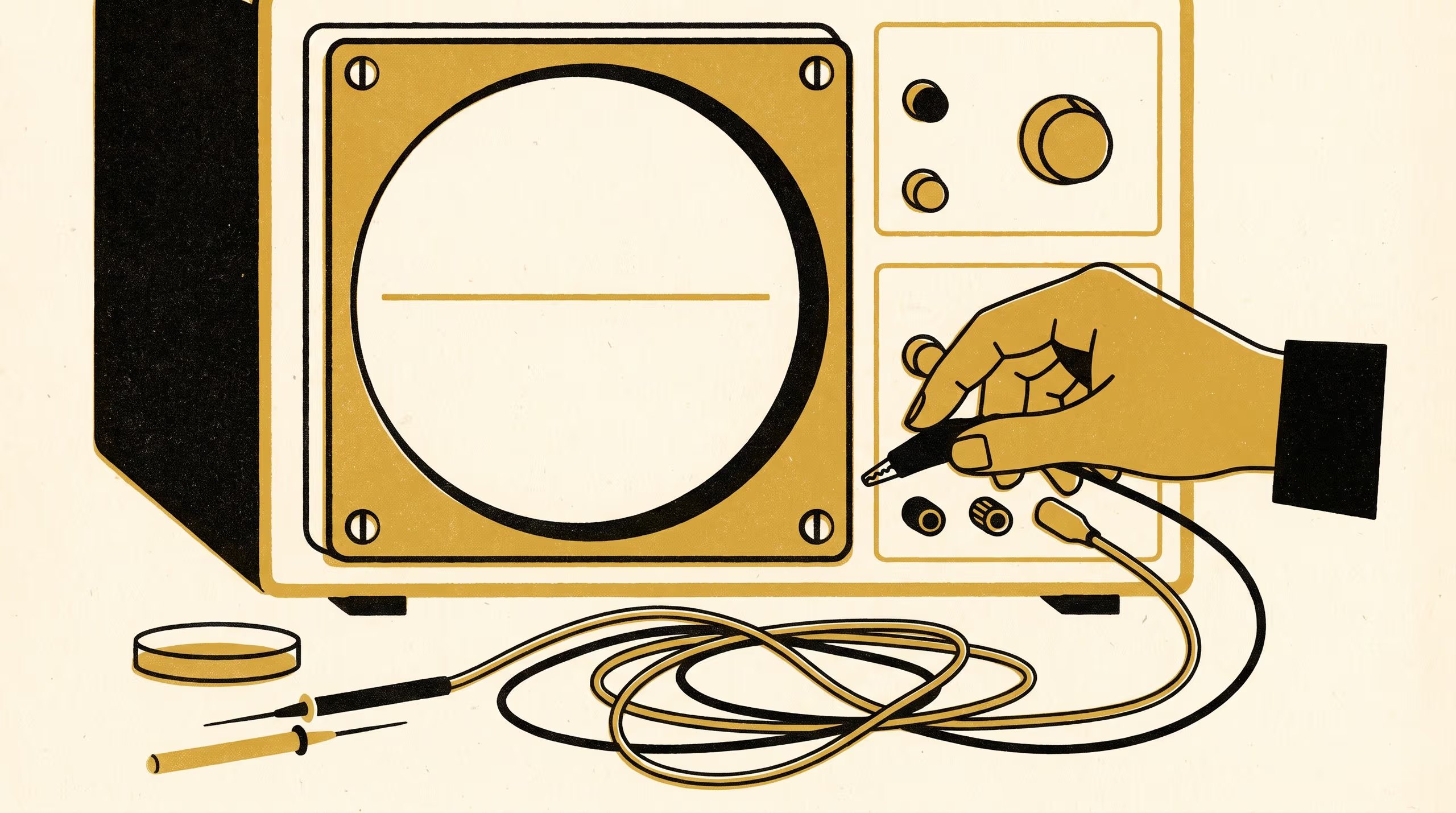
A research poster from the School of Underlying Conditions reports that student pairs whose nerve recording never produced a signal later outscored their classmates at finding a fault in the equipment.
Three years of bench sheets from a second-year nerve-recording class are set against what the same students could do five weeks later
A practical class that ends without a result is ordinarily entered in the book as a bad afternoon. Nothing on the Trace: What Second-Year Students Learn from a Nerve Recording That Never Fires, a research poster by Dr Vigdis Emenike, Senior Lecturer, and Dr Brynjar Obiora, Senior Research Fellow, both of the School of Underlying Conditions, enters it differently.
The poster follows 212 pairs of students through a single laboratory session in which each pair attempts to record the electrical activity of a nerve. Some pairs had a signal inside five minutes. Nineteen pairs never had one. Five weeks on, the pairs who had waited longest scored highest when shown a faulty recording and asked what to check, and no differently from anyone else when asked a question about the nerve.
The demonstrators wrote a time on every bench sheet for three years, and at no point did anybody tell them what it was for. We are in their debt, and we have now told them.
— Dr Vigdis Emenike, Senior Lecturer, School of Underlying Conditions
The work brings the School’s teaching-laboratory records into alignment with its assessment outcomes, connecting an observational bench-level dataset to a learning-transfer framework and anchoring both in a single cohort-spanning analysis. The University counts its teaching laboratories among the places where its research is done, and the poster is released on that understanding.
Dr Obiora noted that one bench had run an entire term with a broken lead. “It was reported eleven times, by eleven pairs, each of whom assumed they were the first,” he said. “That is a finding of a kind, though it is not on the poster.”
The full poster is available from the University’s research repository under an open licence, doi:10.5555/slop.ie0jvl.