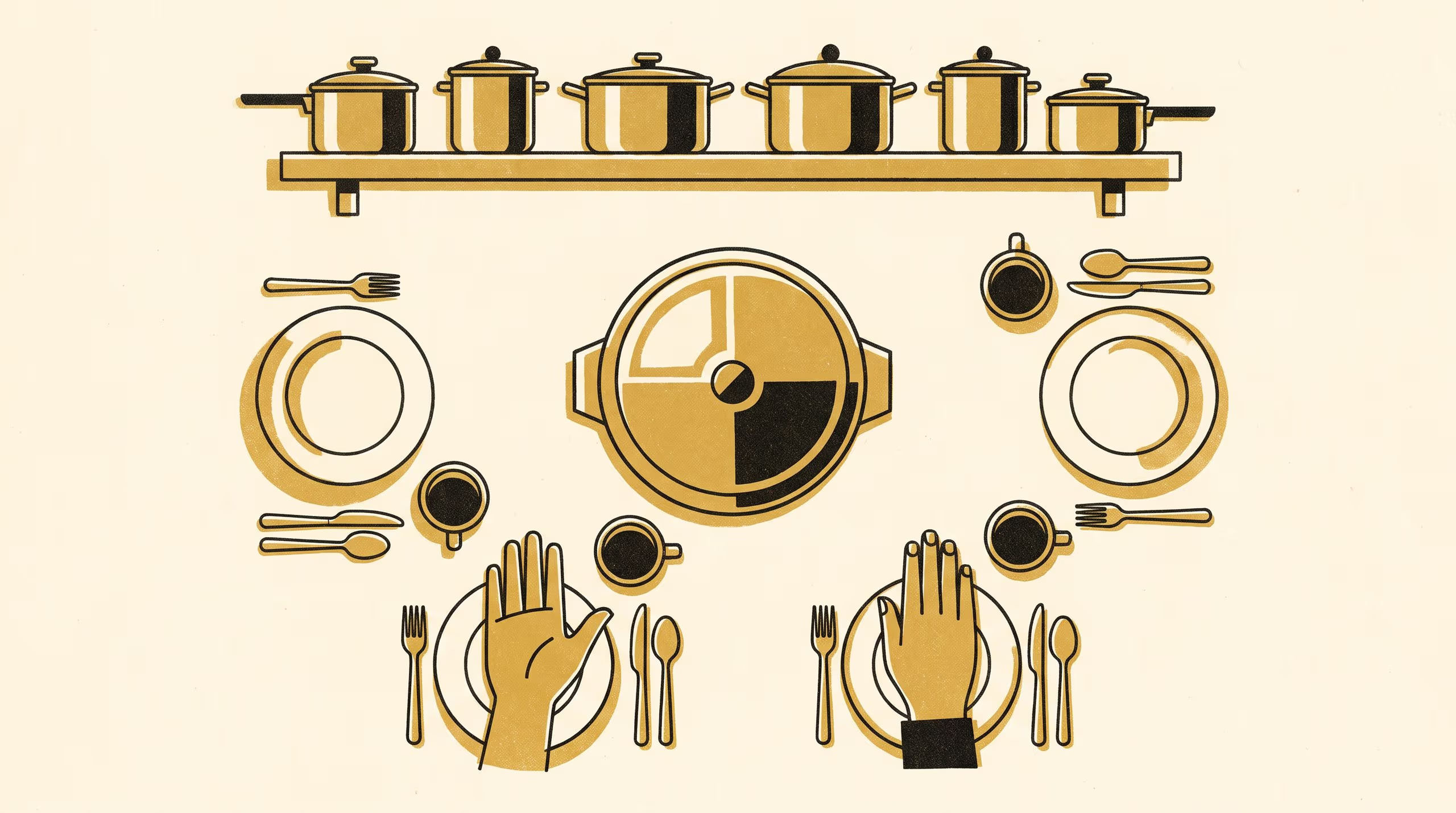
A theoretical paper from the School of Underlying Conditions treats the household dinner as one dish chosen under unanimity and derives the number of dishes a household will come to rotate through.
A model of the shared dinner as a vote that anyone can lose finds the length of the rotation settled by two people at the table
No household was observed, surveyed or fed in the preparation of the University’s newest paper, which proceeds entirely by proof. The Veto at the Table: Unanimity, Experimentation and the Length of the Weeknight Rotation is the work of Dr Brynjar Obiora, Senior Research Fellow in the School of Underlying Conditions, and it concerns the dinner that everybody present is prepared to eat.
The paper positions the cook as the holder of an agenda and every other member as the holder of a veto, and aligns the resulting framework with established traditions in household economics and the theory of public goods. From that alignment it derives how many dishes a household will settle on. In the paper’s worked example a couple comes to rest at nine and a household of six at four. Where refusals turn on a single quality of a dish, the paper shows that two members decide the matter and the remainder are, for the purposes of the menu, guests.
A proposition has the advantage that it cannot be late for dinner. I am told this is not the same as being useful, and I have taken the point in the spirit in which it was offered.
— Dr Brynjar Obiora, Senior Research Fellow, School of Underlying Conditions
The paper also identifies a remedy, under which the cost of a refused dinner is divided equally among those at the table whoever did the refusing. The University counts it a strength of the School that it can turn from the ground to the table without relaxing its standard of proof, and notes that the result makes no recommendation as to what anyone should eat.
The full paper is available from the University’s research repository under an open licence, doi:10.5555/slop.t3vq8k.