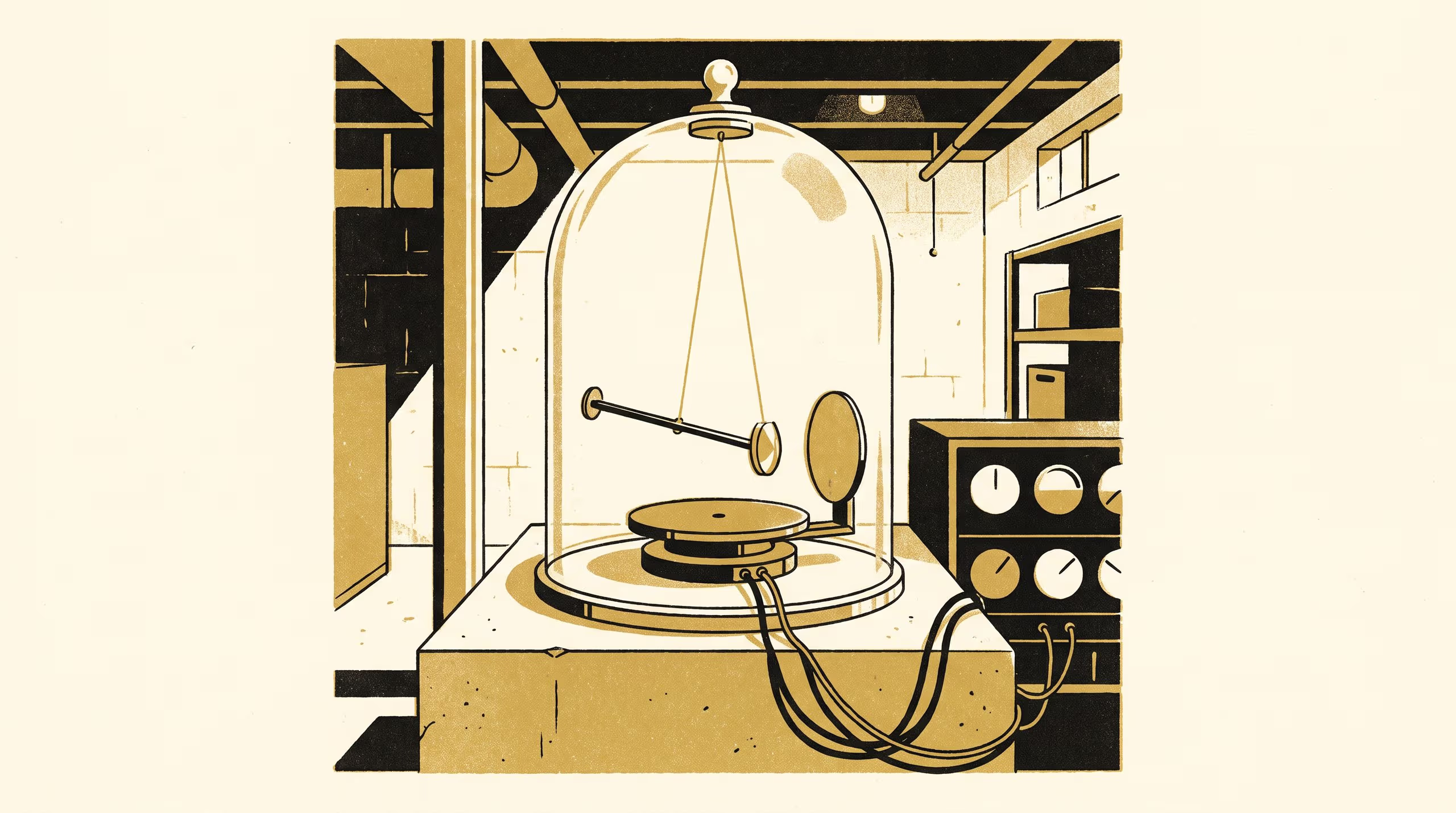
A paper from the School of Continuous Improvement and the School of Underlying Conditions rotates one surface of a torsion balance under vacuum and finds that a long-standing nuisance voltage goes round with it.
Eight sites on a single gold disc are brought in turn before the same lens, a few thousandths of a millimetre away
A gold-coated disc the width of a jar lid was turned an eighth of a revolution at a time beneath a lens hung from a tungsten thread, and each time it was turned the instrument was left alone for two nights before anyone asked it anything. That is the whole of the intervention reported in Turning the Plate: A Rotation Test of the Patch Origin of the Distance-Dependent Minimising Potential in a Sphere–Plate Torsion Balance, by Dr Torun Ezeigwe, Senior Lecturer and Director, Master of Applied Measurement, and Dr Joost Nwosu, Postdoctoral Fellow, of the School of Continuous Improvement, with Associate Professor Ragnhild Uzoma, Associate Professor and Lead, Basement Relations Group, of the School of Underlying Conditions.
Two metal surfaces held very close together attract one another electrically, and the small voltage needed to cancel that attraction is known to shift as the surfaces are moved apart. The authors report that across 630 measurements on 45 nights the shift was different at each of eight places on the disc, fell at some and rose at others by as much as 2.8 thousandths of a volt, and was recovered when the disc came back to where it began.
The lens was the same lens every night, and so were we. It is a useful thing for a measurement programme to be shown which of its parts was doing the varying, and a courtesy when it turns out not to be the staff.
— Dr Torun Ezeigwe, Senior Lecturer and Director, Master of Applied Measurement
The paper brings a precision-force apparatus and a surface-characterisation question into a single chamber, and couples them through a stage that lets one surface be exchanged for another part of itself. A compact account of how the voltage ought to behave over a gently uneven surface is set beside the observations and found to describe them.
Cross-school use of a shared room is something the University has encouraged for some time, and it counts an instrument that two schools will both sit up with as a fair return on the room. Associate Professor Uzoma said the goods lift had been “an obliging colleague throughout, chiefly by agreeing to stay where it was”.
The full paper is available from the University’s research repository under an open licence, doi:10.5555/slop.ege842.