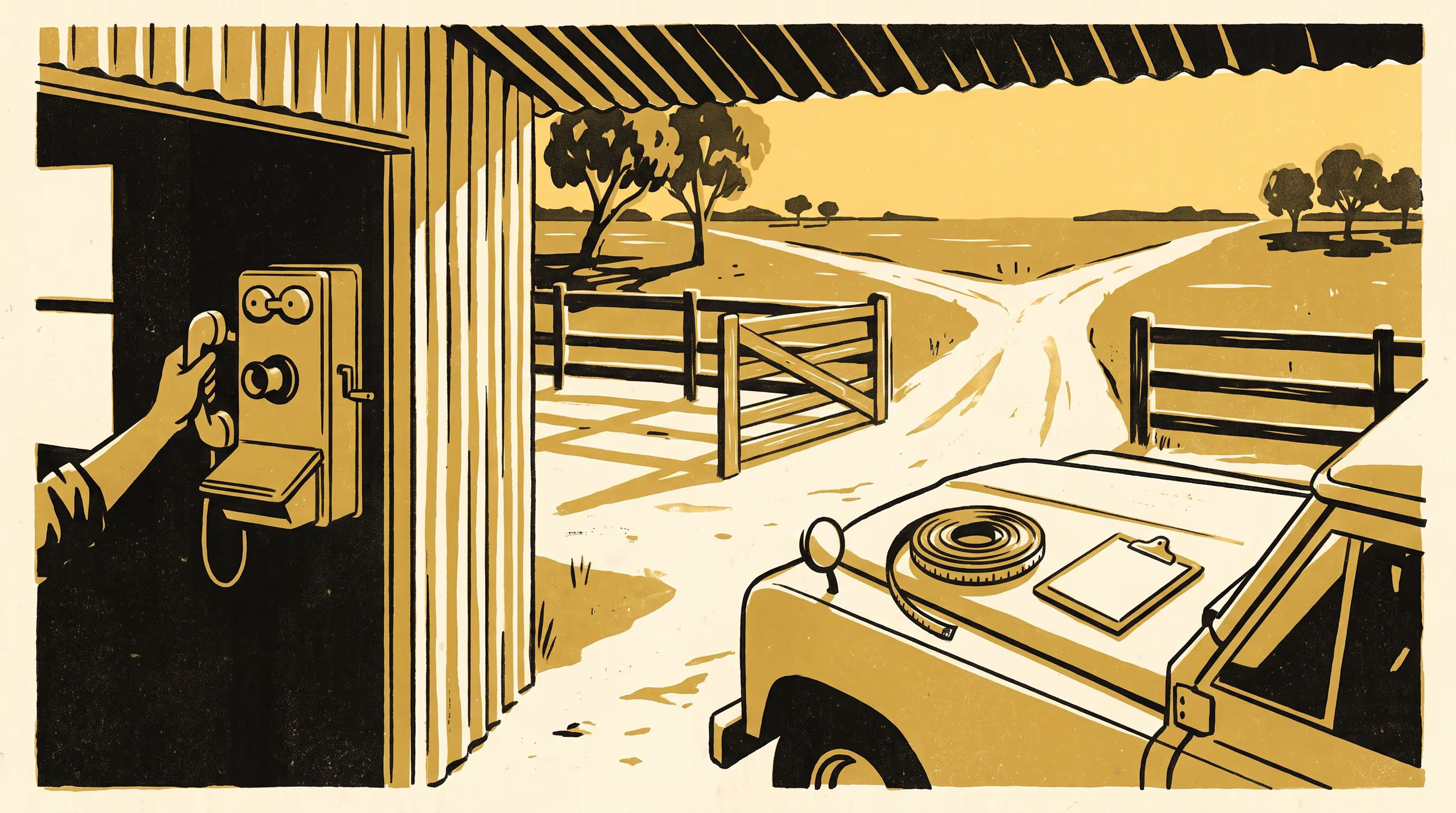
A research poster from the School of Underlying Conditions works out what advance word of a creek crossing is worth to a field officer with fourteen bores to visit in a day.
A decision analysis of one monthly bore round asks which way to turn at the gate, and what it is worth to know before turning
Once a month the School of Underlying Conditions sends an officer out to fourteen monitoring bores, five of which sit on the far side of a creek. The School has now turned its attention from the bores to the gate, and to the choice made there each morning about which way to go first.
A fork in a road is a generous thing to be handed at seven in the morning. We have tried, over three wet seasons, to be worthy of ours.
— Dr Vigdis Emenike, Senior Lecturer, School of Underlying Conditions
What the Phone Call Is Worth: Expected Value of Perfect Information about a Creek Crossing on a Fourteen-Bore Dip Round is a research poster by Dr Emenike with Dr Brynjar Obiora, Senior Research Fellow in the School. The University regards it as a welcome instance of a school applying its analytical capability to its own mornings.
The poster brings the established apparatus of decision analysis to bear on a day in the field, aligning the officer’s two possible routes with the two possible states of the crossing and weighing each against the other. It identifies the point at which the routes are evenly matched, and positions a telephone call to a nearby landholder within that framework as a source of advance knowledge whose worth rises and falls with the officer’s own uncertainty. Across 31 logged rounds the call would have repaid its cost on 24. It was made on 7.
Dr Obiora said the round would go out next month as it always had. “I expect it to go out a little more deliberately,” he said, “and I would not want to put it more strongly than that.”
The full poster is available from the University’s research repository under an open licence, doi:10.5555/slop.3wbie1.