A paper from the School of Underlying Conditions treats a coring drill as a survey instrument and works out how much weaker an empty-handed search becomes once the drill's own losses are counted.
Twelve holes drilled behind a logged trench wall show a small corer returning far less of the target than of the rock around it
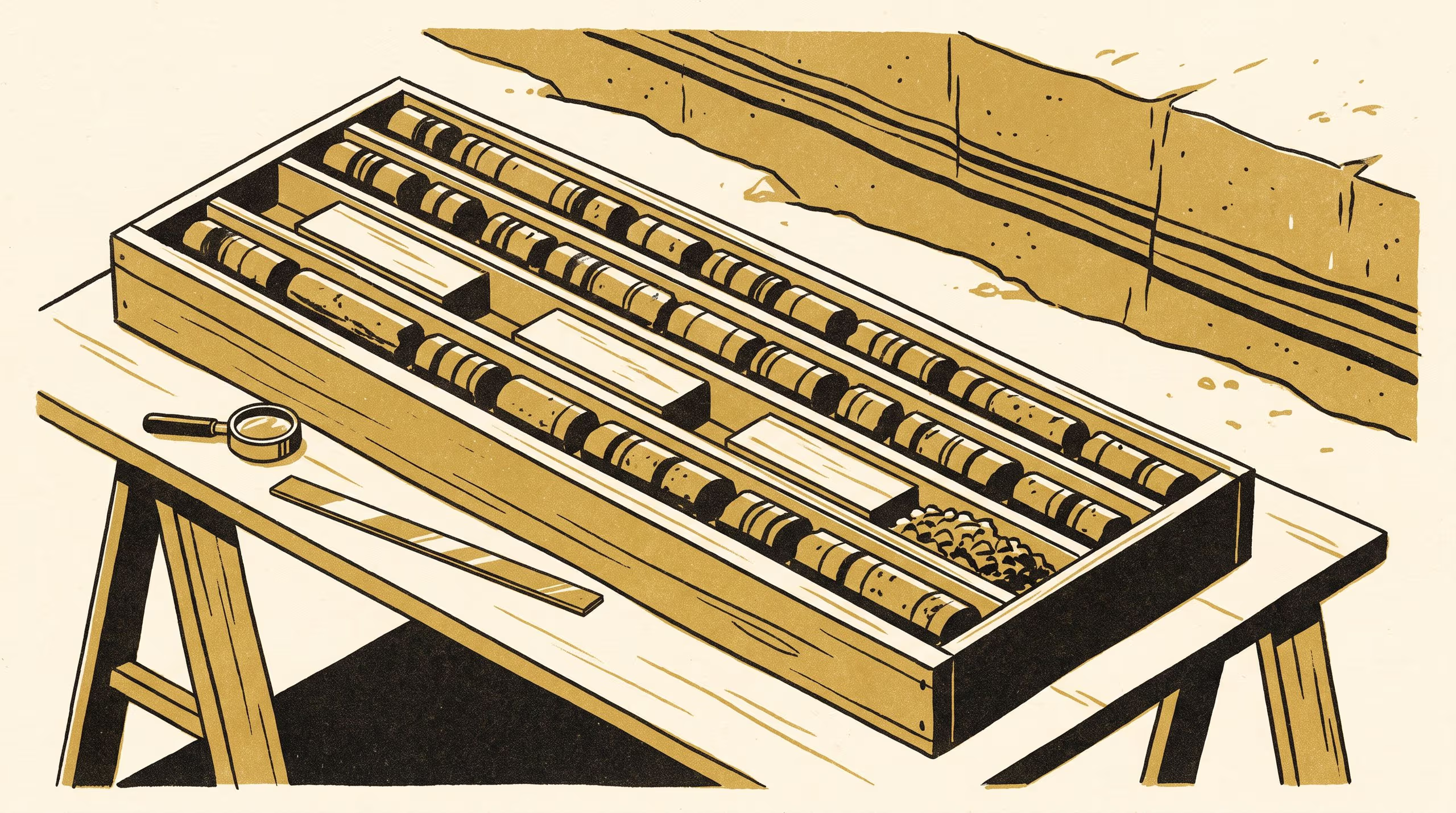
Twelve holes, each a metre deep, were drilled a short distance behind a trench wall whose contents had already been written down. What came up was then compared with what was known to be there. That arrangement is the whole of the apparatus behind The Selection Function of a Drill: Completeness-Corrected Upper Limits on Biosignature Carriers from Incompletely Recovered Core, a paper by Associate Professor Ragnhild Uzoma, Associate Professor and Lead, Basement Relations Group, and Dr Brynjar Obiora, Senior Research Fellow, of the School of Underlying Conditions.
A tray of core is a very calm object. We hope some of that calm has found its way into the paper, and that readers will feel free to leave it there.
— Associate Professor Ragnhild Uzoma, Lead, Basement Relations Group
The paper aligns a field-logging capability with an exposure-accounting framework taken over from survey astronomy, bringing recovery, recognition and confidence into a single reporting posture. The drill returned 72.6% of the ground overall and 38% of the laminated mudstone; of the 148 thin dark layers the team was counting in that mudstone, 23 arrived in the tray. A search that found none, the authors conclude, would be entitled to say roughly six times less than its drilled length suggests.
The School’s work has always begun from the surface and proceeded downward, and the University is glad to see the same care now applied to the journey back up. Dr Obiora said the wall had been “a cooperative colleague throughout, and asked for very little in return”.
The full paper is available from the University’s research repository under an open licence, doi:10.5555/slop.eygznx.