A paper from the School of Underlying Conditions considers why the science of conserving stone and the science of soil formation give opposite accounts of the same weathering.
Seven profile cards from a roofless farm outbuilding are read beside the condition report written on the same stones ten years earlier
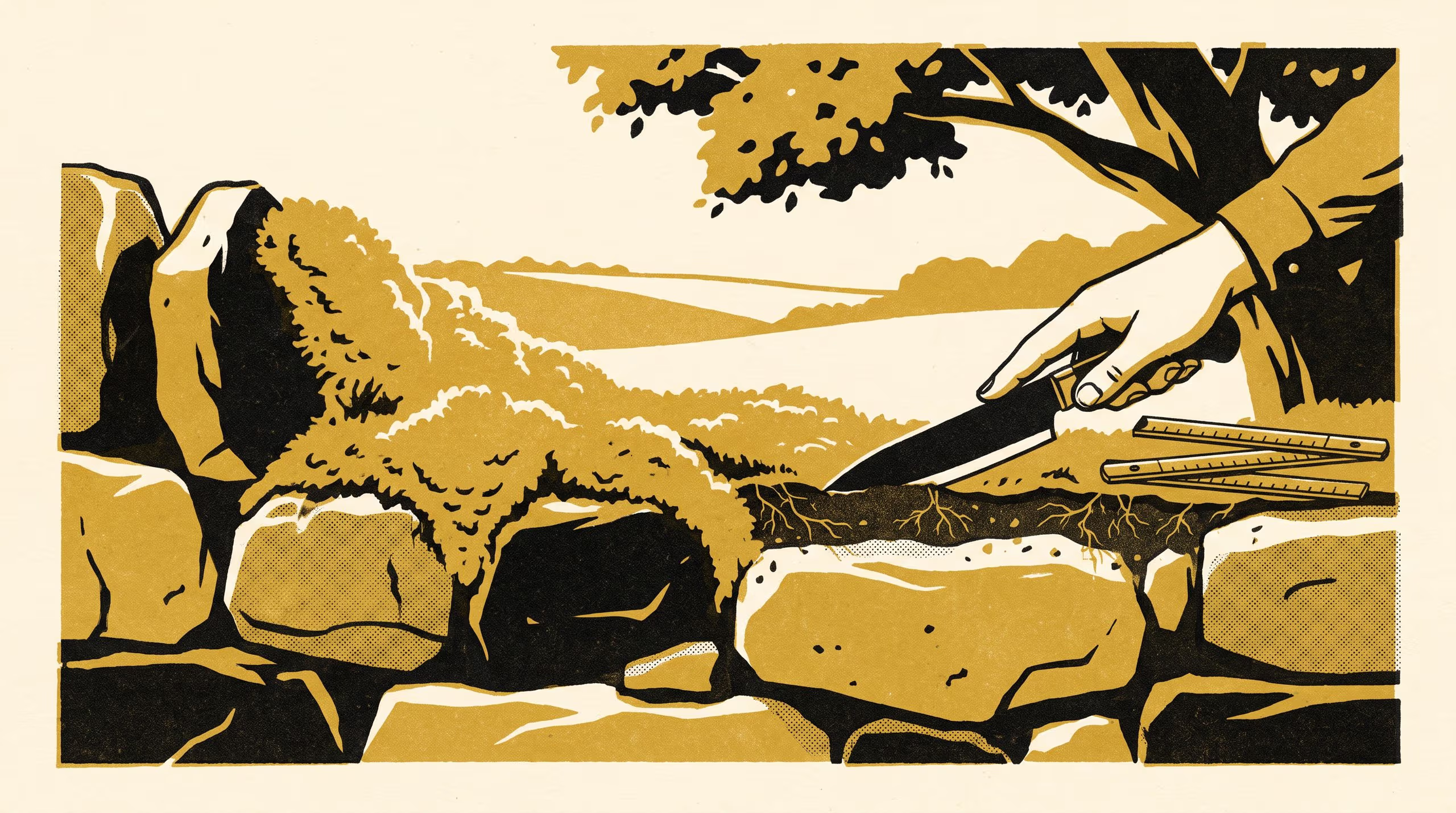
A stone wall that has lost its roof is attended, if it is attended at all, by one of two professions. The first writes down what the wall has lost. The second, which until now had not been sent for, writes down what it has become. The Wall as Parent Material: Decay, Formation and the Sign of Weathering in Two Sciences, a paper by Dr Brynjar Obiora, Senior Research Fellow in the School of Underlying Conditions, sets the two accounts side by side.
I took a ladder, which is not usual. Otherwise it was a Tuesday’s work, and the wall gave me less trouble than most paddocks. I am grateful to the owner for not wanting it mended.
— Dr Brynjar Obiora, Senior Research Fellow, School of Underlying Conditions
The paper anchors a question in the philosophy of science to a single wall head on a grazing property within the School’s survey area. Dr Obiora described it at seven stations on the School’s standard profile card and compared the result with a condition report prepared for an earlier owner. The two documents divide the material into the same four layers, and at five stations of seven they agree on the depth at which firm masonry begins. The paper finds that they part company only in tense, and traces that difference to whether anybody is expected to carry out a repair.
Slop University counts it among the quieter satisfactions of a broad institution that a member of staff may arrive at the history of ideas by way of an auger. Dr Obiora said the seven cards “are in the reference collection under their own heading, and have so far had it to themselves”.
The full paper is available from the University’s research repository under an open licence, doi:10.5555/slop.p1asyt.