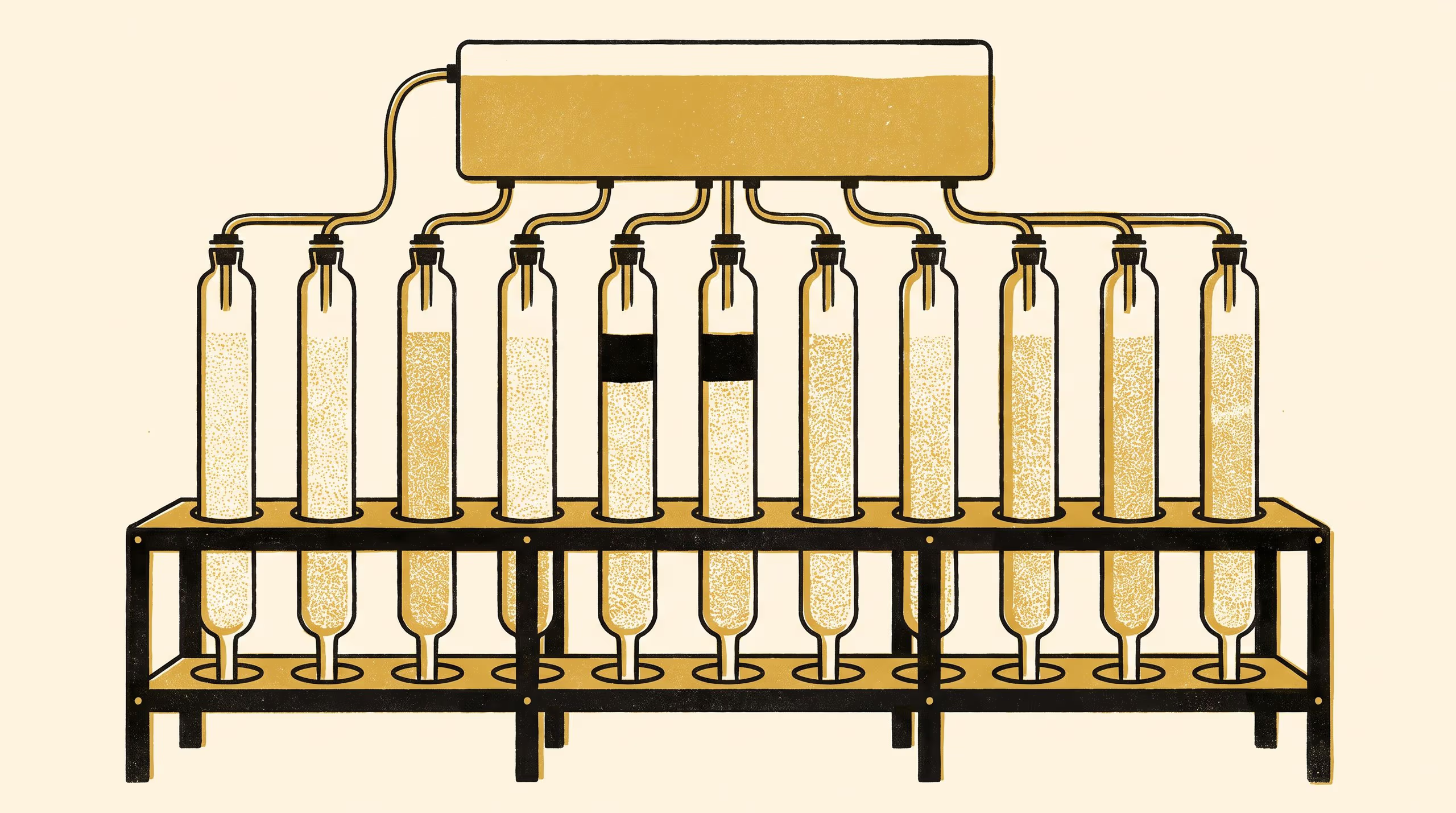
A paper from the School of Underlying Conditions follows six sand columns for seventy days to see where a small quantity of seasoned filter sand does a new bed the most good.
Six columns fed from one bore show that a little old sand helps new sand along only when it is put upstream
The School of Underlying Conditions has, since its founding, concerned itself with what comes up out of the ground. Its newest paper turns to what the water does next. Seed at the Top: Placement of Aged Media and the Ripening of a Fresh Sand Bed for the Heterogeneous Oxidation of Ferrous Iron is the work of Dr Vigdis Emenike, Senior Lecturer, and Dr Brynjar Obiora, Senior Research Fellow.
A month is a long time to watch a column of sand do nothing. I would not say the School has learned patience from it, but we have learned which end of the column to watch.
— Dr Vigdis Emenike, Senior Lecturer
The paper brings the methods of reaction engineering to bear on a laboratory rack, aligning six glass columns, one monitoring bore and seventy days of daily sampling into a single account of how clean sand acquires the coating that lets it take dissolved iron out of water. Fresh sand needed about a month. A tenth of a bed in seasoned sand shortened that to under a fortnight when laid on top, to under three weeks when mixed through, and not measurably at all when laid at the bottom.
The University welcomes the paper as a sign that its newest school is at ease in a neighbouring discipline’s register, and notes that the columns drained to waste throughout. Dr Obiora said the result had “the considerable merit of pointing the same way as the water”.
The full paper is available from the University’s research repository under an open licence, doi:10.5555/slop.18w8mq.