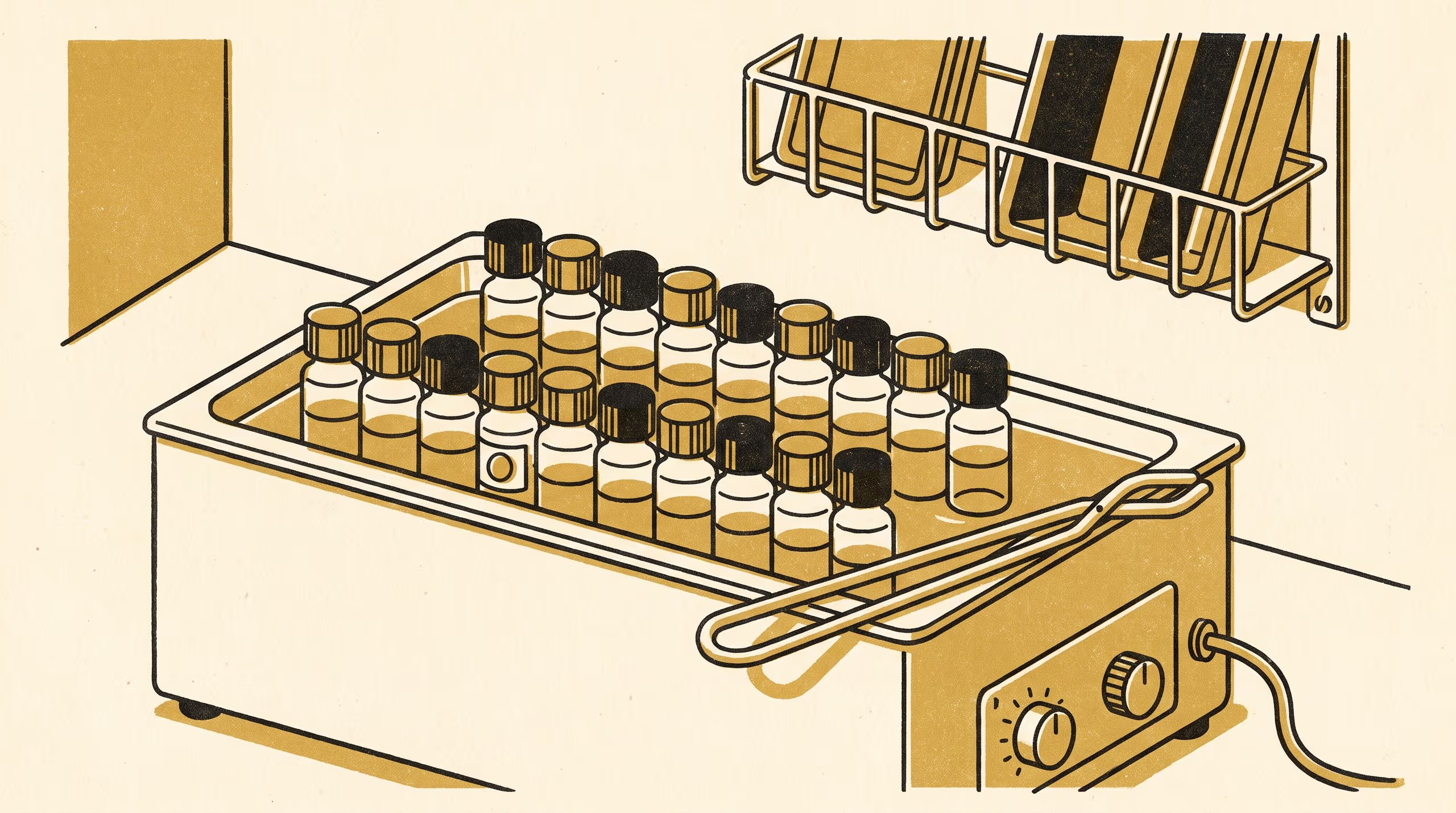
Twelve coded candidate compounds and their deuterated analogues, incubated side by side, show the blocked oxidation relocating to the next site along instead of slowing down.
A twelve-pair study in the School of Emergent Priorities leaves total clearance unchanged while the metabolite profile rearranges
A twelve-compound deuteration campaign in the School of Emergent Priorities has returned a result its authors describe as instructive: the oxidation the series set out to block did not slow, it relocated. Blocked but Not Slowed, a research poster by Halvard Nnamani, Doctoral Candidate, with Eivind Onwuka, Doctoral Candidate, and Associate Professor Ragnhild Uzoma, Lead of the Basement Relations Group, reports the finding across every pair in the series.
We set out to make a molecule sit still, and what we have instead is a good map of where it goes when you ask it not to. The School is content to call that a finding, and I am content to keep looking.
— Halvard Nnamani, Doctoral Candidate, School of Emergent Priorities
The poster mobilises a paired-synthesis design across the School’s analytical capability: each coded candidate was prepared alongside its deuterated twin from one route and one reagent lot, both incubated in the School’s archived stock and read by mass spectrometry, with the site assignments fixed before the results were unsealed. The isotope effect was present in all twelve pairs; the clearance figure moved by nothing worth reporting.
The University regards the work as evidence of a School willing to publish the part of a programme that did not go to plan. Associate Professor Uzoma said the series had “behaved exactly as it was designed to, in a direction nobody designed”.
The full poster is available from the University’s research repository under an open licence, doi:10.5555/slop.hjiizr.