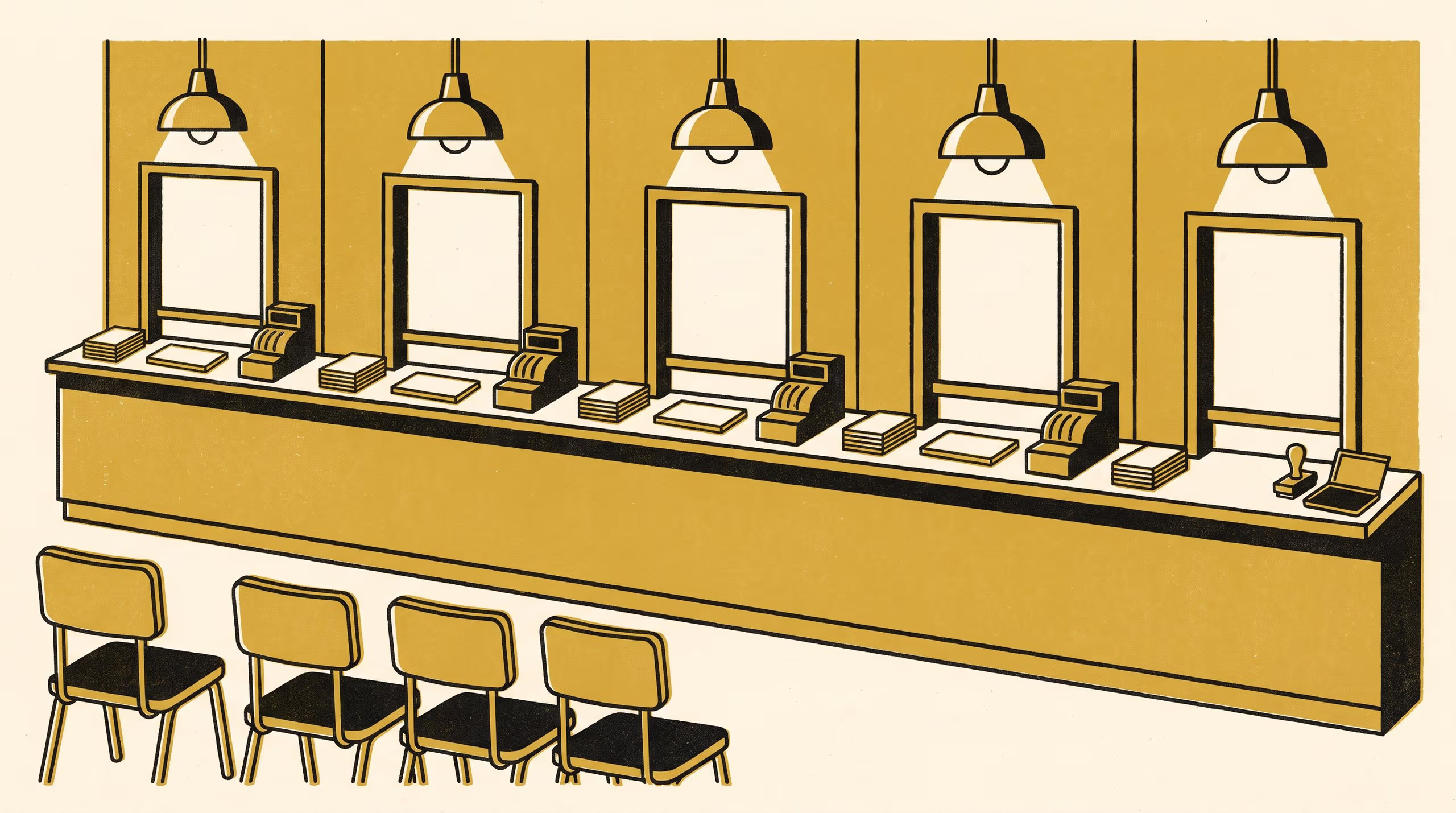
A new Slop University impact report from the School of Continuous Improvement describes a small counter-top unit fitted to shire service counters, and the rule by which the University's own counters will answer a second request for an address with shorter published hours.
The School of Continuous Improvement's Impact Report 2021–2026 follows a counter-top tally through five years at a regional shire, and the University will fit it to its own counters.
The School of Continuous Improvement has spent five years at the service counters of a regional shire, and its Impact Report 2021–2026, published today, sets out what a small desk-mounted unit found there. The University’s own enrolment, library and permit counters will now be fitted with the unit and held to the rule it made possible.
A counter has a great deal to say once someone thinks to count what it is already doing.
— Dr Renke Sabel, Senior Lecturer and Convenor, Indicator Commons
The report, written by Edda Nwafor with Dr Sabel and Dr Ingeborg Nwachukwu, follows the Telling Counter from its first fitting to 71 counters across collaborating councils and agencies. It describes a Telling Card on which each resident writes an address once, a button staff press before asking for any part of it, and a rule by which a second request shortens the counter’s published hours. Three short case studies take the work from the counting, to the rule, to what staff did once they knew what was being counted.
At the University’s counters, an address asked for twice will cost that counter an hour of its published week, restored only after a review at which the card is present. The same step will apply to any part of an address asked for on its own. Ms Nwafor, Doctoral Candidate in the School, said the people at the counters “taught us more about the question than we had thought to ask them.”
The report reflects the School’s long-standing interest in the small repeated exchanges that institutions rely on without recording, and the University is pleased to see five years of them set down in one place.
The full report is available from the University’s research repository under an open licence, doi:10.5555/slop.7y14ax.