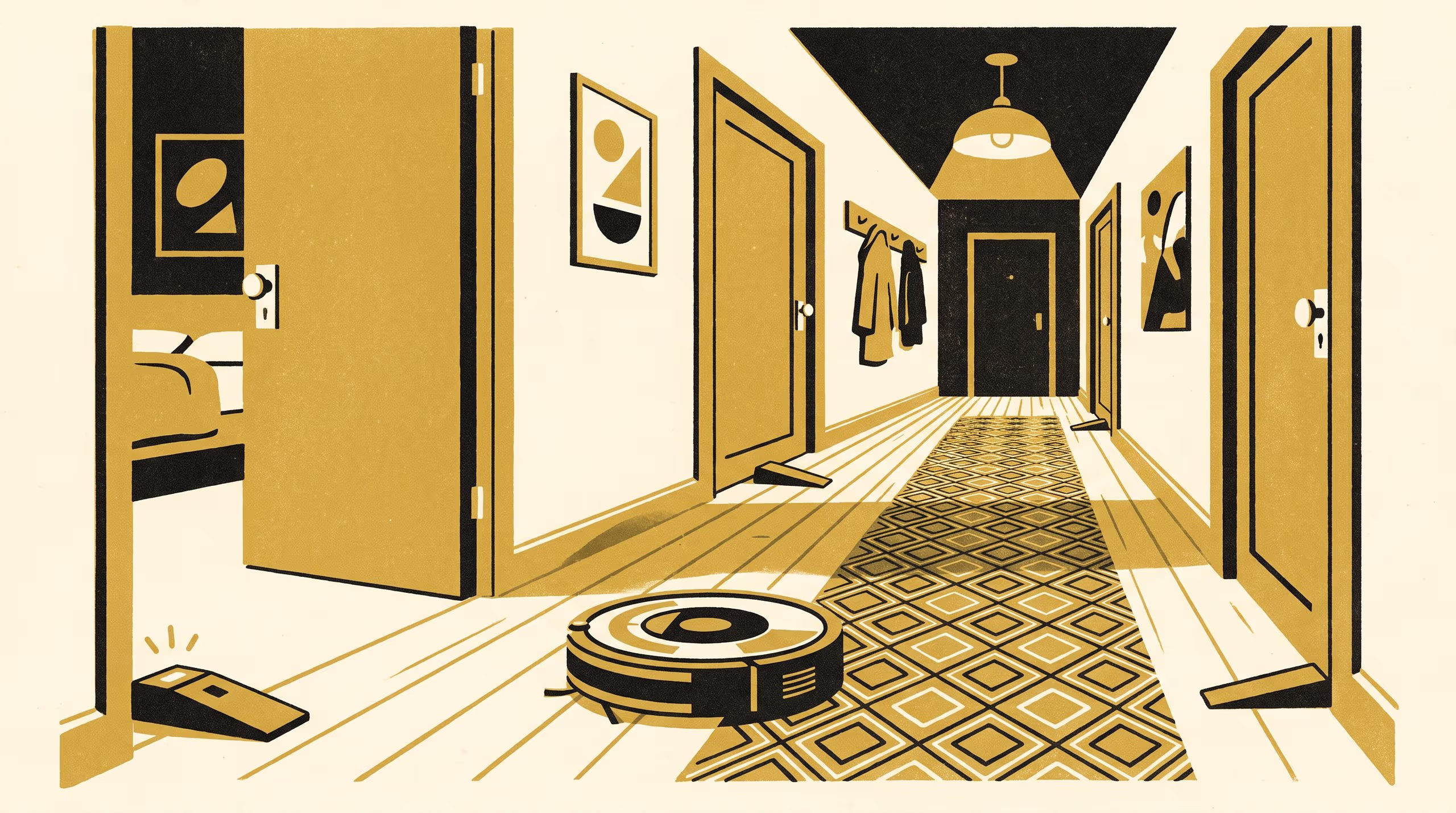
A new Slop University paper reports DOORTURN, an actuated door-stop system that gates a share house's shared robot vacuum to whichever bedroom is next in the cleaning rotation, with no manual override.
DOORTURN's actuated door-stops admit the robot vacuum only to the bedroom whose turn it is, and never elsewhere, with no manual override
A share house’s cleaning roster has, until now, relied on whoever remembers whose turn it is. A new Slop University paper from the School of Continuous Improvement reports DOORTURN, a system that removes that reliance entirely: an actuated door-stop wedge at each bedroom threshold opens only for the household’s shared robot vacuum, and only into the room whose occupant is next in the roster, on a fixed cycle with no manual override.
The work draws on the School’s Evaluation of Evaluation program, which studies how review and audit arrangements hold up once the conditions that motivated them have moved on. Deployed across a small cohort of share houses, DOORTURN’s rotation compliance rose sharply once turn order left human memory for automated enforcement, alongside a modest rise in occupants’ reported irritation at a door that will not be argued with.
A roster that depends on memory is already halfway to failing; ours simply removes the half that was optional.
— Dr Dagny Okafor, Lecturer and Convenor of Evaluation of Evaluation
Senior Research Fellow Sten Okwuosa said the deployment reflects the Impact Pathway Atlas’s growing interest in instruments that outlast the conditions that first motivated them. The School counts the result among the clearer cases for its founding wager: an arrangement holds only once it no longer depends on anyone holding it in mind.
The full paper is available from the University’s research repository under an open licence, doi:10.5555/slop.ye8m6s.