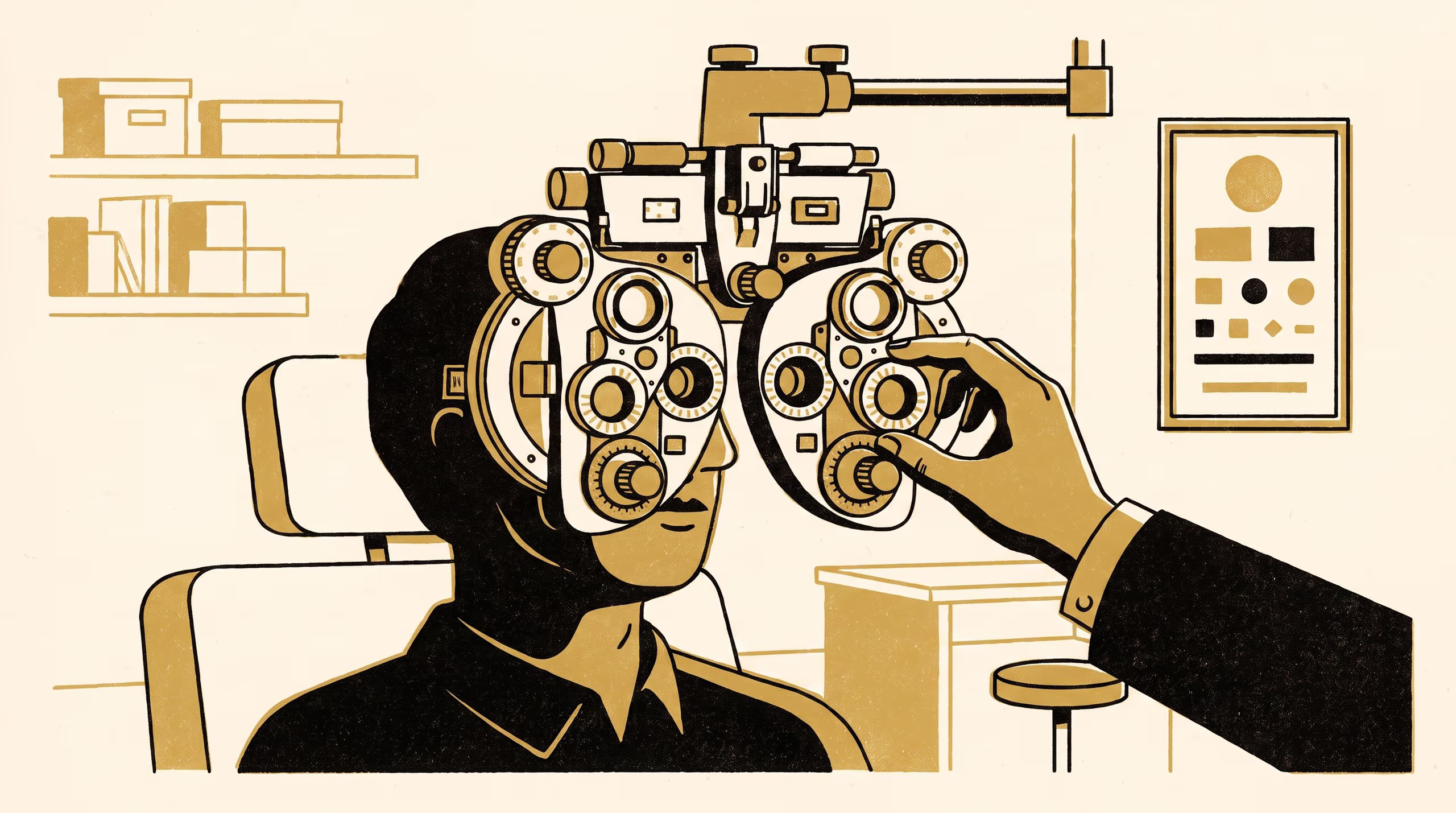
A School of Emergent Priorities paper codes 4,218 lens-flip exchanges and finds a completeness rule stopped patients saying "same" without changing remake rates.
A 36-practice taxonomy of 1-or-2 responses shows the same-declared share falling after a completeness rule, while spectacle remakes do not move
Once the two lenses look the same, the clinically available answer is to say so. A suburban optometry chain recoded that answer as an incomplete refraction, and withheld the next continuing-education day from any practice that still logged it above a published threshold.
A paper published today by Associate Professor Kwame Lindqvist, Dr Ingrid Vasseur and Dr Iben Chikere of the School of Emergent Priorities follows 4,218 lens-flip exchanges across 36 practices, fourteen weeks before that rule and twenty-six weeks after it. Patients’ spoken turns are sorted into a five-class taxonomy: a discriminated preference, a first-offered default, an alternation, an unprompted “same”, and a guess produced only after a re-ask.
The same-declared share fell from 14.2 per cent of flips to 2.9 per cent. The forced-guess share rose from 9.1 per cent to 21.4 per cent. Discriminated preference did not move, and nor did the chain’s own spectacle remake rate. Eleven practices sat above the eight-per-cent threshold in the first quarter after the rule and had a continuing-education day withheld; by the fourth quarter all eleven had fallen below it.
The paper belongs to a line of University work that takes a logged completeness rate seriously enough to ask what it is complete of.
The log got cleaner. The 1-or-2 question did not get easier; the safer turn was to pick a number.
— Associate Professor Kwame Lindqvist, Director, Master of Priority Studies
Dr Ingrid Vasseur, who convenes Futures in Committee, said a rule that closes an available answer “does not retire the moment the two lenses look alike; it only changes what gets written down about it.”
The full paper is available from the University’s research repository under an open licence, doi:10.5555/slop.02j1em.