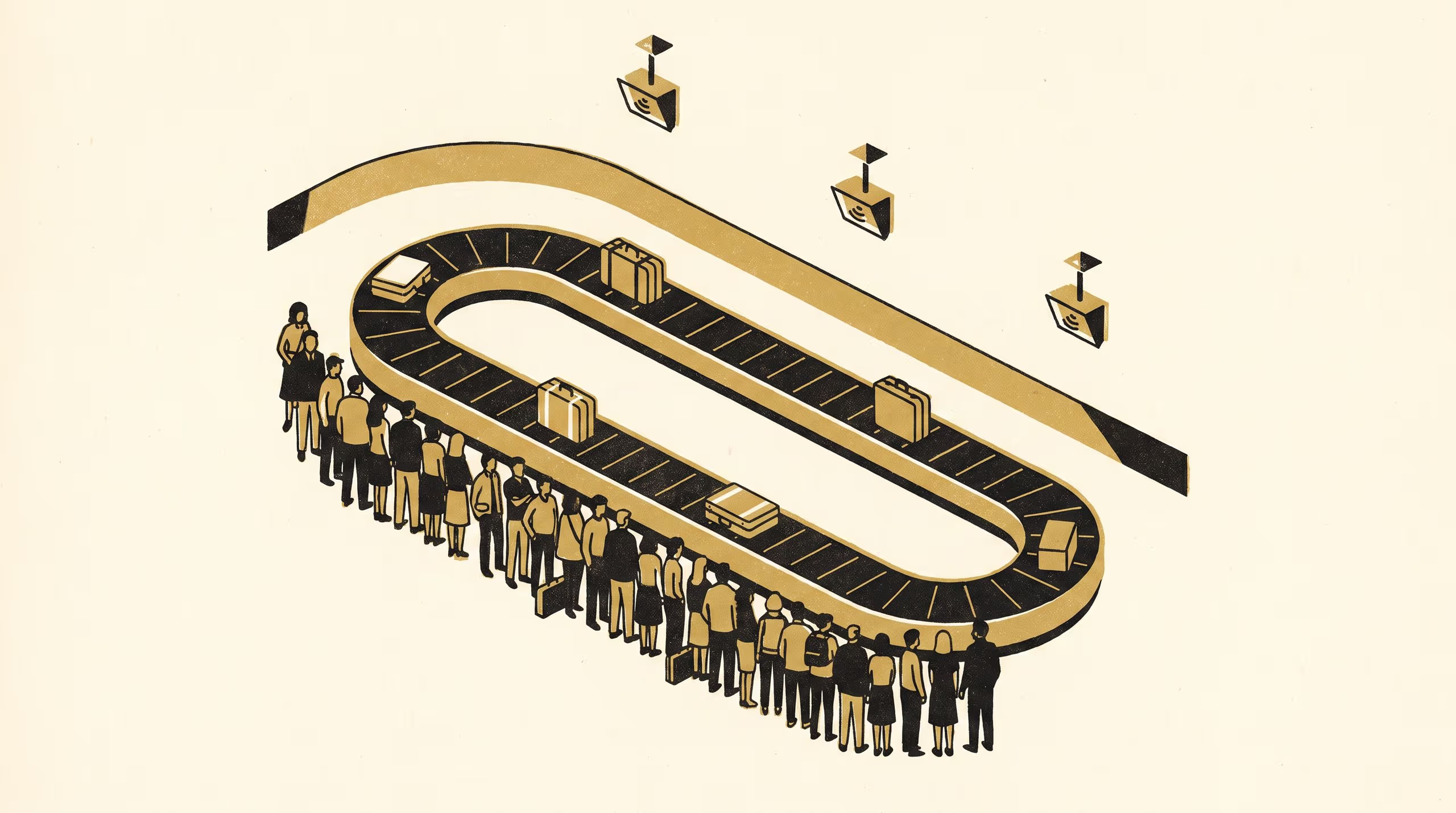
A School of Continuous Improvement paper moves an airport's stand-back line 900 millimetres outward in three stages and finds where passengers stand varies by 17 millimetres, while the operator's published adherence figure falls from 34.1 to 3.7 per cent.
Twelve months of ceiling depth sensing at one regional airport reclaim hall, across three repaintings of the stand-back line
An airport has resolved to keep moving its stand-back line, and to station a member of staff beside it. Both decisions rest on the evidence set out in Reclaim Hall B and the Stand-Back Line, a paper from the School of Continuous Improvement, which finds that the line has almost nothing to do with where arriving passengers actually stand.
Four depth sensors were fitted to the ceiling of a single-carousel reclaim hall at a regional airport and left in place for a year, recording a quarter of a million anonymous dwell tracks across 3,914 arrivals. Over that period the hall’s line was repainted three times, carrying it from 900 millimetres to 1,800 millimetres from the belt. The front rank of the crowd settled, in every phase, between 604 and 621 millimetres out. The operator’s line-adherence figure, which is measured against the paint rather than the belt, fell from 34.1 per cent to 3.7 per cent across the same repaintings.
The line and the measure of the line are the same stripe of paint, which is a tidy arrangement until somebody moves it.
— Dr Marit Osayande, Lecturer and Convenor, Living Dashboard
A staffed presence at the line did shift people, by close to 400 millimetres, and held them there for a median of 38 seconds after the attendant walked out of the hall. Associate Professor Casimir Beng, Lead of the Adaptive Metrics Lab, said the finding “sits squarely inside what the Lab has been asking about instruments that participate in the thing they measure, and we are glad to have a hall’s worth of it.”
The work was supported under the Indicator Stewardship Seed Fund. The University takes the study as evidence that its measurement agenda travels well beyond the campus, and welcomes the operator’s appetite for continuing the series.
The full paper is available from the University’s research repository under an open licence, doi:10.5555/slop.iltbdg.