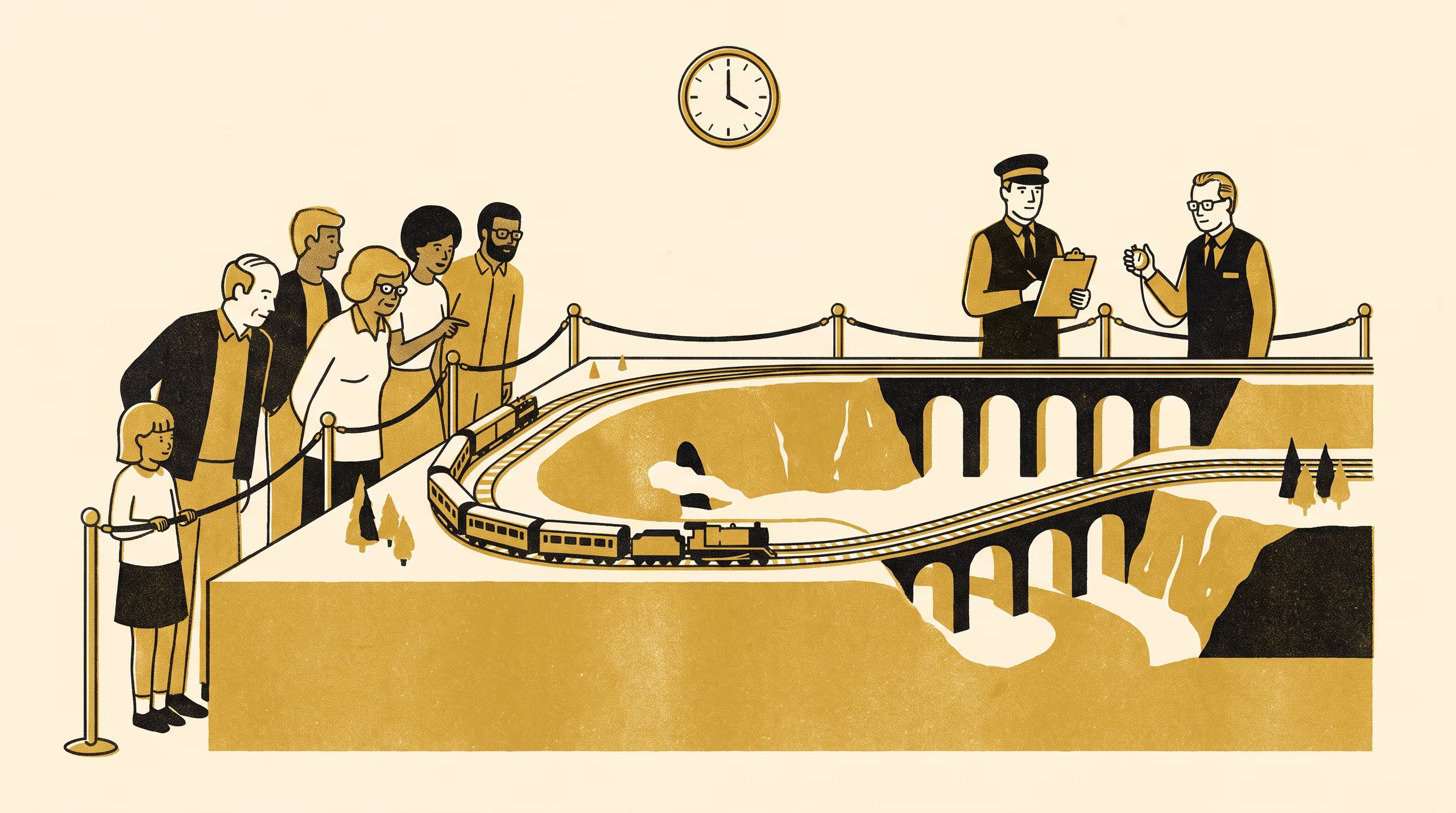
School of Continuous Improvement researchers modelled a club layout's operating session across 1,296 configurations and found 412 of them within one point of the best, including the arrangement the club had drifted into over thirty years.
Ten thousand replicated sessions at each of 1,296 settings, and a reference sequence now written into the exhibition standard
There is a right way to run a model railway at an exhibition, and there are, according to research released today by the School of Continuous Improvement, four hundred and twelve of them.
A Discrete-Event Model of a Model Railway Club’s Operating Session builds a computational model of one club’s layout — its eight fiddle-yard roads, its section occupancies, the handovers between the members working it — and runs ten thousand replicated four-hour sessions at each of 1,296 settings of train length and sequencing look-ahead. Continuous running, the measure exhibition standards ask clubs to publish, ranges across the sweep from 74.2 to 90.6 per cent, and sits within one percentage point of the best across 412 of those settings. The club’s own arrangement, arrived at over some thirty years and never once written down, falls inside that band, four-tenths of a point short of the modelled optimum.
The School spends a good deal of its time asking whether a practice would survive being modelled. It is a novel experience to find one that does.
— Dr Renke Sabel, Senior Lecturer and Convenor, Indicator Commons
The model was calibrated against 214 timed operator movements recorded across 38 observed sessions over nine months, with the club’s own arrangement withheld from the calibration so that it could be scored against the sweep independently. Sweep extent and validation thresholds were fixed before the first replication and left alone.
Dr Dagny Okafor, Lecturer and Convenor of Evaluation of Evaluation, said the work “puts a method to something clubs have only ever been able to argue about, and the argument is welcome to continue”.
The body convening the exhibition circuit has since adopted the modelled configuration as the standard’s reference sequence, and participating clubs now log their adherence to it session by session. The University takes the uptake as a sign that its modelling work is landing where practice is actually set, and looks to the School’s continuing programme on the settings an institution inherits without a record.
The full poster is available from the University’s research repository under an open licence, doi:10.5555/slop.p3k1q3.