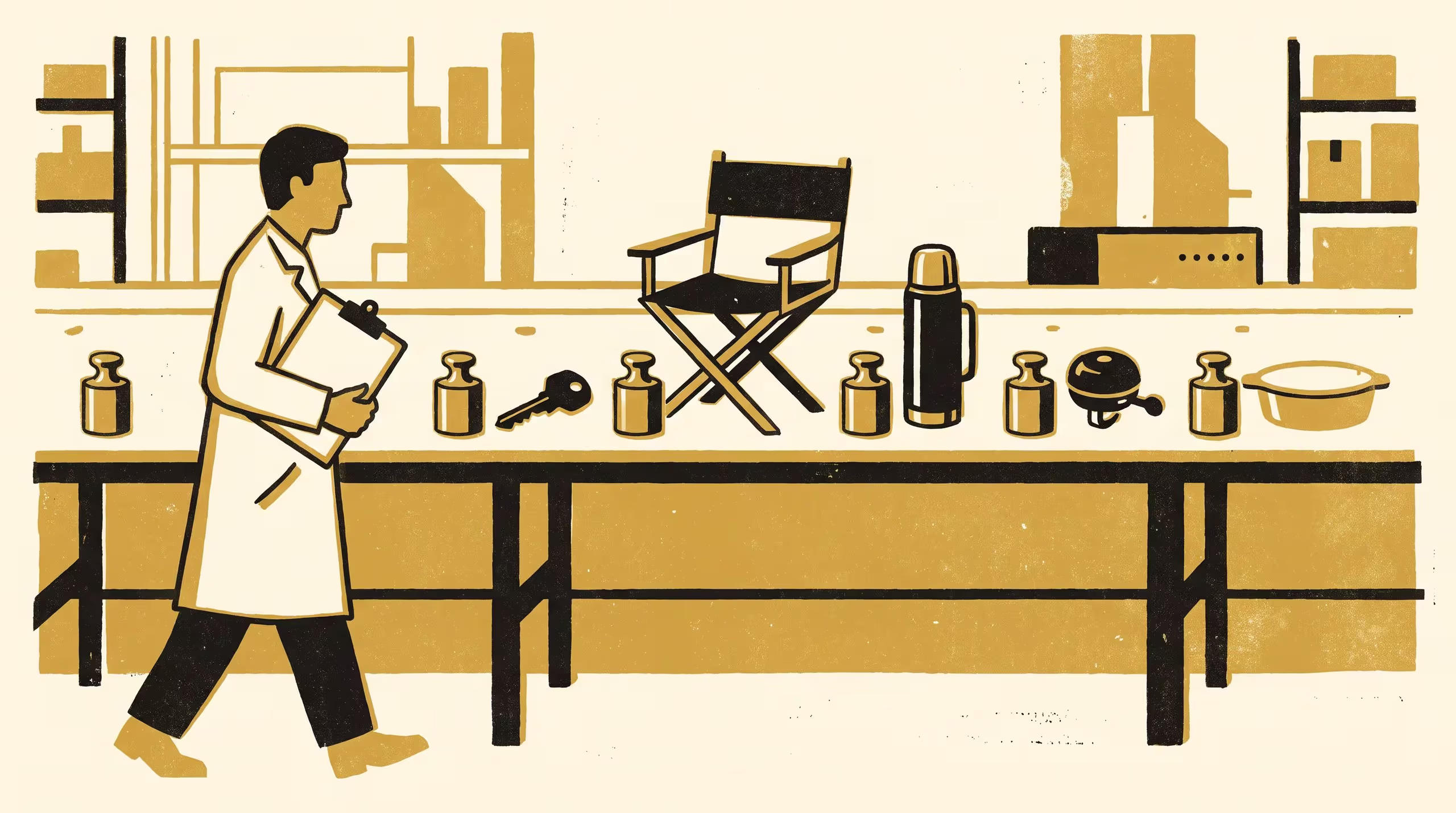
Slop University has published its 2021 to 2026 Impact Report, five years of the School of Continuous Improvement's work on a published table converting a spare key held next door, a lift to an appointment and a Saturday fixture into one comparable unit, and on the custody that table never had.
The Impact Report 2021 to 2026 traces a schedule of equivalences that has carried three coefficients through five annual returns with one revision between them
Converting a spare key held next door, a lift to an appointment and a Saturday sporting fixture into a single comparable figure was the School of Continuous Improvement’s principal undertaking of the past five years. Unchanged, and Therefore Agreed, the School’s impact report for 2021 to 2026, published today, is largely an account of what happened after that was done.
The schedule of equivalences went out through the Indicator Commons in the first year, and the apparatus assembled itself around it: an annual return, a Capability Sprint teaching people to complete it, a review cadence, and eventually a published ranking that collaborators consult more often than they consult the School. Of the three coefficients the schedule carries, one has been revised. The report is candid that no mechanism for revising the other two was ever built.
The table was the easy part. What we did not build was any reason for anyone to come back to it, and five years is long enough for that to stop being an oversight.
— Dr Thandiwe Solberg, Senior Lecturer and Convenor, Demo Quarter
Its later chapters follow the instrument outward, into the allocation meetings where the return now functions as an input rather than a description, and into a ranking that has held the same order since its third year.
“The Sprints have taught people to complete the return,” said Dr Ingeborg Nwachukwu, Lecturer and Convenor, Capability Sprints. “The next cohorts will be taught the conditions under which a coefficient should be argued with, and our collaborators have been asking for that for longer than we have been offering it.” The University regards the report as the fullest account it has published of an instrument of its own making, and of the quiet that settles around one.
The full report is available from the University’s research repository under an open licence, doi:10.5555/slop.tmc5ja.