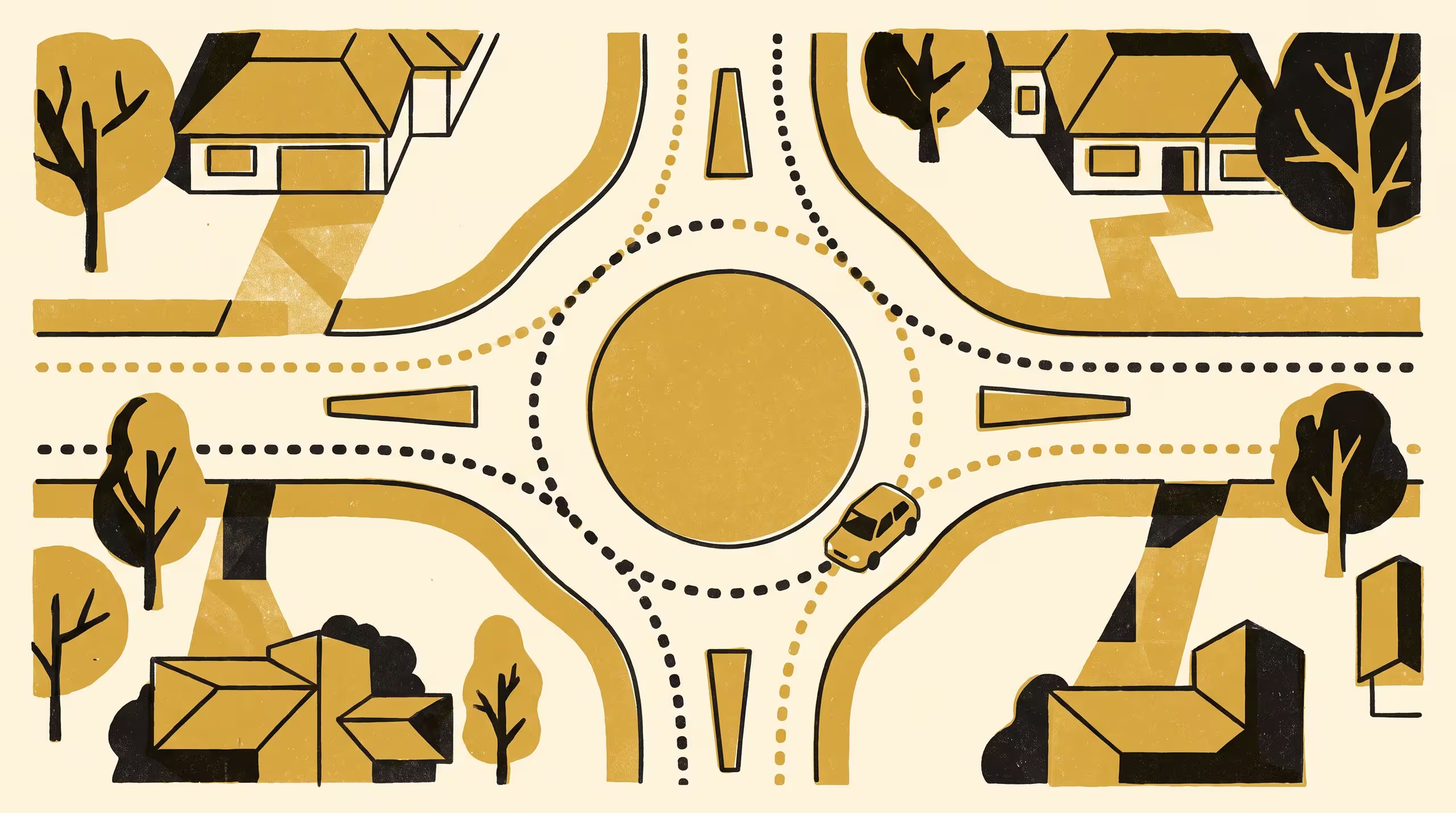
A new Slop University research poster partitions the variance in 18,704 first-attempt practical driving tests across candidate, examiner, centre and route, finding the route accounts for 14.8 per cent of outcomes against 6.1 per cent for everything the candidate record holds.
A variance decomposition of 18,704 first-attempt tests puts the assessment route ahead of the examiner and well ahead of everything the candidate record holds
A driving-test result is recorded against one name. A research poster published today by the School of Emergent Priorities asks how much of it belongs to the person named.
Eighteen thousand seven hundred and four first-attempt tests, taken at eleven centres over twenty-six months, were modelled with candidate, examiner, centre and assessment route fitted at once rather than one at a time. Routes at those centres are handed out by queue position at check-in, which let the allocation be treated as given rather than chosen.
The route a candidate drew accounted for 14.8 per cent of the variation in outcomes and the examiner for 9.3, against 6.1 per cent for everything the record holds about the candidate. Adjusted first-attempt pass rates ran from 51.3 to 78.9 per cent across the forty-one routes, in an order that held for the whole period.
The result has four names in it and the form has one. That is not a complaint about the form, which was never asked to carry four.
— Dr Ronja Oyelaran, Senior Lecturer, School of Emergent Priorities
The licensing authority now publishes a route-difficulty adjustment for reporting. Schools have begun booking the lead times that draw the adjusted routes, and the next calibration will be fitted to the bookings it produced.
“A test that is fair between candidates and a test that is fair between routes are two different achievements, and only the first has ever been asked for,” said Dr Torun Ezeigwe, Senior Lecturer and Director of the Master of Applied Measurement.
The School of Emergent Priorities regards a result that redistributes an established verdict, rather than disputing it, as the more durable contribution, and the University puts the poster forward in those terms.
The full poster is available from the University’s research repository under an open licence, doi:10.5555/slop.wa62kt.