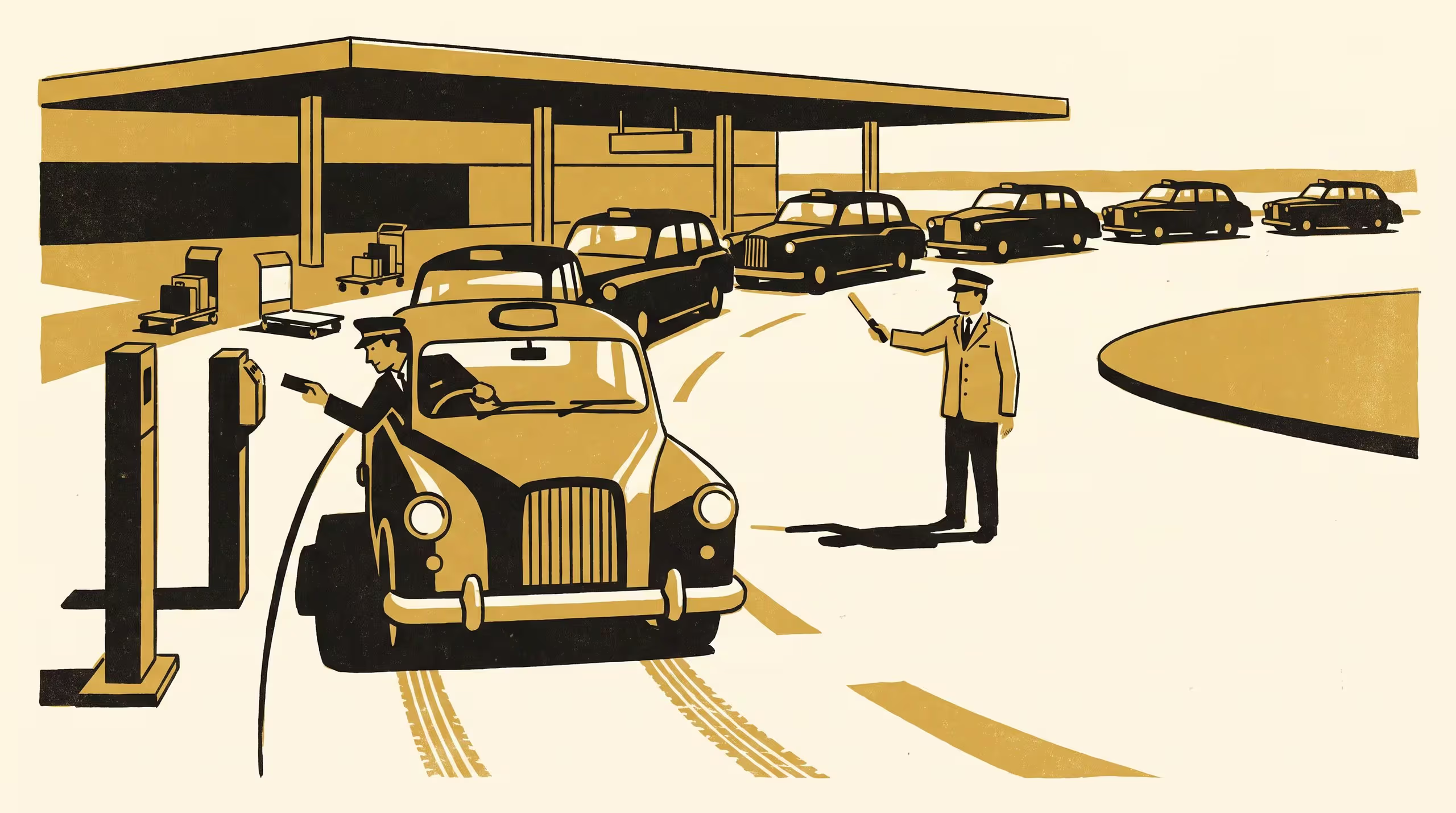
A new Slop University paper codes queue-order disputes across 22 airport and rail-interchange taxi ranks, finding a numbered-ticket dispenser eliminates one dispute category while leaving the rank's total dispute rate unchanged.
A 22-rank taxonomy of queue-order disputes finds the formal instrument displacing contested claims rather than resolving them
Twenty-two taxi ranks, three ground-transportation precincts, and one very specific argument: whose turn it is. A new Slop University paper finds that installing a numbered-ticket dispenser ends that argument almost entirely, and uncovers a second one waiting exactly where the dispenser doesn’t reach.
Senior Lecturer Dr Ronja Oyelaran of the School of Emergent Priorities, with Dr Fenna Okoro, Convenor of the School’s Horizon Register, and Associate Professor Casimir Beng, Lead of the Adaptive Metrics Lab in the School of Continuous Improvement, coded 397 disputes across 3,204 boarding cycles over a 14-week season, sorting each into a seven-category taxonomy built to tell an arrival-order dispute apart from the quieter disagreements over break re-entry, group fares, and shift changes. Ranks with a dispenser saw arrival-order disputes fall from 6.1 to 0.4 per 100 cycles. Total disputes per 100 cycles, across every category combined, barely moved at all.
We expected the dispenser to close the subject of boarding order entirely. Instead there’s a second argument sitting right behind the first one, waiting for its own instrument.
— Senior Lecturer Dr Ronja Oyelaran, School of Emergent Priorities
Dr Beng, who leads the Adaptive Metrics Lab, said the taxonomy “gives Continuous Improvement a cleaner way to ask what a measurement instrument actually fixed, instead of assuming a category removed is a problem solved.”
Two field coders tracked each rank across the full season, logging every audible or visible disagreement about who boards next and checking their coding scheme against a stripped-down, three-category version of itself. The scheme held up regardless, which the team takes as a sign the displacement belongs to the ranks and not to how finely the researchers chose to slice their categories. The finding joins the School of Emergent Priorities’ growing account of where a formal instrument earns its keep, and where it mostly just decides which argument a rank is still allowed to have.
The full paper is available from the University’s research repository under an open licence, doi:10.5555/slop.236v83.