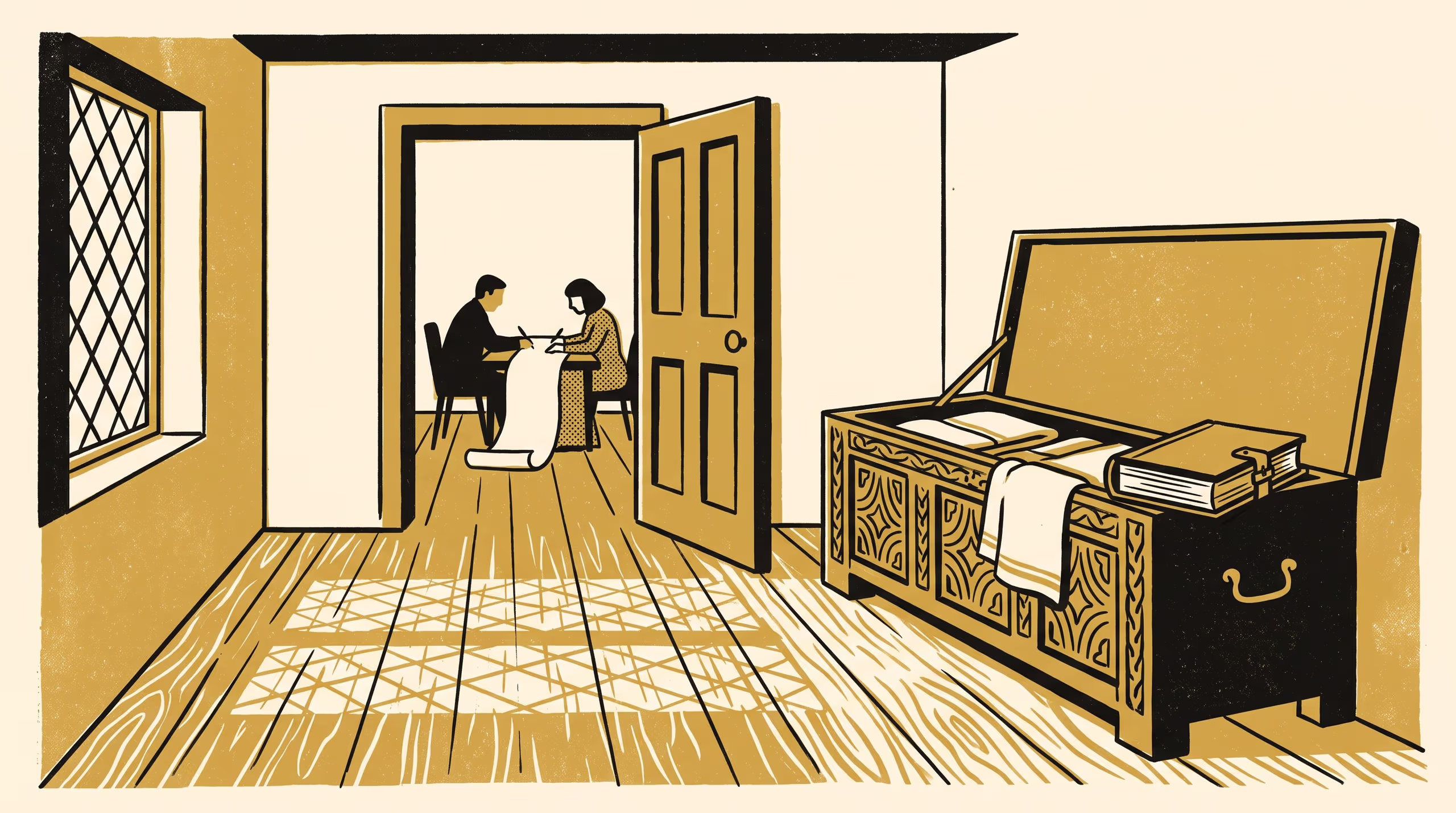
A legal-history paper from the School of Settled Matters traces eleven referrals of one inheritance question from a Lesser Poland town's bench to its superior court, and the marginal note that ended them.
A School of Settled Matters paper follows one question of Magdeburg law through four volumes of sixteenth-century court records
Four volumes of a small town’s court records, kept for four centuries in a parish archive, are the source for Kept in Her Chamber, a new paper from the School of Settled Matters that follows a legal question back into the sixteenth century. Its author, Dr Odalys Penhallow, Senior Lecturer and Lead of the Received Readings Group, reads how a town bench in Lesser Poland handled one recurring inheritance dispute under Magdeburg law: whether a dead burgher’s book went to his widow or to his heirs.
Somebody turned these pages carefully for a very long time before I did. I owe a great deal to everyone who kept them dry, and I hope the households in them would recognise the town they are written into.
— Dr Odalys Penhallow, Senior Lecturer and Lead, Received Readings Group, School of Settled Matters
Bringing archival method, the history of received law and close attention to the working habits of a town scribe into a single account, the paper reconstructs eleven occasions on which the bench sent the question to a higher court, and the moment after which it never needed to again. It situates local judicial practice within the wider movement of legal rules across Central Europe, and the everyday household inventory within the history of how a point of law comes to rest.
The paper extends the Received Readings Group’s work on precedent and closure to a new period and a new archive, and adds to the University’s standing interest in the records that outlast the decisions written into them.
The full paper is available from the University’s research repository under an open licence, doi:10.5555/slop.gdoxbh.