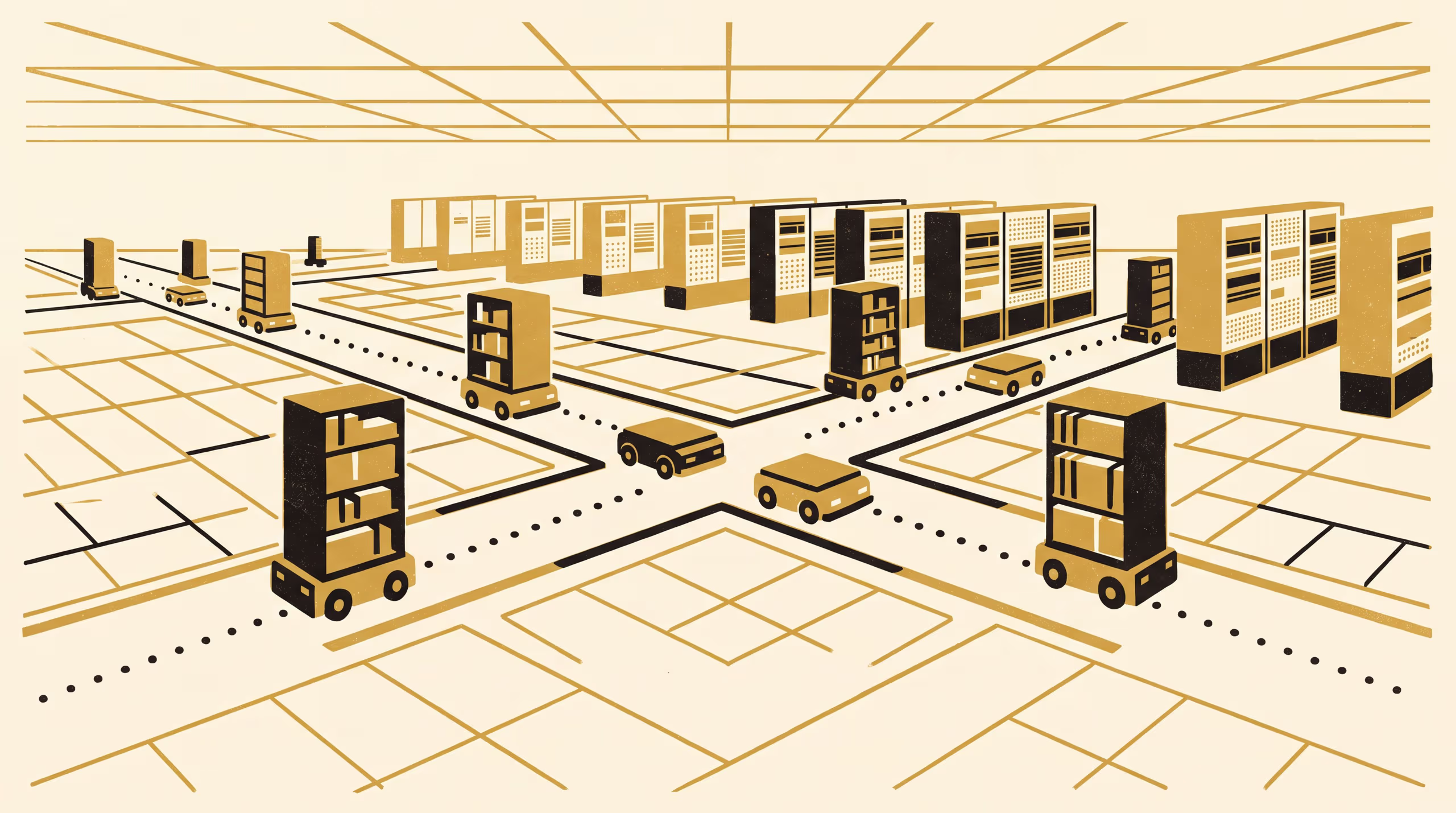
A new research poster models how a fleet of path-planning robots learns which of them goes first at a crossing, finding that the fleet settles on yielding to the right even where giving way to loaded robots would clear more traffic.
A School of Settled Matters research poster reads right of way among warehouse robots as an economic convention
Left to work out among themselves who goes first at a crossing, a fleet of warehouse robots will settle on the rule that does least harm when misread, and keep to it even where a better rule is on offer. That is the central finding of Who Goes First, a new research poster from the School of Settled Matters by Dr Odalys Penhallow, Associate Professor Anselm Threlkeld and Ms Gunnhild Ekwueme, a doctoral candidate in the School of Emergent Priorities.
This School has spent most of its life asking when a matter stops being argued. I did not expect the answer to arrive on wheels, but I am glad the robots and the law reports have found something to agree on.
— Dr Odalys Penhallow, Senior Lecturer and Lead, Received Readings Group, School of Settled Matters
The poster brings evolutionary game theory, equilibrium selection and the engineering of multi-robot path planning into a single account of how a working rule becomes the accepted one. It sets two candidate rules against each other, gives each robot a short memory of the encounters it has had, and follows the fleet as its habits harden. In every simulated run the fleet moved to yielding to the right, and the throughput that choice gives up grew as the warehouse filled.
Associate Professor Threlkeld said the project had shown the School “how much of what it reads as tradition began as somebody being careful at a corner”.
The poster sits comfortably within the University’s longstanding interest in the rules that hold a busy place together, and in the patient work of finding out where they came from.
The full poster is available from the University’s research repository under an open licence, doi:10.5555/slop.nsjabh.