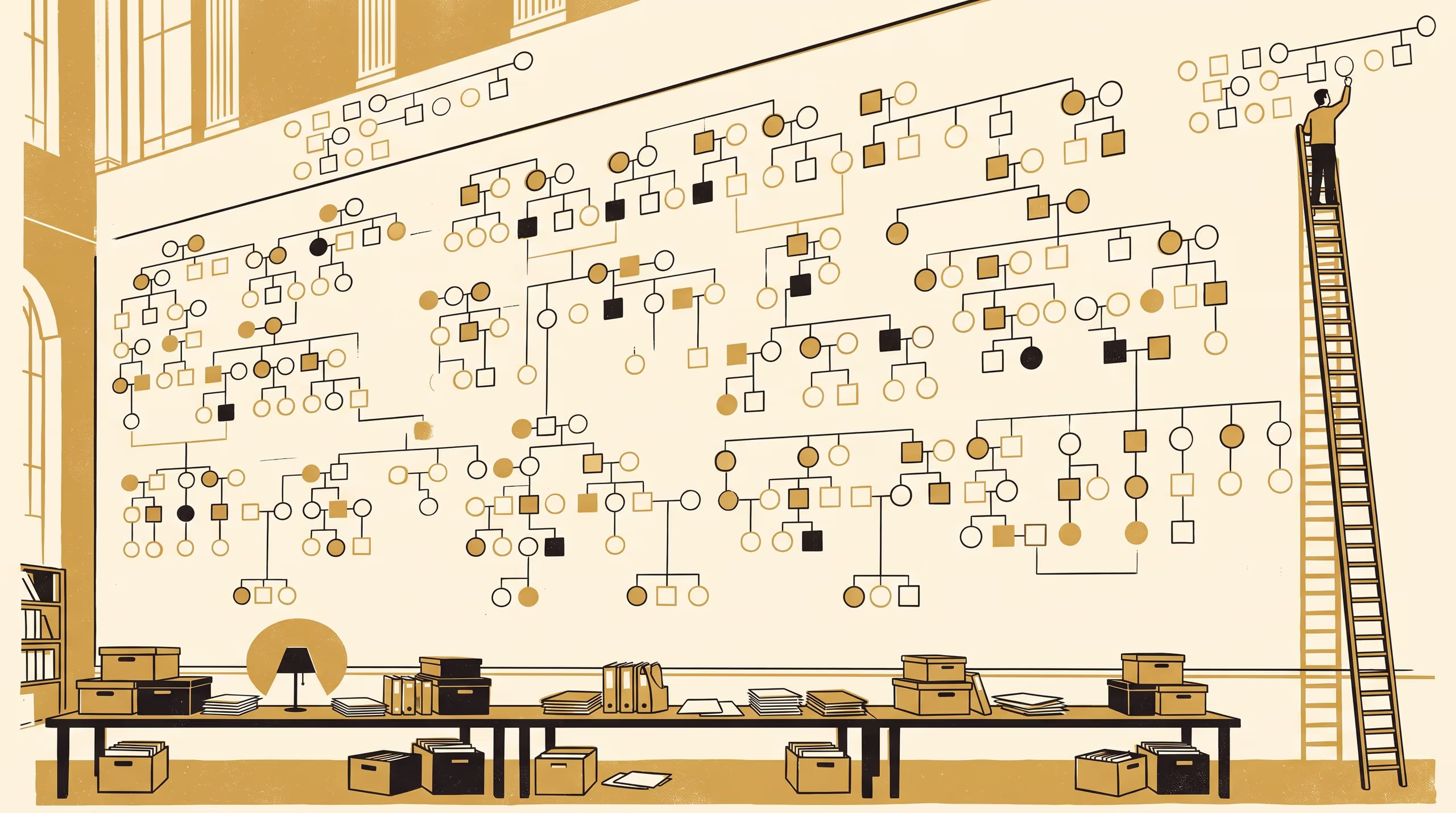
A new campaign for the University's portrait screens presents the School of Emergent Priorities' research on inherited neurological conditions as work planned across generations, and invites passers-by to read the record behind it.
A portrait campaign for the signage panels carries the School's long-horizon research on inherited neurological conditions to the screens
The School of Emergent Priorities plans in decades, and its newest campaign says so at bus-stop height. Planning for the Next Generation, prepared for the University’s portrait signage panels by Dr Anneke Tolan, brings the School’s long-horizon research on inherited neurological conditions to the screens between lectures.
A forecast about ourselves turned out to be the easiest kind to keep. The School has learned a good deal from how comfortable that felt, and intends to go on learning.
— Dr Anneke Tolan, Senior Research Fellow and Deputy Convenor, Futures in Committee, School of Emergent Priorities
The poster sets the viewer in a tall planning room whose whole wall is given over to a family tree, drawn in the circles and squares of the clinical pedigree. Two researchers on a ladder pin a new row to the top, every shape in it still blank. The campaign draws its claim from the School’s own reading on the Indicator Commons composite, aligning anticipatory capability, research stewardship and institutional patience behind a single line of display type.
As with the University’s other campaigns, the poster closes on a short reading list from the published corpus, running from the conditions copied forward on a regulator’s licences to the hedges that survive a committee’s minutes and the time a reporter cell line takes to settle after handling.
The University sees in the campaign a School comfortable with the length of its own horizon, and expects the panels to keep it in view for some while.
The full poster is available from the University’s research repository under an open licence, doi:10.5555/slop.odtghs.