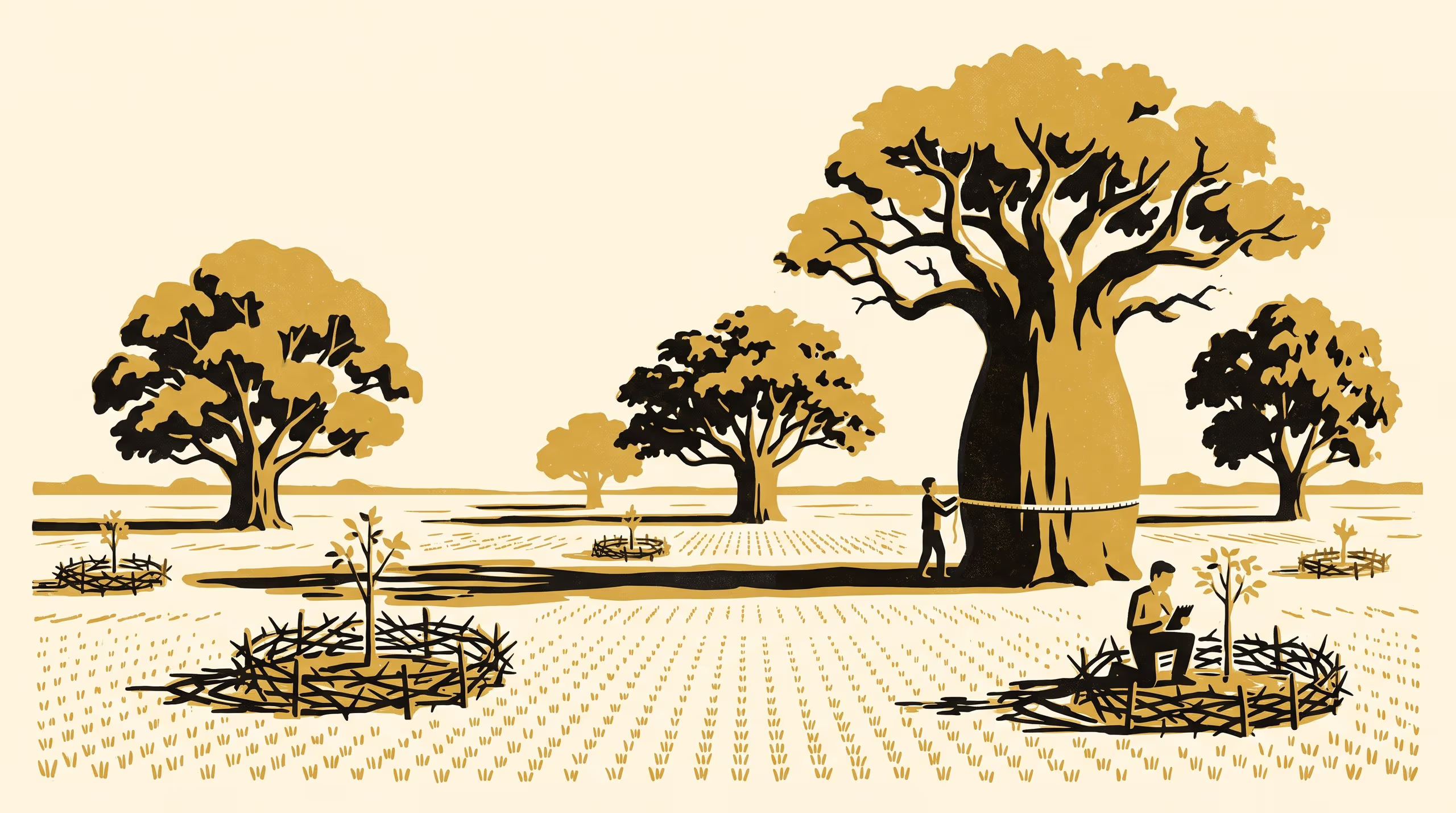
A new paper measures every tree in 48 farmed fields and shows that the gap between the trees a farmer spared and those that came later dates when each field was first cleared.
A survey of 48 fields in a West African parkland finds that the trees spared at clearance record a field's opening for about forty years
Two Schools more often found in a reading room have spent a dry season in the field, and come back with a way of telling a field’s age from its trees. What the Clearing Kept, a new paper by Associate Professor Anselm Threlkeld and Dr Clemency Tredinnick of the School of Settled Matters with Ms Gunnhild Ekwueme of the School of Emergent Priorities, reports the result.
When a field is opened in a parkland, the larger fruit trees are spared and almost everything else is cut. The team measured more than five thousand stems across 48 fields and found that the gap left between the spared trees and the newcomers narrows at a steady pace, dating each opening to within a few years of the village’s own register. After about four decades the gap closes, and the trees stop telling.
None of this was possible without the households who walked their boundaries with us and answered the same question about a great many trees. Whatever the paper knows, it learned at their field edges.
— Ms Gunnhild Ekwueme, Doctoral Candidate, School of Emergent Priorities
In institutional terms, the study brings field ecology, land records and household testimony into a single evidentiary frame for the governance of working landscapes, and it strengthens the University’s standing in the stewardship of long-lived shared assets. Associate Professor Threlkeld said the School intended to keep the fields in view. “A forty-year record suits a School that is used to waiting for its matters to settle,” he said. “We expect to have more to say about the older fields once we have learned how to ask them.”
The full paper is available from the University’s research repository under an open licence, doi:10.5555/slop.8vu8hr.