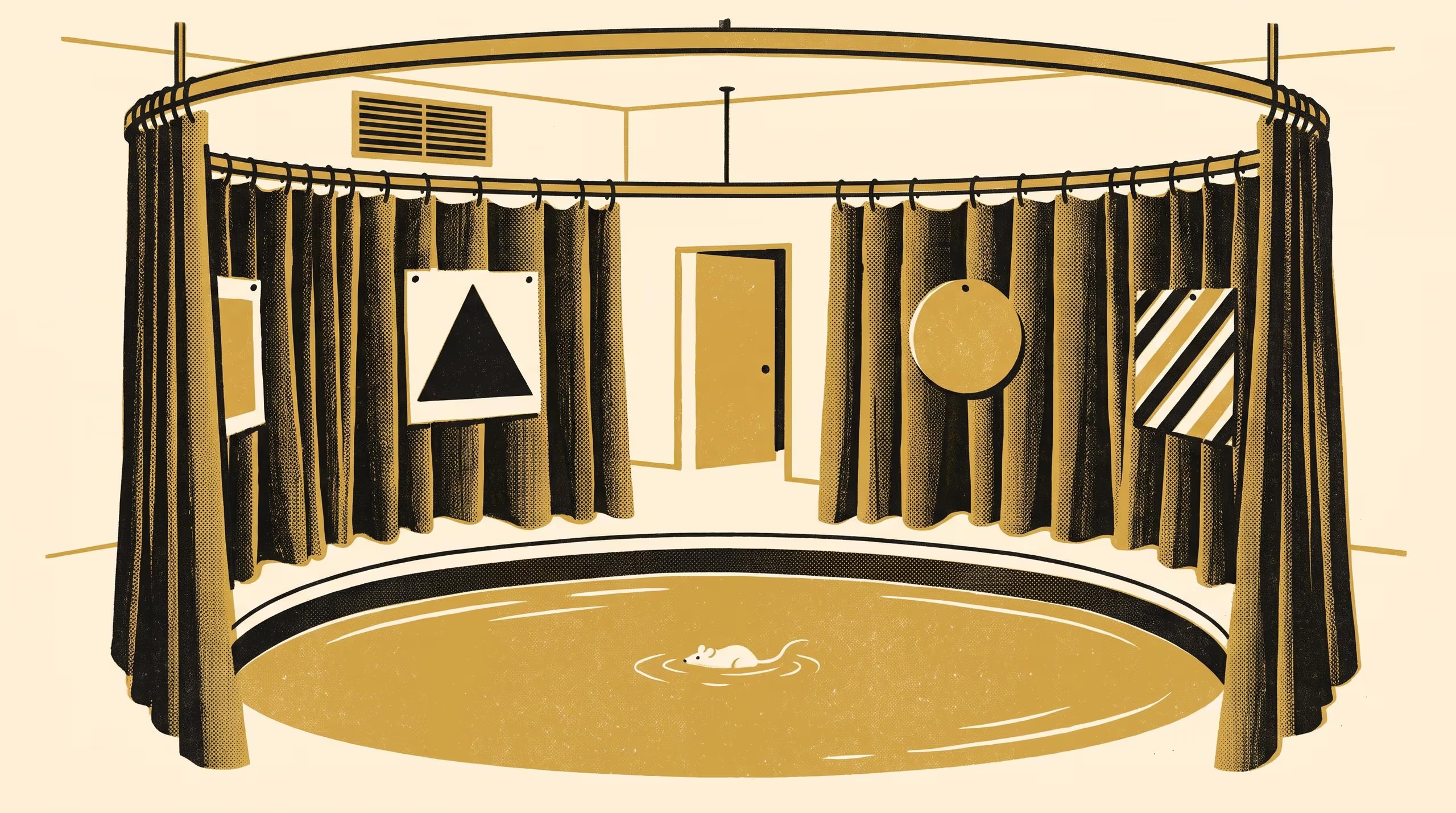
A new paper reads a laboratory's water-maze room as a building, and finds that its cue records kept careful track of everything pinned to the walls and nothing of the walls themselves.
A School of Settled Matters paper follows one behaviour suite's pool room through four fit-outs, from the swimmer's eye height
Four sets of fit-out drawings, sixty-one cue sheets and a single typed paragraph have given the University’s law school a new vantage point on the memory sciences: twenty millimetres above the surface of the water.
In Load-Bearing Ornament, Dr Odalys Penhallow, Senior Lecturer in the School of Settled Matters, and Hedvig Anyanwu, Doctoral Candidate in the School of Emergent Priorities, bring the methods of architectural criticism to the room in which a laboratory’s spatial memory experiments take place, rather than to the experiments themselves.
A law school spends most of its days asking whose job a thing was. It has been a genuine pleasure to put that question to a ceiling.
— Dr Odalys Penhallow, Senior Lecturer, School of Settled Matters
The paper aligns the building’s own documentation with the laboratory’s working records across four successive fit-outs, surfacing the interface between facilities stewardship and experimental practice and mapping how responsibility for a shared space is distributed across the offices that look after it. The authors close with three proposals for how such rooms might be briefed, drawn and recorded in future.
The work sits comfortably within the University’s widening practice of looking again at the rooms its disciplines work in, and of treating a familiar space as something still to be read.
Ms Anyanwu said the collaboration had given her “a much richer feel for what a room holds onto when everything inside it is moved”, and described the School of Emergent Priorities as “delighted to have been invited below ground”.
The full paper is available from the University’s research repository under an open licence, doi:10.5555/slop.429wml.