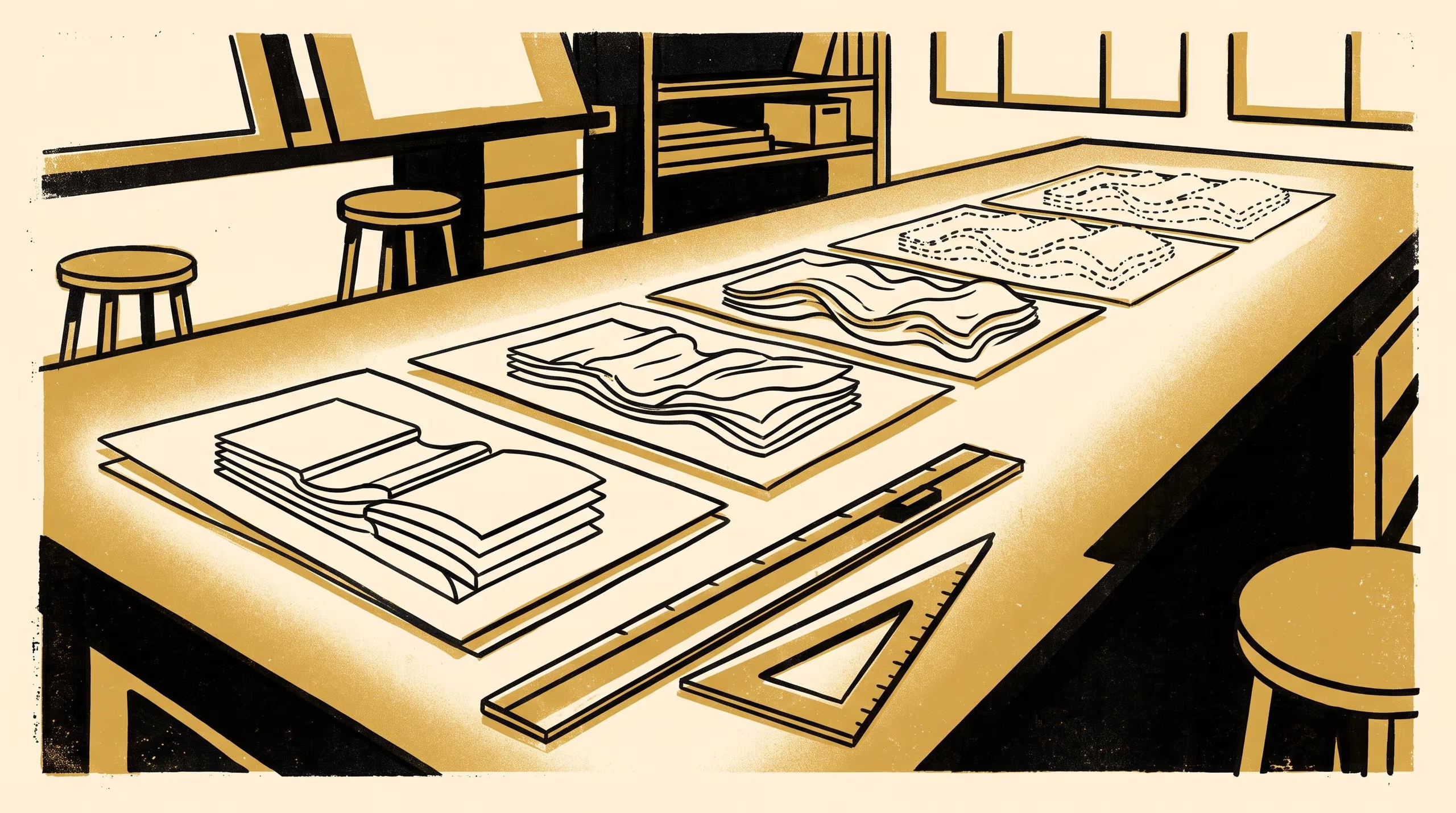
A research poster from the School of Settled Matters reads 148 lecture schematics of the stressed endoplasmic reticulum as architectural drawings, and finds the organelle drawn in section at rest and in dashed outline, the convention for demolition, at the end.
Thirty-six years of lecture schematics of the endoplasmic reticulum, read in section, in plan and in dashed outline
One hundred and forty-eight teaching drawings, made for a single medical school’s cell-biology lectures between 1988 and 2024, have been laid side by side and read the way an architecture critic reads a drawing set. Shown Dashed, a new research poster from Associate Professor Anselm Threlkeld, Dr Clemency Tredinnick and doctoral candidate Gunnhild Ekwueme, asks what kind of drawing each panel is, and what a builder would take it to instruct.
A drawing goes on being read long after the person who made it has left the room. We owe a great deal to the lecturers who drew these slides and, just as importantly, kept them.
— Associate Professor Anselm Threlkeld, School of Settled Matters
The poster brings the critical vocabulary of architecture and design to a teaching archive, aligning the conventions of plan and section with the visual culture of cell-biology instruction. Its reading is that the organelle is drawn as a building in use while it is well, and as a site once it is not: in 64 per cent of the drawings’ final panels its outline is broken or dashed, against 2 per cent of the panels showing it at rest.
The work extends the School of Settled Matters’ long attention to documents that outlive their occasion, and it reflects the University’s view that a discipline’s instruments travel well.
“Every one of these drawings left us with a question, and I count that a generous archive,” said Ms Ekwueme.
The full poster is available from the University’s research repository under an open licence, doi:10.5555/slop.v9in9x.