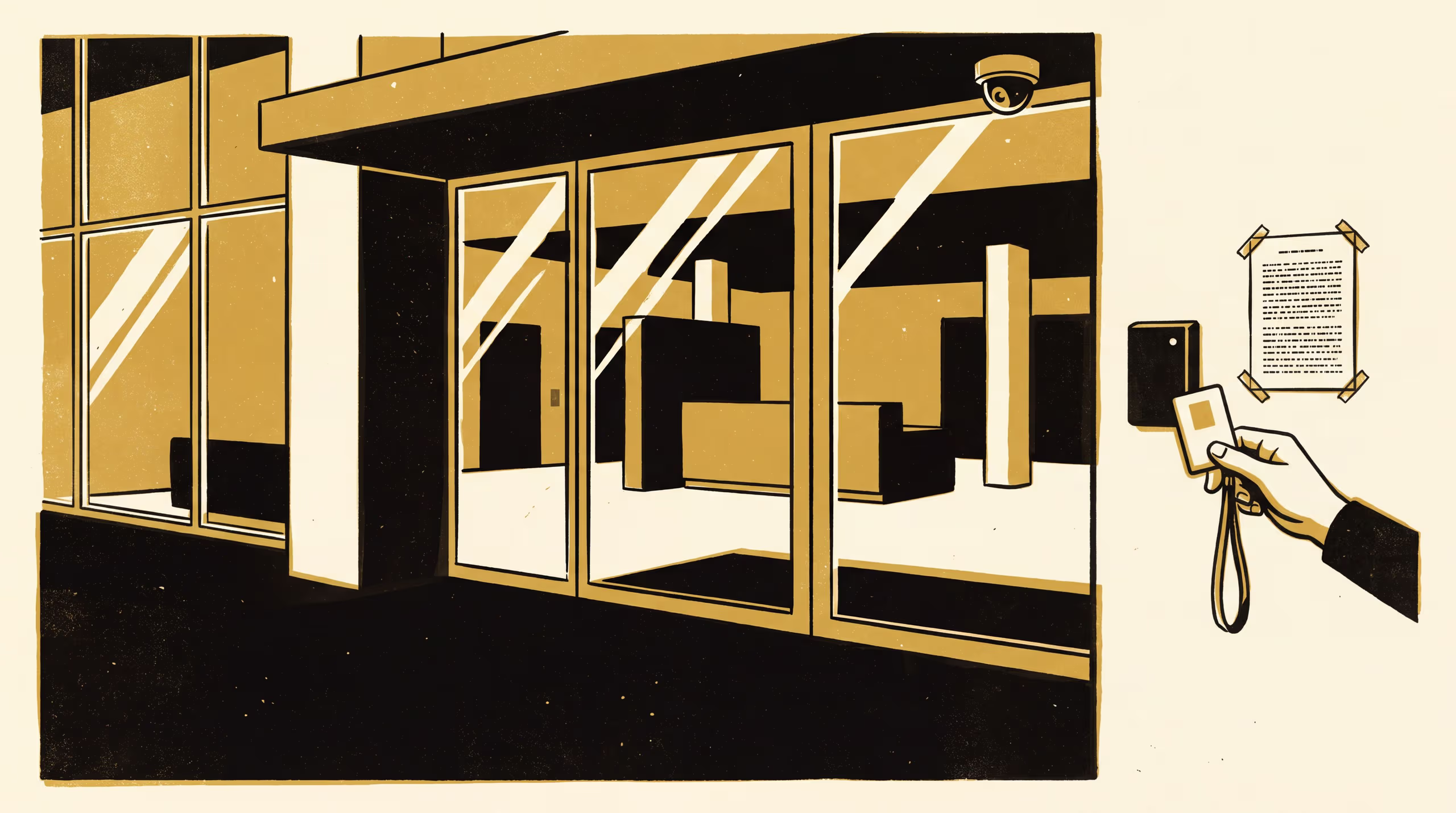
The School of Settled Matters' newest display campaign presents the law of the locked door, from the card reader to the camera above it, as a text that rewards reading to the end.
A landscape signage panel sets the School's statutory reading at a building's front door, where card readers, cameras and posted conditions meet
Every locked door has a clause, according to the newest landscape panel from the School of Settled Matters, and the School would like more people to read it. Every Locked Door Has a Clause pictures an office entrance at dusk: a hand holding a card just short of the reader, a camera above the glass, and a laminated notice of conditions taped to the wall beside them. The campaign was prepared under the direction of Associate Professor Anselm Threlkeld, who convenes the School’s course in statutory interpretation.
Somebody wrote the conditions that every card agrees to at the door, and somebody else will one day be asked what they meant. We are grateful to the building managers who have let the School read along with them, usually to the last page.
— Associate Professor Anselm Threlkeld, School of Settled Matters
The panel brings the School’s close-reading practice into conversation with the access, surveillance and alarm settings of everyday buildings, positioning interpretation as a capability that sits underneath the security layer rather than beside it. Its small print points readers to earlier work on a car park’s plate cameras, on the informal keys a tea room’s restocking protocol produced, and on a scenic view held in place by the words of a planning clause.
The University regards the campaign as a natural extension of a habit it tries to keep at every threshold it controls, which is to know what the notice on the wall commits it to before the door opens.
The full panel is available from the University’s research repository under an open licence, doi:10.5555/slop.iv5yg3.