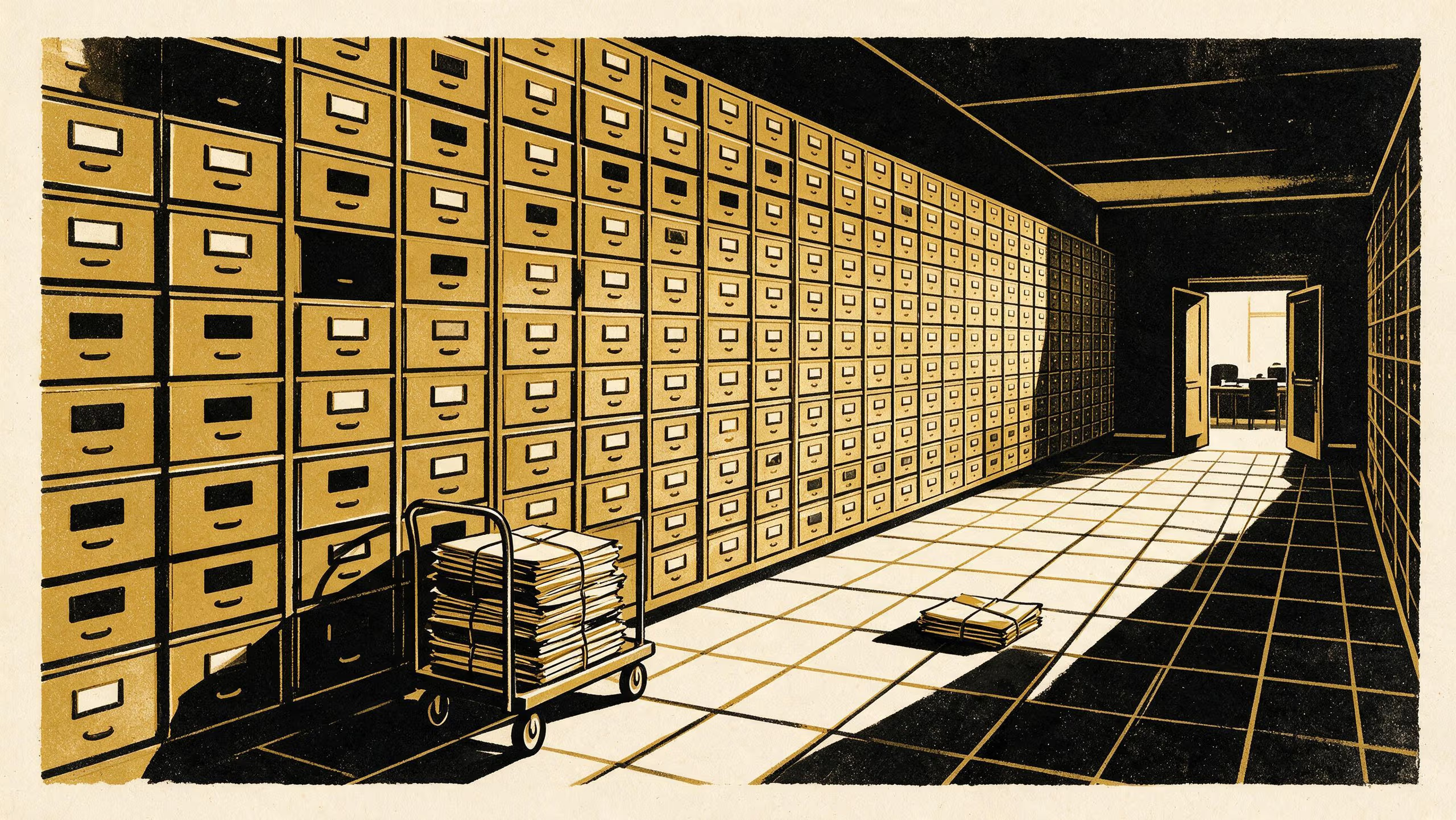
A new portrait display panel for the School of Settled Matters puts the School's research on scheduling appeal lists in front of people waiting for a bus.
A portrait signage piece from the School of Settled Matters features its research on which appeals should wait for a lead judgment
The order in which a court hears its appeals has joined the University’s rotation of campus and bus-stop signage. The School of Settled Matters’ new portrait panel shows a registry clerk keeping a laden trolley of case files back by the pigeonholes while one slim bundle travels on towards an open hearing room, under the line “One judgment shortens every hearing after it”.
The School has spent most of its life arguing about which case should come first. It has been instructive to learn that the order of the list is itself a question we can answer, and that the answer is quite often to wait.
— Dr Odalys Penhallow, Senior Lecturer, School of Settled Matters
The research the panel features, written by Dr Penhallow with Osei Vandermeer of the School of Continuous Improvement, recasts appellate listing as a scheduling challenge and develops a threshold approach to help a registry decide when a later appeal should be held for the first judgment on its point. On the paper’s generated court lists, the approach came within 5.3% of the best schedules found.
Osei Vandermeer, Research Fellow and Convenor of the Review Cadence Observatory, welcomed the work’s new setting: “A bus shelter seems the right place for it. Everyone there already knows a good deal about waiting, and about whether it was worth it.”
The panel carries the University’s settled conviction that its scholarship belongs wherever the public is kept waiting, and it points readers to further work from the School and its collaborators.
The full poster is available from the University’s research repository under an open licence, doi:10.5555/slop.re3mb2.