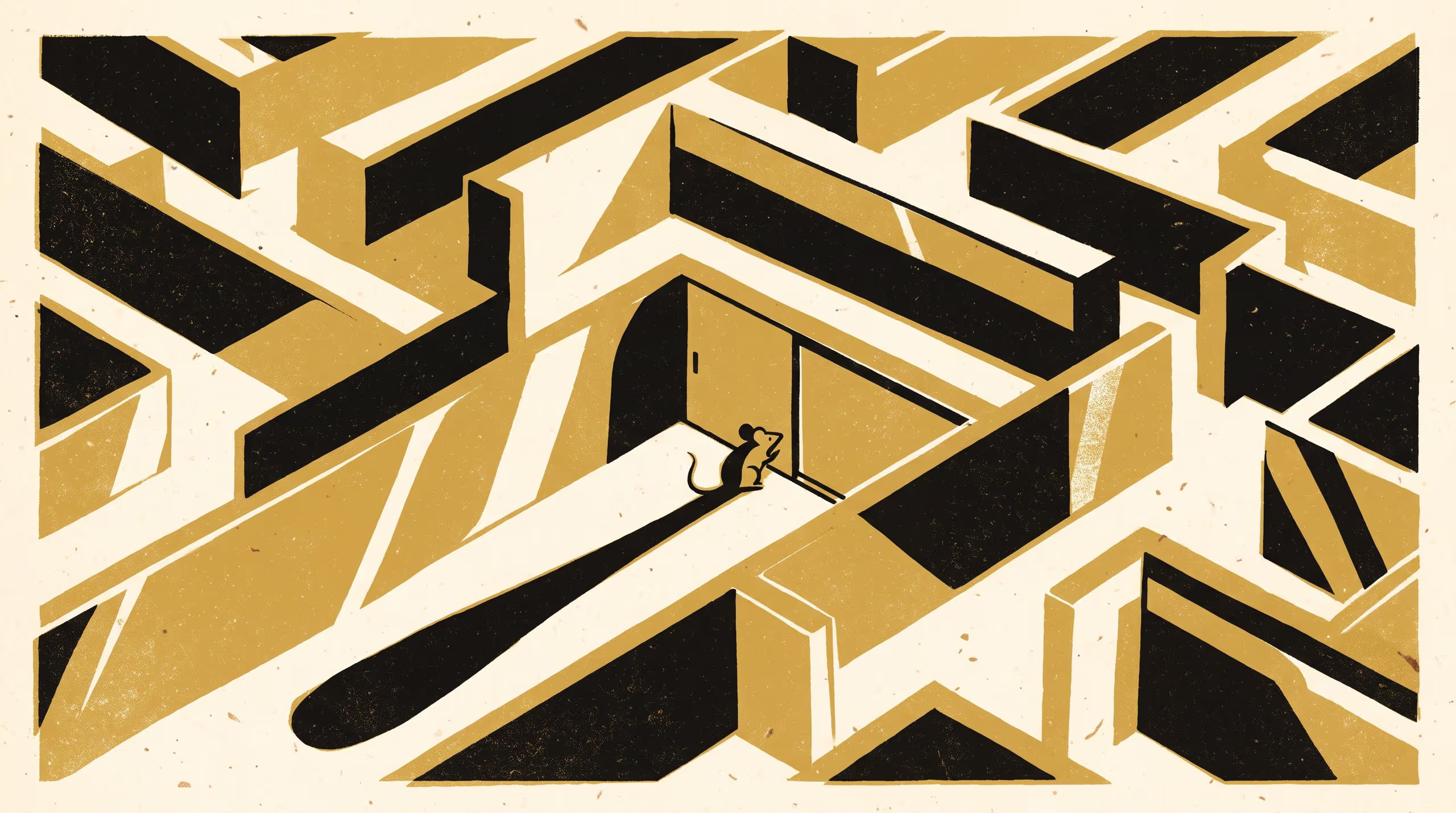
A new research poster from the School of Settled Matters asks how long mice keep returning to a maze route after it has been closed, and finds the answer turns on neurons the brain adds after the closure.
A School of Settled Matters poster shuts one arm of a maze and follows 41 mice back to the closed panel, day after day
Most of us keep walking up to one or two doors that stopped opening some time ago. It has been instructive to watch that question put so carefully to someone else, and the School expects to be thinking about its own doors for a while yet.
— Dr Clemency Tredinnick, Lecturer, School of Settled Matters
With those words Dr Tredinnick introduces Still Trying the Shut Door, a research poster from the School of Settled Matters prepared with her colleague Associate Professor Anselm Threlkeld and Ms Gunnhild Ekwueme, a doctoral candidate in the School of Emergent Priorities. The team taught 41 mice a single route through a maze, closed it, and recorded how long each animal went on visiting the closed panel.
The answer, the poster reports, depends on timing. Pairing a staged closure with a selective pause in the production of new neurons, the authors identify the brain’s newest cells as a lever in how a learned habit is eventually retired. Mice that stopped making them on the day of the closure kept to the old route for a median of 17 days, against 8 for their unaltered counterparts.
Associate Professor Threlkeld said the poster “leaves a good deal for the next study to settle”, and that the School was in no hurry to close the question.
The University welcomes the work as a measure of how widely its Schools are prepared to range, and of the care they bring wherever they land.
The full poster is available from the University’s research repository under an open licence, doi:10.5555/slop.uqs0hv.