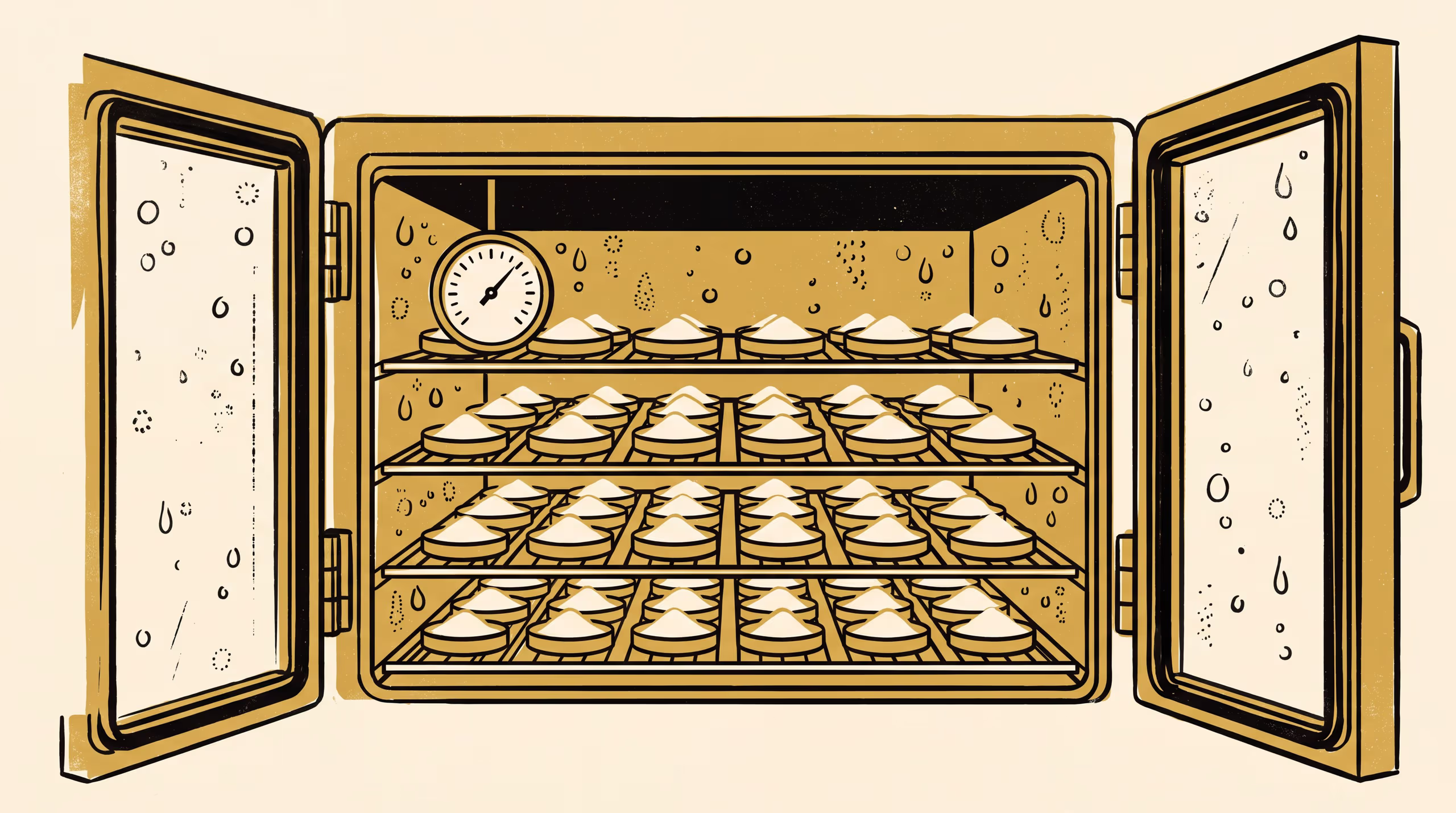
A School of Settled Matters research poster screens eight amino acid partners for a poorly soluble drug and finds that salt formation, rather than the glass transition, orders how long each pair resists crystallising.
A new poster finds that how far each amino acid partner ionises the drug, not its glass transition, tracks how long the pair stays amorphous on the shelf
A poorly soluble drug held in its amorphous form will, given time and humidity, try to return to the crystal. Which partner molecule delays that return the longest is the question behind What Holds the Pair, a new research poster from the School of Settled Matters.
The poster is led by Dr Clemency Tredinnick, with Associate Professor Anselm Threlkeld and Ms Gunnhild Ekwueme. Across eight amino acid partners kept for a year under accelerated conditions, the team reports that the degree of salt formation between drug and partner ordered the pairs’ stability closely, with a rank correlation of 0.96, while the glass transition temperature, the more familiar gauge of a glass, did not.
The School has always been interested in what binds, and for how long. It is a pleasure to see that interest find its way onto a laboratory shelf.
— Dr Clemency Tredinnick, Lecturer, School of Settled Matters
The work situates solid-state characterisation within a wider formulation-stability agenda, bringing thermal, spectroscopic and diffraction perspectives into a single partner-selection conversation. It marks a steady widening of what the School is prepared to count as a settled matter.
Associate Professor Threlkeld described the year of monthly sampling as “the kind of patience the School is glad to be known for”, and thanked the colleagues who kept the stability chamber running through it.
The full poster is available from the University’s research repository under an open licence, doi:10.5555/slop.3emmth.