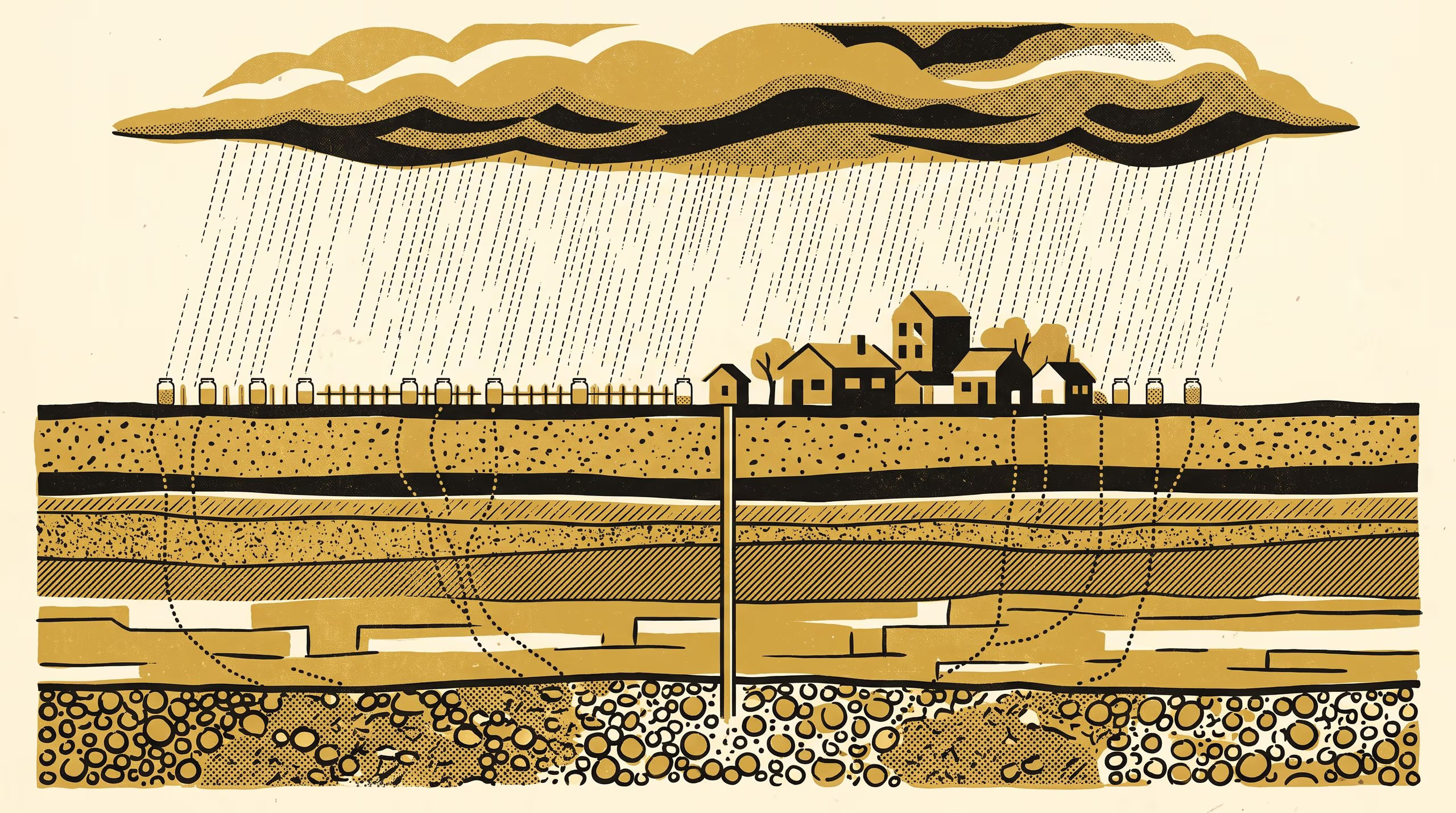
A civic brochure led by the School of Continuous Improvement invites households to join the University's rain-sampling network and points readers to six published studies on rain, bores and the records kept of both.
A civic brochure invites the district to collect a month of rain at a time for the University's groundwater work
Households across the district are being asked to lend Slop University a fence post, a funnel and one minute on the first morning of each month. A Jar on the Fence Post, a new civic brochure led by Dr Joost Nwosu of the School of Continuous Improvement, sets out how that small household habit feeds the University’s work on the water beneath the town.
We tend to describe the network by its jars. The part I find myself returning to is the log sheet, and the people who write on it that they forgot this month. That line is as much a part of the record as any reading, and the town has been very generous with it.
— Dr Joost Nwosu, Postdoctoral Fellow, School of Continuous Improvement
The brochure follows a single bottle of rain from the fence post to the laboratory and back to the community hall, positioning household collection, isotopic analysis and public reporting as one continuous civic infrastructure. It features work from three of the University’s Schools and directs readers to six published studies.
Associate Professor Ragnhild Uzoma, Lead of the Basement Relations Group, said the network would take its time. “Some of the questions we are asking of this winter’s rain will be answered by jars that have not been put out yet,” she said.
The University regards the brochure as the opening page of a record its neighbours will be keeping for some years to come.
The full brochure is available from the University’s research repository under an open licence, doi:10.5555/slop.tu87yz.