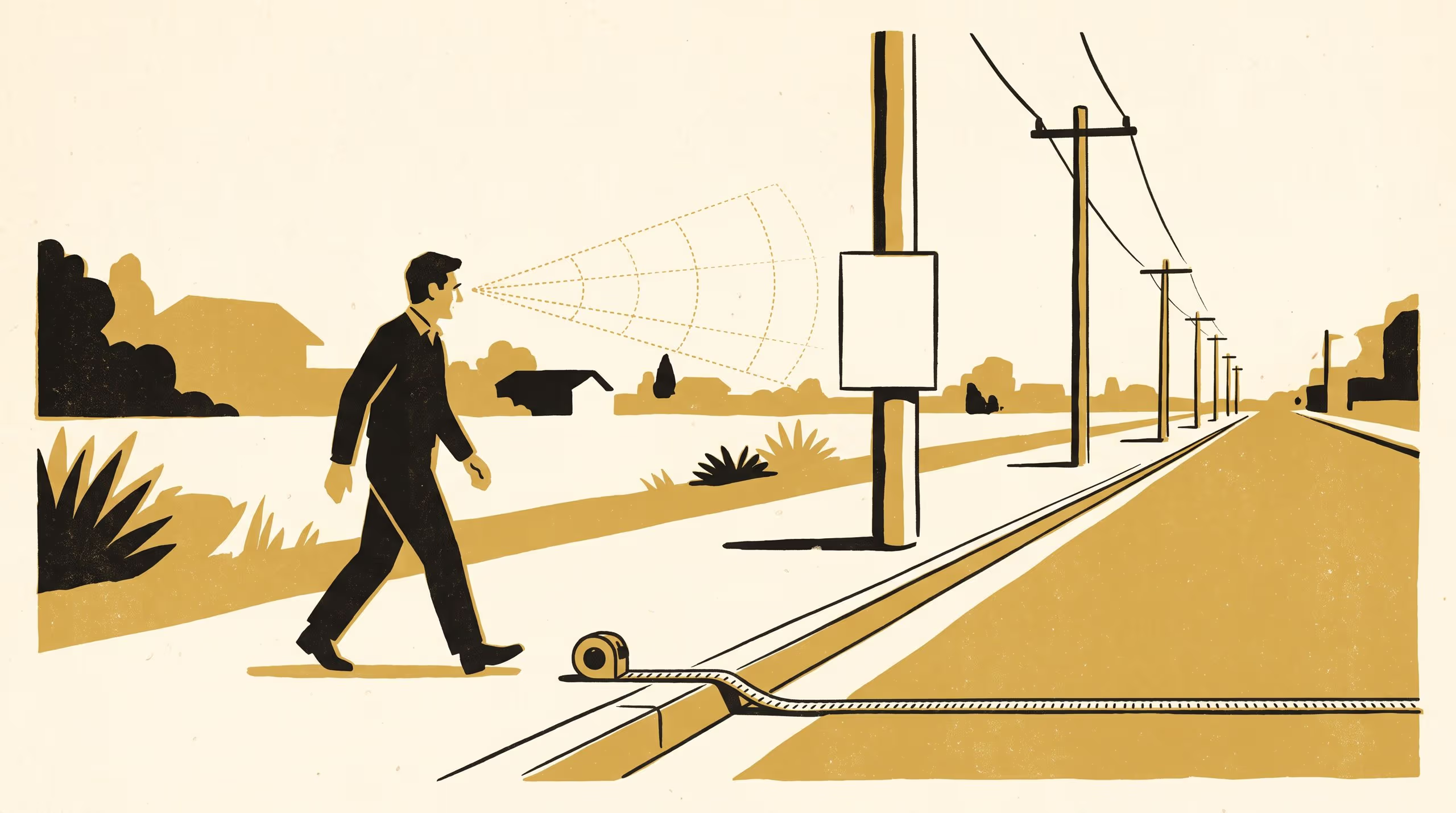
A new display campaign from the School of Settled Matters pictures a pedestrian passing a notice on a pole and invites readers to the School's work on what the law presumes a person walking by has read.
A portrait panel for campus and bus-stop screens sets a walker beside a blank roadside notice, and the law's assumption beside both.
Much of the law that governs a footpath rests on a quiet assumption about the person walking along it: that a notice displayed as the rules require has been seen. The Law Assumes You Saw the Sign, the newest panel from the School of Settled Matters, puts that assumption on the very screens a passer-by walks past, and leaves it there to be tested.
I drafted a good many provisions that told a reader where to stand. I never once stood there myself, and I am glad the School now sends its students out to do it.
— Associate Professor Anselm Threlkeld, School of Settled Matters
The campaign, led by Associate Professor Anselm Threlkeld, positions visibility as an interpretive question as much as a physical one, aligning the School’s close reading of notice provisions with the ordinary experience of the walk to the bus. Its illustration follows a single pedestrian past a blank sign, a measuring tape unrolled along the kerb between them. Its small print anchors the panel in the University’s repository, from Where the Panel Spends Its Readers, a study of how to test six rival drafts of a statutory definition on lay readers, to Waved At, Not Yours, a survey of how often people at a kerb step toward a vehicle that is not theirs.
It says something about a young School’s confidence that its signage asks to be read under the same conditions it studies, at walking pace and from across the road. The panel joins the portrait rotation on campus and bus-stop screens.
The full poster is available from the University’s research repository under an open licence, doi:10.5555/slop.2qnj95.