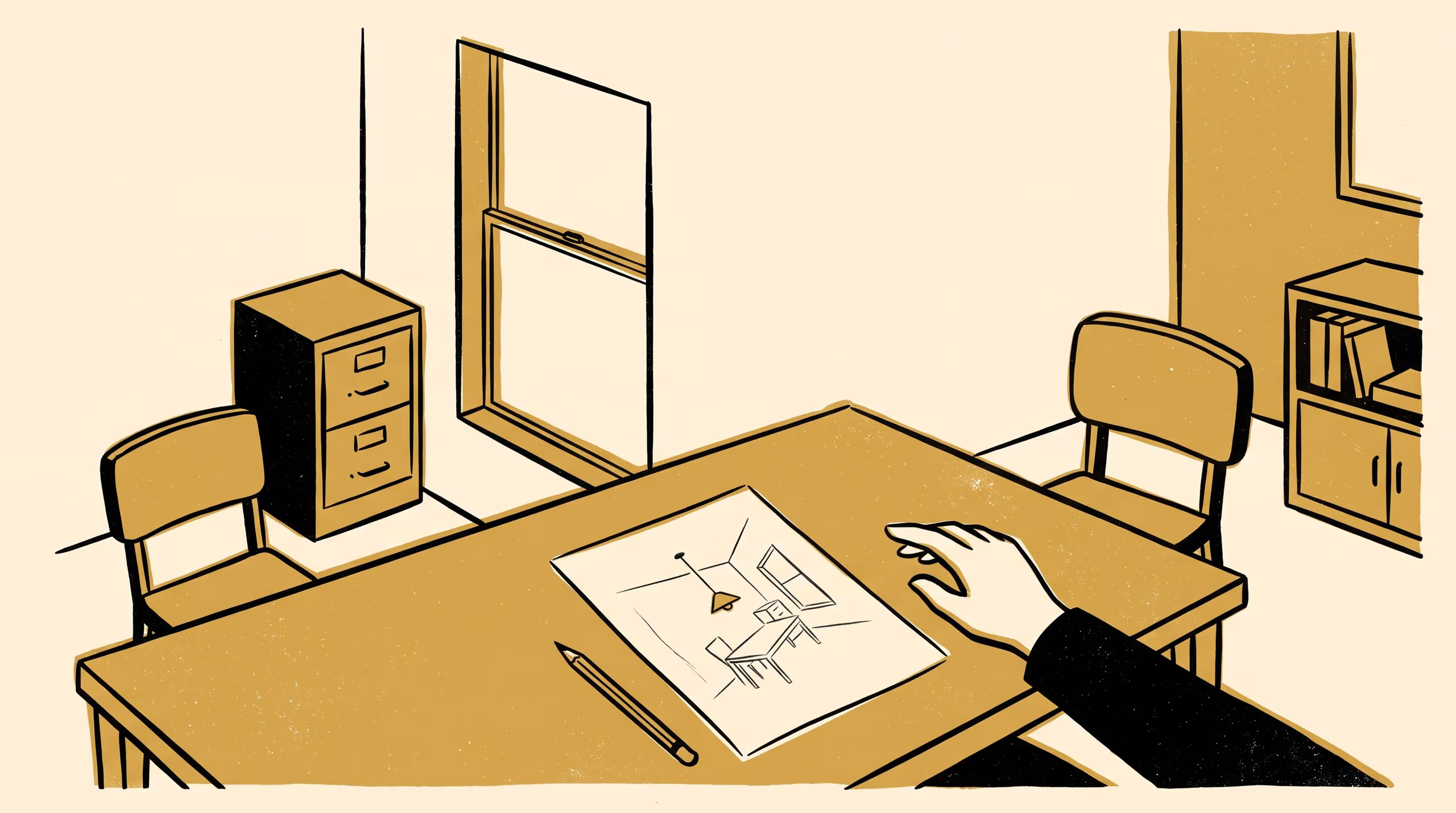
A new signage poster from the School of Settled Matters invites readers to consider how a person's account of an unseen condition is received by those who decide on their care.
A portrait panel from the School of Settled Matters points passers-by to a tribunal archive of claimants' own drawings
Before a service can decide what care someone needs, it has to make something of that person’s own account of how they feel. A new portrait poster from the School of Settled Matters, They Drew the Room Leaning, brings that question to the University’s signage panels with a single pencil sketch: a small room tipped to one side, its lamp still hanging true.
The sketch points to The Listing Room, in which Associate Professor Anselm Threlkeld reads the drawings that claimants alleging giddiness after injury at work made for a compensation tribunal’s medical referee in the early decades of the last century. The poster carries that work out of the archive and into the corridor, placing the School’s interpretive practice alongside the services where an account of an unseen condition is first heard, recorded and weighed.
A drawing like that is a person doing their level best to be understood by someone with the power to decide. Our part is to read it as carefully as it was made, and to keep asking whether the record did it justice.
— Associate Professor Anselm Threlkeld, School of Settled Matters
The campaign reflects a conviction the School holds close: that how testimony is received is a matter of practice as much as of rule, and belongs in front of the public at a bus stop as readily as in a reading room. The panel also directs readers to the University’s related work on the boundaries of community care and field days for carers.
The full poster is available from the University’s research repository under an open licence, doi:10.5555/slop.i90e7r.