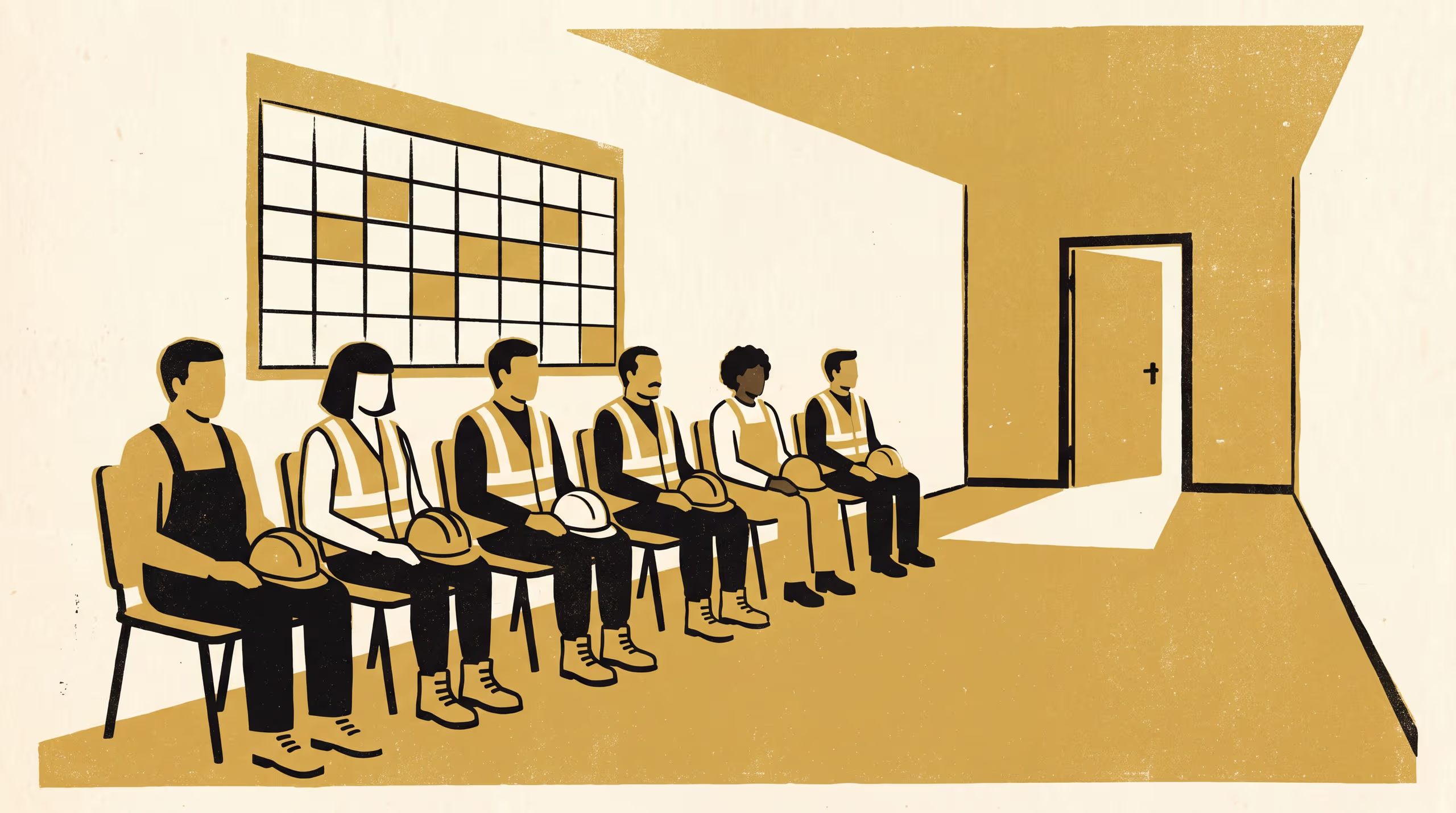
A research poster from the School of Continuous Improvement reads fourteen years of a small clinic's fitness-for-work renewals through the theory of periodic scheduling.
A new research poster finds the sessions were always there, and the renewal rule kept them empty
In uniform supply you learn that a whole crew gets measured on the same morning. It has been a real pleasure to discover that mathematics has been thinking carefully about mornings like that for decades, and to bring some of that patience to a clinic that turned out to have more room than its calendar admitted.
— Edda Nwafor, Doctoral Candidate, School of Continuous Improvement
Lapsed with a Session to Spare, a new research poster from the School of Continuous Improvement, takes the renewal calendar of a small workplace clinic in a Polish town and asks a question the clinic had not thought to put to it: were the certificates that ran out ever short of an appointment?
The poster positions the clinic’s register within a well-established body of theoretical computer science, translating each year of renewals into a scheduling instance and testing it against the field’s density thresholds. Across fourteen years and 22 crews, the team reports that every year could have been run without a single lapse on the sessions the clinic already held. The lapses, 41 crew-months in all, trace instead to a renewal window that kept sessions idle while crews waited to become due.
For the School, the work extends a sustained engagement with the calendars institutions keep and the rules they keep them by, and sits comfortably beside its broader programme on review cadence and rostering. Dr Thandiwe Solberg, Senior Lecturer and Convenor, Demo Quarter, described it as “a careful piece of work that gives the School a new vocabulary for something it has always cared about.”
The full poster is available from the University’s research repository under an open licence, doi:10.5555/slop.0krc44.