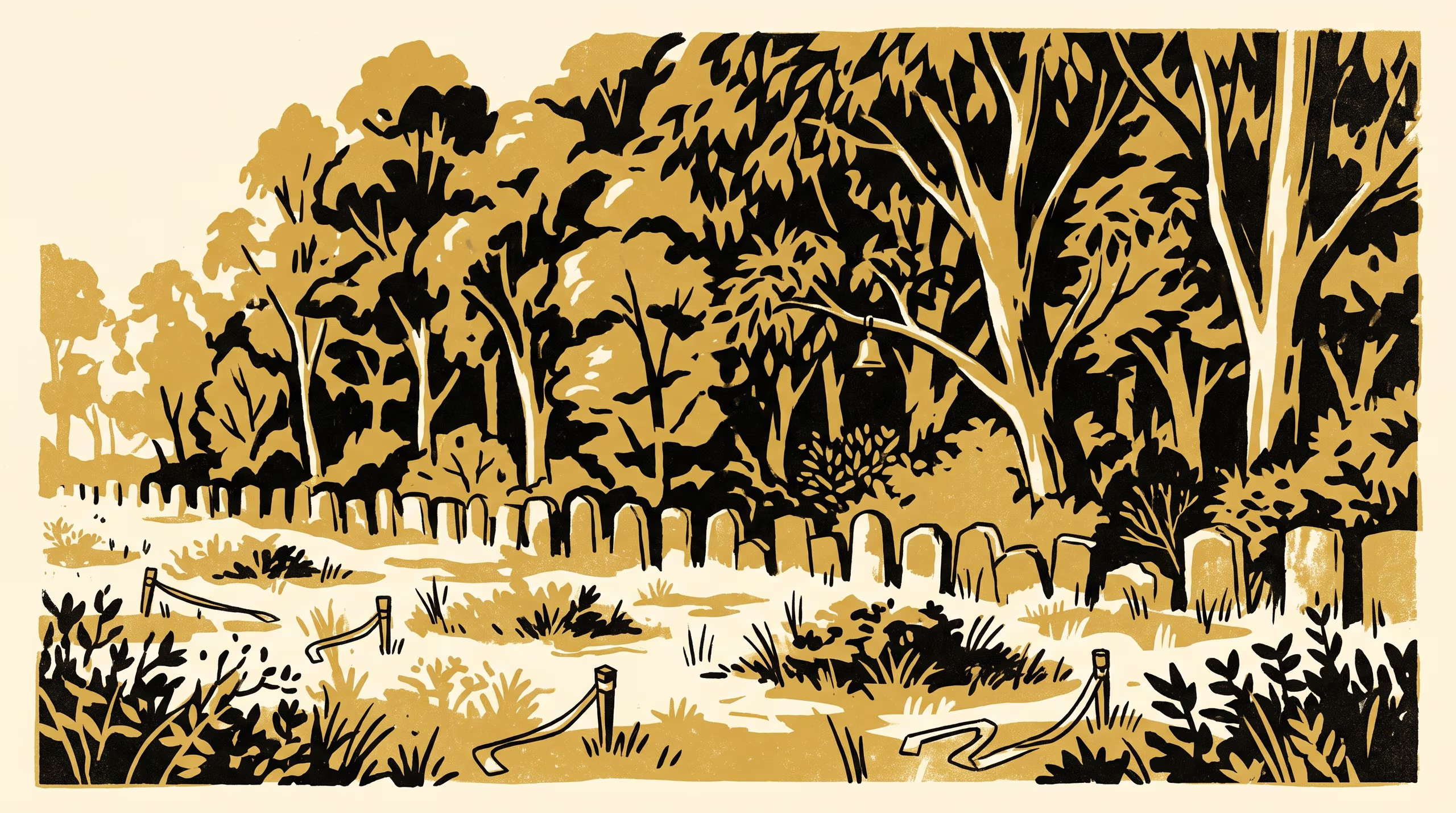
A research poster from the School of Settled Matters walks thirty-two survey lines out of a forest grove each month to ask which of its two boundaries the region's snarers actually observe.
A year of monthly transects at the edge of a grove where killing is forbidden finds its later boundary has displaced its older one
Once a month for a year, researchers from the School of Settled Matters walked the same thirty-two survey lines out of a forest grove and into the scrub beyond it, counting the wire snares they found along the way. The result is Where the Prohibition Ends, a research poster by Associate Professor Anselm Threlkeld, Dr Clemency Tredinnick and Dr Odalys Penhallow, which finds that the grove’s old rule against killing within hearing of its bell has quietly given way to the line of marker stones set down long after it.
The School was founded to ask what becomes of a rule once it has been settled. This poster is one more step along that road, and a muddier one than most of us are used to.
— Associate Professor Anselm Threlkeld, School of Settled Matters
The work brings the instruments of field ecology to bear on a question the School has long pursued in the law reports, positioning the edge of a protected place as a site where custom, community and interpretation meet. Its season-spanning approach offers a grounded framework for understanding how a boundary, once fixed, comes to carry the words it was drawn to hold. On both slopes of the grove, the 1,763 snares recorded begin at the stones, however far the bell can be heard.
Dr Tredinnick described the year as “the first season of what we hope becomes a habit of taking the School’s questions out of doors.”
The University takes particular satisfaction in scholarship that carries a law school’s questions across a fence line, and thanks the grove’s keepers for their patience with a year of pegs and tape.
The full poster is available from the University’s research repository under an open licence, doi:10.5555/slop.a6tubx.