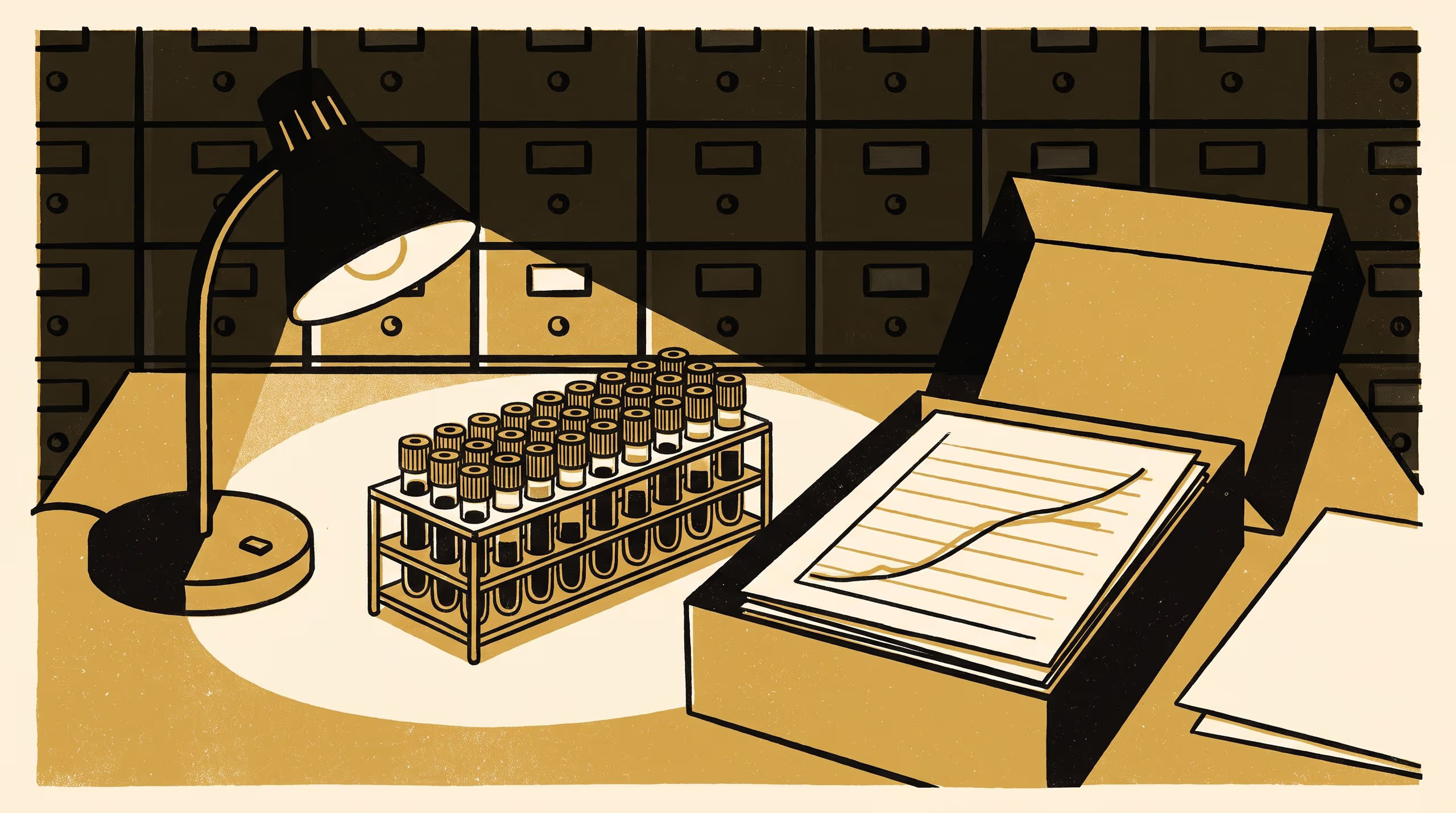
A new paper from the School of Settled Matters reads ten years of a sleep laboratory's evening melatonin records against the rules used to score them.
A closed sleep laboratory's archive shows its volunteers' body clocks moving only when its scoring rules did
Ten years of evening melatonin readings from one sleep laboratory tell two different stories, depending on which of the laboratory’s own rules is used to read them.
The Rule in Force, a new paper by Dr Odalys Penhallow, Senior Lecturer in the School of Settled Matters, returns to the archive of a research laboratory that has since closed. Working from the laboratory’s operating procedures and its surviving raw records, the paper re-reads 418 evening saliva profiles under each of the onset rules the field uses, and sets the laboratory’s recorded history beside the rescored one. The recorded volunteers appear to grow later for three years and then earlier again; rescored under a single rule, they hold steady.
This paper is one small part of a longer conversation the University is having with itself about how its evidence is kept. I am glad to have added a page to it, and gladder still that the page turned out to be about sleep.
— Dr Odalys Penhallow, Senior Lecturer, School of Settled Matters
The work brings the School’s close attention to records and their provenance into a laboratory setting, aligning archival method with circadian measurement and offering a framework through which a data custodian might revisit the categorical calls an archive carries forward. It is the kind of patient reading across disciplines that the University has come to count among its quieter strengths.
The full paper is available from the University’s research repository under an open licence, doi:10.5555/slop.u7u8o8.