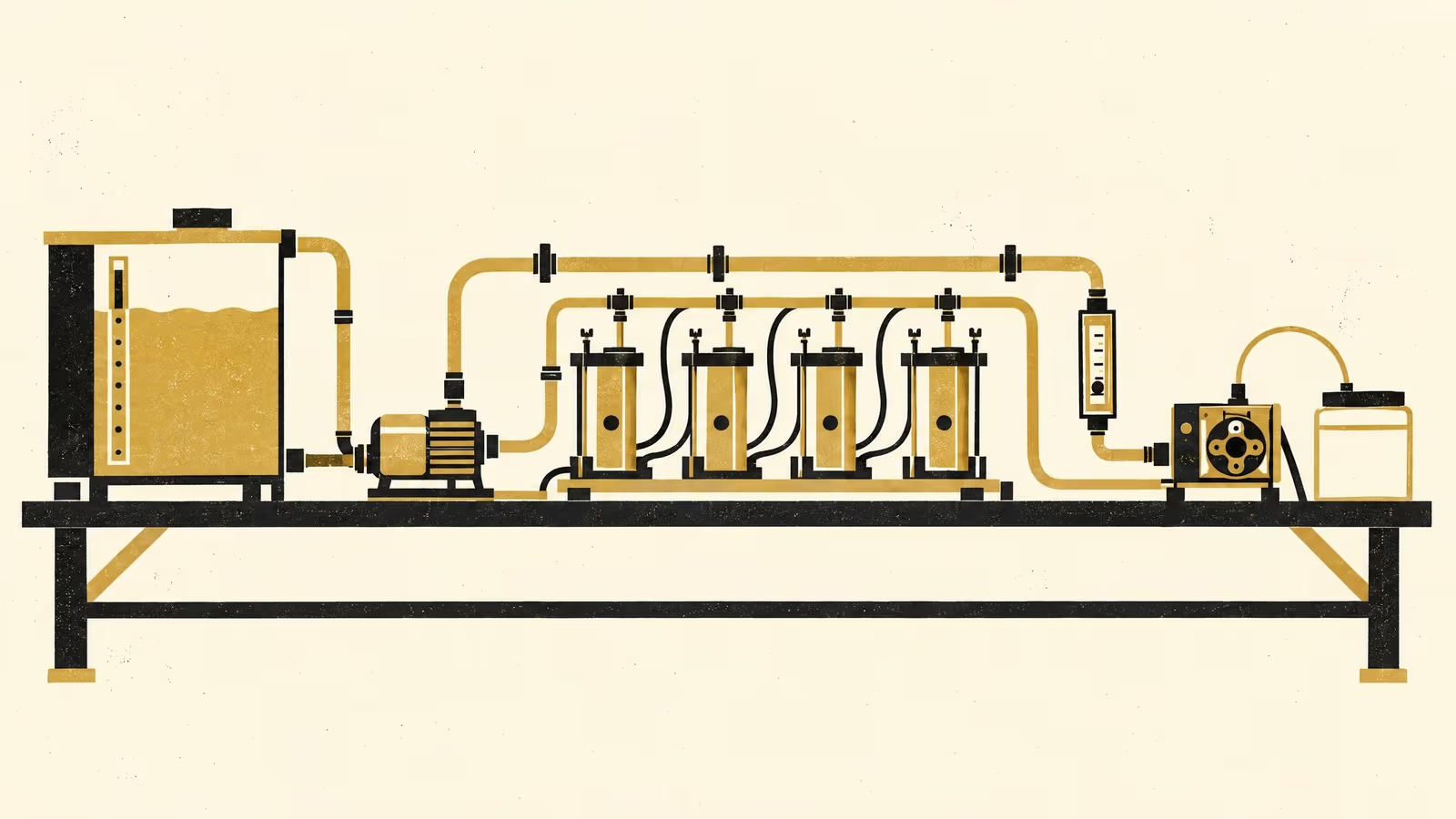
A new research poster from the School of Settled Matters times how long a dosed steel surface stays free of mineral scale once the inhibitor is switched off, and finds that a longer dosing history buys very little extra time.
Twenty-four heated steel coupons, four dosing histories and a residue that stops growing after a week
Protection against mineral scale lingers on a steel surface after the dosing that provides it has stopped, but a longer history of dosing does surprisingly little to extend it, according to After the Last Dose, a research poster released today by the School of Settled Matters.
The poster is led by Dr Clemency Tredinnick, Lecturer in the School, with Dr Vigdis Emenike of the School of Underlying Conditions and Associate Professor Casimir Beng, Lead of the Adaptive Metrics Lab. Together the team brought a bench-scale water loop, a set of heated test surfaces and a careful record of what each surface had been given into a single line of inquiry, asking how long a measure keeps working once the hand applying it has been withdrawn.
Across twenty-four coupons the answer settled quickly: surfaces dosed for a week and surfaces dosed for four weeks held off scale for nearly the same span.
I came to this expecting the long history to matter, and it mostly did not. That is the kind of result that leaves a group with better questions than it started with, and we intend to keep asking them.
— Dr Clemency Tredinnick, Lecturer, School of Settled Matters
Associate Professor Beng thanked “everyone who checked the loop overnight and wrote down what they saw, including on the nights nothing happened.”
The University regards the poster as a fine instance of its schools lending one another their benches, and of a question being followed wherever its apparatus happens to be.
The full poster is available from the University’s research repository under an open licence, doi:10.5555/slop.9kiizm.