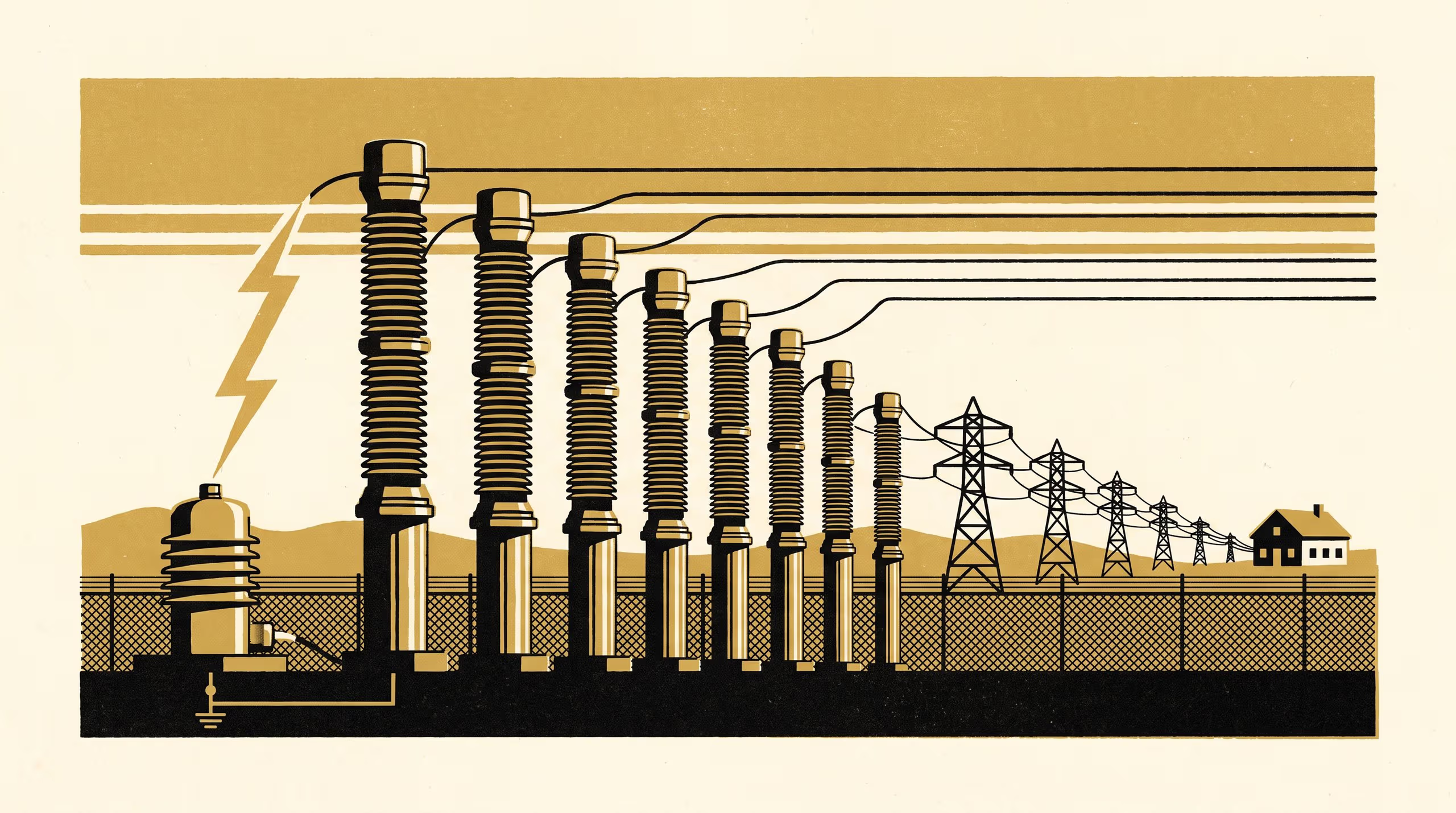
A new paper from the School of Settled Matters reads a regional transmission operator's insulation coordination file as a constitution, and asks who consented once its rules began to admit failure at a stated rate.
Half a century of one transmission operator's insulation coordination file, read the way a lawyer reads a statute
High-voltage networks are built to fail in a chosen order, and the choosing is done on paper, years before any storm arrives. In Who Fails First, Associate Professor Anselm Threlkeld of the School of Settled Matters takes that paperwork seriously as political theory, treating the engineering practice of insulation coordination as a constitution for deciding, in advance, which part of a network gives way so that the rest does not.
Engineers have been writing careful rules about failure for far longer than lawyers have been reading them. I owe a great deal to the people who kept these files in good order, and who were patient while a former drafter of bills learned what an arrester is for.
— Associate Professor Anselm Threlkeld, School of Settled Matters
The study brings the interpretive disciplines of statutory reading to a forty-one-document coordination file spanning five decades, situating each revision within an evolving framework of protective settings, margins and accepted risk. Its central observation concerns the move from a margin to a rate: once part of the network was governed by a statistical method, the figure carrying the decision came to sit in a calculation appendix that the decision’s own prose never repeats, leaving later readers able to apply it but not to recover why it was chosen.
The paper extends the School’s interest in texts that outlive their drafters into the infrastructure that keeps the lights on, and the University regards it as a significant marker of how far that interest can usefully travel.
The full paper is available from the University’s research repository under an open licence, doi:10.5555/slop.zybnse.