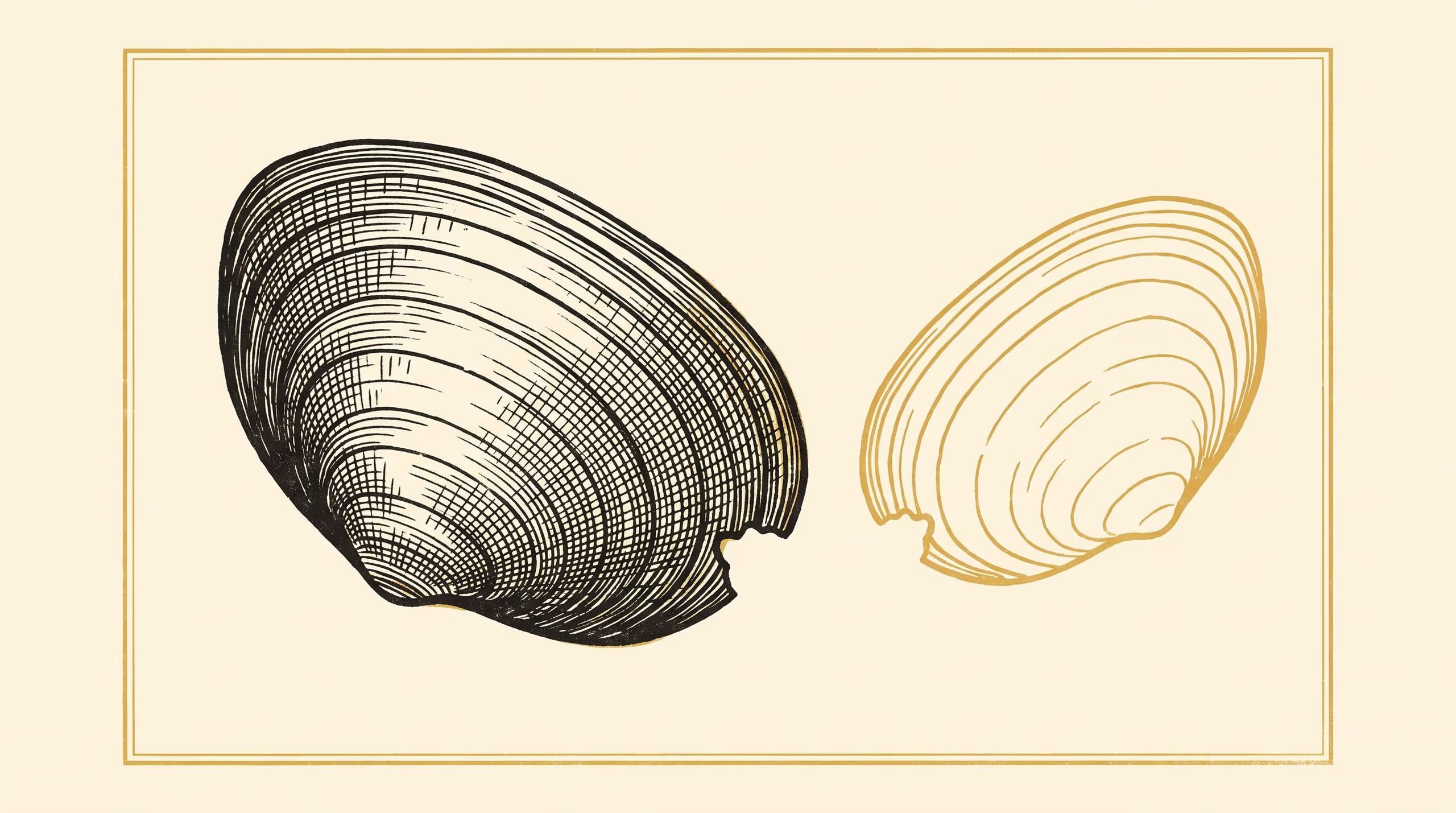
A new paper from the School of Settled Matters follows one engraved plate of a freshwater mussel through every regional key that reprinted it between 1894 and 1987.
Fourteen printed copies of one engraving, and the broken shell behind them, in a river district's identification keys
The School of Settled Matters usually asks how a question of law comes to be treated as closed. Its newest paper puts the same question to a picture.
The Notch Was a Break, by Dr Odalys Penhallow, Senior Lecturer in the School, follows a single engraving of a river mussel’s shell from a field club’s bulletin of 1894 to a laminated field card of 1987, by way of fourteen regional identification keys. Setting each printing beside the one before it, the paper finds the picture losing detail at every remove while keeping one small mark on the shell’s edge, a mark it traces back to a chip in the very specimen the first engraver drew, still held in a museum drawer.
I came to this plate expecting to find a picture of a mussel. What I found was a picture of a decision, made once and then reprinted for most of a century, and I am grateful to the keys for having kept such good company with it.
— Dr Odalys Penhallow, Senior Lecturer, School of Settled Matters
The study brings the School’s long-standing interest in precedent to bear on the visual record of natural history, aligning print-historical collation with the practical work of species identification and offering custodians of field guides a way of reading the images they inherit. It sits comfortably within the University’s growing habit of letting one discipline’s questions find a home in another’s archive.
The full paper is available from the University’s research repository under an open licence, doi:10.5555/slop.dg2y0t.