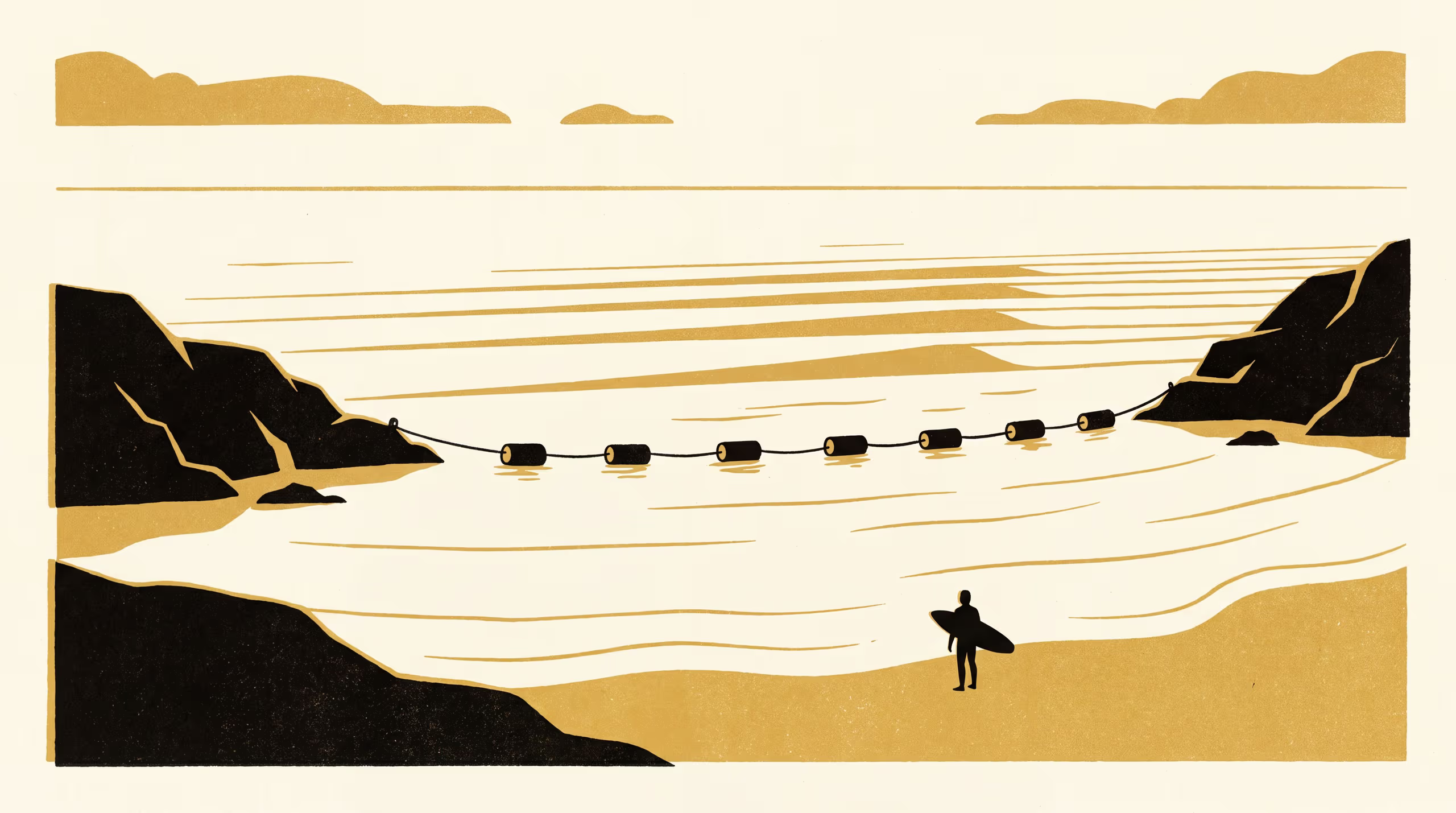
A research poster from the School of Continuous Improvement reads the doctrine of prescriptive easements against nineteen years of wind and swell records from one bay, and finds where a coast's claim to its waves gives way.
A research poster asks whether a bay can claim its swell by long enjoyment once a wave-energy array is moored across it
A coast has always seemed to me the most public room there is. It has been a privilege to spend a year deciding how the law would describe its doorway, and I suspect the School will be furnishing that room for some time yet.
— Ms Edda Nwafor, Doctoral Candidate, School of Continuous Improvement
Ancient Swells, a new research poster led by Ms Nwafor of the School of Continuous Improvement with Dr Odalys Penhallow, Senior Lecturer, and Associate Professor Anselm Threlkeld, both of the School of Settled Matters, asks whether a surf coast can come to own, through long use, the waves an offshore wave-energy array now takes before they reach the beach.
The work places an old question about light and air beside the newest of the coast’s energy technologies, reading the four conditions the law asks of a prescriptive easement against nineteen years of wind and swell records from one bay sheltered by two headlands. Inside the headlands, 96% of the swell arrived through a single 22-degree window, which meets the test of definiteness the law has long withheld from wind. The claim gives way instead on a condition the sea could never satisfy: nobody ever held the water’s surface in a way that would let them grant it.
Associate Professor Threlkeld said the School of Settled Matters was “glad to see an old doctrine handed a new question, and to find it still willing to give an answer”.
The poster takes its place in the University’s widening contribution to the energy transition, carried this time by some of the oldest instruments the law possesses.
The full poster is available from the University’s research repository under an open licence, doi:10.5555/slop.e3z5mw.