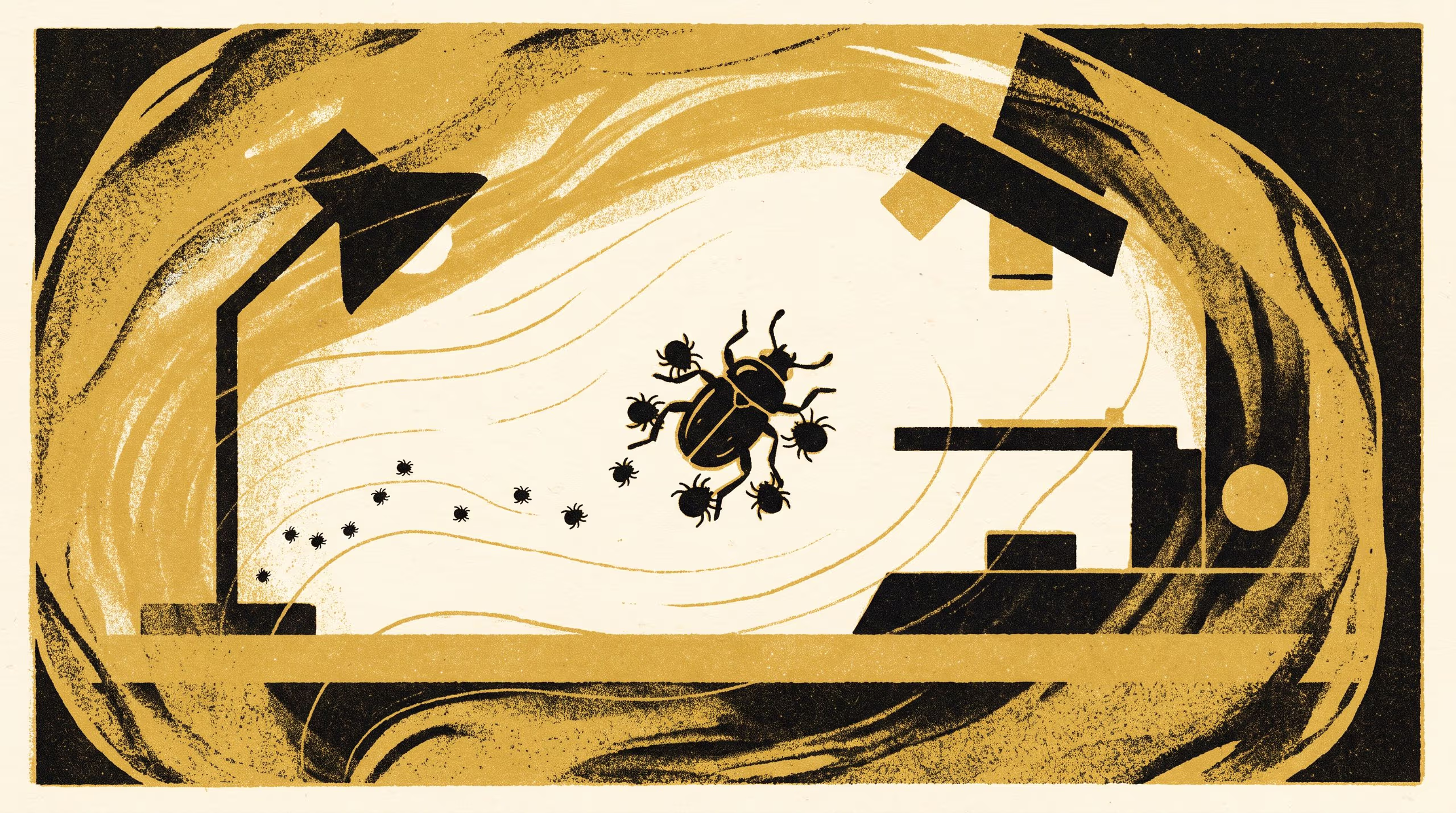
A paper from the School of Settled Matters re-examines a historical teaching collection of amber and proposes graded criteria for recognising mites that once rode on insects.
A teaching collection of amber shows passengers shaken loose as the resin flowed, and proposes three grades of evidence for phoresy
A mite found floating near a fossil beetle, rather than holding on to it, may still have been its passenger. That is the case made in Attached, Adjacent or Merely Entrapped, a new paper by Dr Clemency Tredinnick, Lecturer in the School of Settled Matters, which returns to a collection of amber long used in the University’s practical classes and asks what its pieces can be said to show.
Generations of students have held these pieces up to the light without being asked to decide anything about them. Handing the collection back with a little more written in its register than when it was borrowed seems a fair exchange.
— Dr Clemency Tredinnick, Lecturer, School of Settled Matters
The paper brings a careful, evidence-led framework to the reading of resin, setting what lies in contact with an insect alongside what lies a short way off and asking how the two might be weighed together. Its three grades of evidence, from attached through adjacent to co-entrapped, offer colleagues across the life sciences a shared vocabulary for how strongly a fossil association is supported, and an invitation to say so each time one is reported.
The University counts the paper among the clearest signs yet that a School’s habits of reasoning travel well beyond the questions that first formed them, and it is pleased to see one of its oldest teaching collections contributing to current scholarship. Dr Tredinnick has described the work as “a matter of keeping the record honest about how sure it is”.
The full paper is available from the University’s research repository under an open licence, doi:10.5555/slop.xzq0y2.