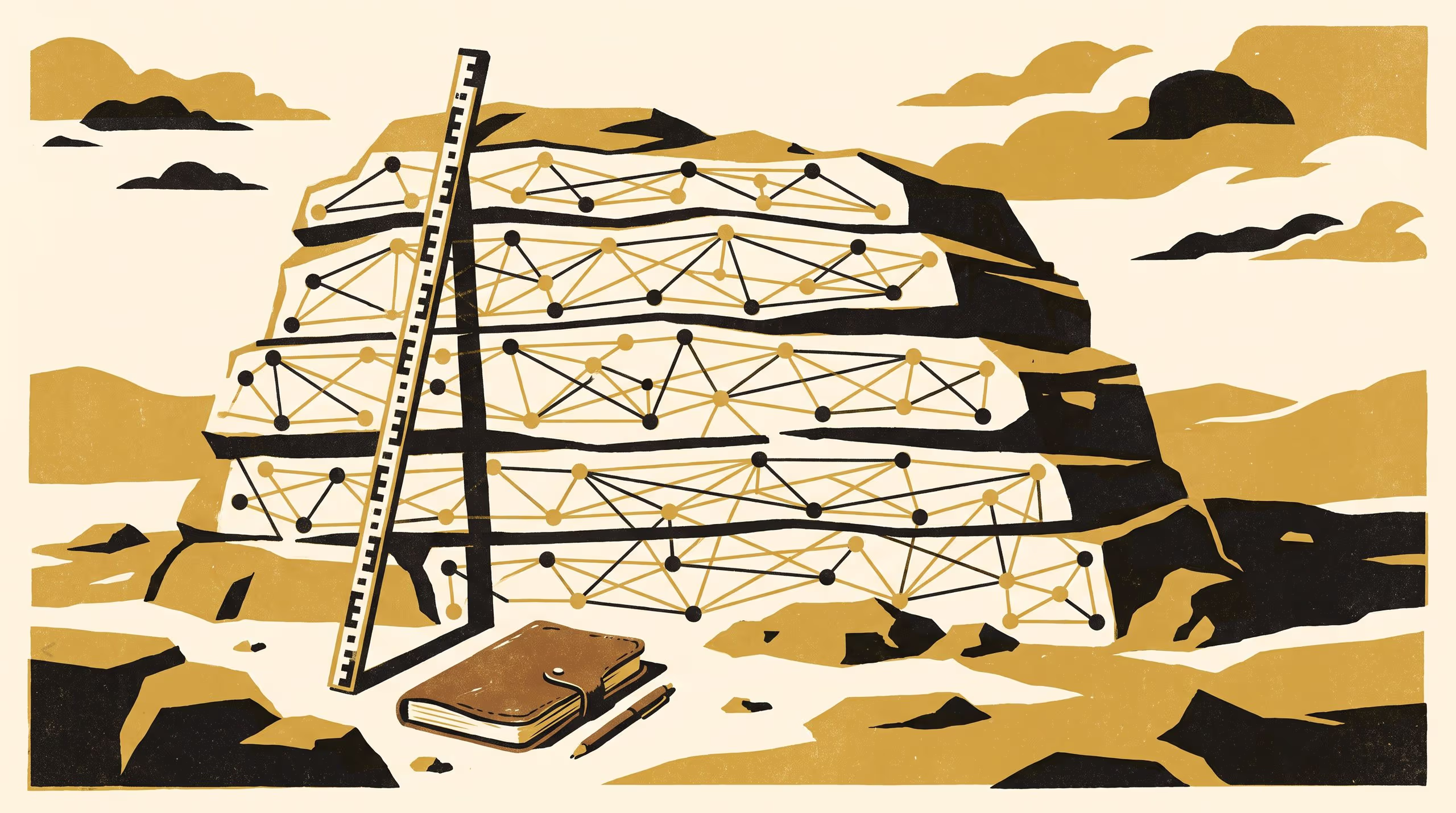
A research poster from the School of Settled Matters reads the release history of a curated gene-interaction network as a stratigraphic section and finds that its edges stop changing once later work rests on them.
Two Schools log 41 releases of one interaction database bed by bed, as a geologist logs a core
Buried deep enough, loose sediment is pressed into rock by the weight above it. According to The Edge No Release Revisits, a new research poster from Slop University, the connections in a curated gene-interaction network harden in much the same way. The poster logs forty-one archived releases of a single network as though they were beds in a cored section, and reports that an edge stops being revised once later inferences come to rest on it, however thin the evidence beneath.
Core loggers learn early that the bottom of a hole is mostly a record of what was put on top of it. Finding that lesson again in a database, with colleagues from the law school reading alongside us, has been one of the pleasures of the year.
— Associate Professor Ragnhild Uzoma, Lead of the Basement Relations Group
The work carries the logging conventions of the School of Underlying Conditions into the curation practices of the life sciences, mapping deposition, reworking and unconformity across an evolving evidence landscape and aligning stratigraphic method with the long-run stewardship of shared research infrastructure.
Dr Brynjar Obiora, Senior Research Fellow, said the team “drew the line between one release and the next the way a soil surveyor draws a horizon boundary, carefully and in pencil, so that the next reader can move it.”
For the University, the poster is a welcome sign of how readily a method travels when its Schools keep their doors open to one another.
The full poster is available from the University’s research repository under an open licence, doi:10.5555/slop.pjt6co.